
When a bold bird screams at your window or locks eyes with you up close, it is rarely subtle, leading many to search for the spiritual meaning of seeing a blue jay. Unlike gentler visitors, this vibrant messenger arrives as an urgent wake-up call centered on speaking your truth, setting firm boundaries, and staying alert.
Because a jay’s behavior carries the core lesson, decoding its actions reveals whether you need fierce protection or honest communication. This guide explores the deeper traditions, shadow aspects, and practical takeaways behind these unmistakable encounters.
Also Read This: Red Cardinal Spiritual Meanings: 9 Signs & Hidden Messages
Key Takeaways
- Voice and truth: The core message is voice and truth. A blue jay encounter is traditionally read as a push to speak honestly, set a boundary, or stop avoiding a conversation.
- Urgency over danger: Loudness means urgency, not danger. The bird’s fierce behavior is protective, and the “warning” reading is better understood as a wake-up call.
- Biblical correction: Blue jays are never named in the Bible, and the popular Elijah story is a mix-up. It was ravens, not a blue jay.
- Trickster folklore: The trickster dimension is real folklore: clever and benevolent in some tribal stories, cautionary in others. Cleverness, the teaching goes, is a tool. Check your motives.
- The shadow side: Sometimes the message is about you. Gossip, harsh words, and scattered energy are the shadow readings most guides skip.
| What Happened | What It Is Believed to Mean |
| A blue jay calling loudly at you | Speak your truth; stop ignoring what you know |
| At your window or tapping the glass | A message needs your attention right now |
| Crossing your path | Confidence and direction; trust your judgment |
| Two blue jays together | Loyalty, partnership, honest bonds |
| In a dream | Truth, voice, or something left unspoken |
| Finding a feather | Courage, clarity, protection |
| After a loss | Strength, and a fierce kind of comfort |
What Does It Mean When You See a Blue Jay? (The Short Answer)
A blue jay is widely seen as a bold spiritual messenger of truth, clear communication, protection, and boundaries. It arrives as a wake-up call to speak honestly and stay alert.
That is the one-sentence version, and it is the one most traditions agree on. The nuance is this: there is no scientific evidence the bird carries messages, and ornithologists will tell you it is simply being a blue jay. Loud, territorial, brilliant, and utterly unafraid. But notice something. The symbolism exists because of the bird’s real behavior, not in spite of it. People did not invent boldness for the blue jay. They watched it mob hawks twice its size, heard it imitate predators to clear a feeder, and named the teaching after what they saw.
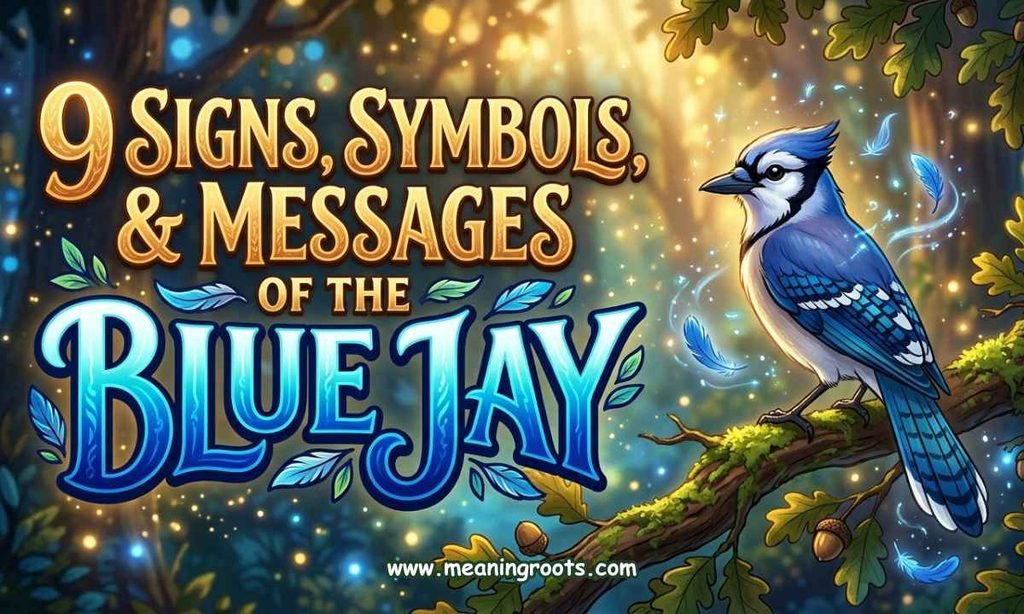
9 Signs, Symbols, and Messages of the Blue Jay
1. A Blue Jay Calling Loudly at You: Speak Your Truth
This is the encounter that starts most searches, because it feels personal. A blue jay screaming at you from a fence post or tree, on and on, while you stand there wondering what you did.
Start with the biology, because it is genuinely interesting. Blue jays are among the most vocal birds in North America, with a vocabulary of calls that researchers are still cataloging. They give harsh alarm calls when hawks or cats are near. They are also famous mimics. A blue jay can reproduce a red-shouldered hawk’s scream so convincingly that other birds scatter, leaving the feeder to the jay. Whether that is strategy or play is still debated by people who study them for a living.
So the bird may be warning its flock, defending a nest, or running a small con. It is probably not yelling at you specifically. But here is the folk reading, and it is the reason you are reading this: the loudness is urgency. Something in your life is being said loudly by your circumstances, and you keep turning the volume down. The postponed conversation. The boundary you keep not setting. The truth you have rehearsed in the shower but never spoken aloud. The jay, in this reading, is the part of you that is done whispering.
Reframe the fear while you are here. A blue jay is not a bad omen. It is not warning you of coming disaster. Its fierceness is protective, the energy of a creature that defends its young against hawks. Read it as a wake-up call, not a warning. One says “be afraid.” The other says “be honest.”
| Warning Reading | Wake-Up Call Reading |
| Something bad is coming | Something true needs saying |
| Be afraid | Be alert |
| The bird is angry at you | The bird is loud by nature; the timing is yours to use |
Next time it happens, try this. Stop and ask one question: what have I been avoiding saying? The first answer that arrives is usually the right one.
2. Blue Jay at Your Window or Tapping the Glass: Urgent Wake-Up Call
A blue jay at the window is a different encounter from the screaming one. Quieter. Closer. It sits on the sill or the railing and looks in, and the boldness that was funny at a distance feels deliberate up close.
There are two versions of this visit. In the first, the bird simply sits and watches. The folk reading treats this as a direct message delivery: something needs your attention now, not later. In the second, it taps or pecks at the glass. Like cardinals, blue jays attack their own reflections, especially in breeding season when territorial instincts run hot. The tapping is the bird fighting a rival that is actually itself.
The folk layer reads the tapping as knocking. Someone at the door of your attention. Notice this now. It is one of the oldest patterns in bird lore, the visitor announcing itself, and it lands hard because a beak on glass is impossible to ignore.
In the moment, do one small thing. Pause, and name what you were avoiding. Not in general. Specifically. The email, the apology, the no you owe someone. Blue jay medicine, if you want to call it that, is specificity. Vague unease is where unspoken things hide. Naming them is where the bird’s work begins.
3. A Blue Jay Keeps Visiting You: The Unheard Message
One visit is a moment. The same bird, or what looks like the same bird, on the same branch or feeder for days or weeks, starts to feel like persistence with intent.
The traditional reading of repeated visits is wonderfully blunt: the message was not received. You can keep ignoring me, the jay seems to say, but I will keep showing up. Other traditions soften it into reassurance. Keep going. Stay the course. Your alertness is working.
The practical reading is worth knowing too. Blue jays are territorial, habitual, and deeply fond of reliable food. A bird that found peanuts or a good nesting shrub in your yard will return because that is what successful animals do. Nesting season makes them bolder and more visible. None of this cancels the meaning. If anything, it sharpens the question the folk reading asks: what conversation keeps getting postponed in your life? The bird returns to the yard. What keeps returning to your mind?
Keep a one-line note each time it appears, with what was on your mind. Patterns emerge fast with this bird. Usually within two weeks, the theme is obvious, and the theme is the message.
4. Seeing Two Blue Jays Together: Fierce Loyalty and Honest Bonds
Blue jays pair up, and the pairs tend to last. They are socially monogamous, raise their young together, and often stay bonded across seasons. A mated pair will defend a territory as a unit, and family groups stay close through the year.
Because of this, two blue jays together carry the symbolism of the bond itself. Loyalty. Partnership. Family ties that hold under pressure. Where a single jay points at your voice, a pair points at your relationships, and specifically at honesty inside them. The reading here is not just “your relationship is strong.” It is “speak honestly inside it.” The jay pair models the thing directly: fierce, loyal, and completely unwilling to be quiet.
One widely quoted reading puts it memorably: a single blue jay is easy to dismiss, but two are twice as hard to ignore. If the message concerns a partnership, the doubling means it is time.
5. Blue Jay Crossing Your Path: Direction Paired with Discernment
It happens fast. A blue jay cuts low across the trail or the road in front of you, a streak of blue and white, and it is gone before you can react. Then you spend the rest of the walk thinking about it.
The traditional reading of a path-crossing is about direction. Confidence. Decisiveness. Trust your judgment and keep moving. But the blue jay adds its own signature to the generic version: look closer before you move. This is the mimic bird, the deceiver of hawks, the creature that is not always what it sounds like. The teaching folded into the crossing is discernment. Not everything is as it seems, so check the situation before you commit.
It is a useful pairing. Confidence to move, wisdom to look first. Speed without discernment is recklessness. Discernment without confidence is paralysis. The jay crossing your path is read as both at once.
Also Read This: Spiritual Meaning of Finding a Grey Feather: 10 Powerful Signs & Symbolism
6. Blue Jay Encounter After a Loss: Fierce Strength and Comfort
Cardinals are the birds most people expect during grief, bringing quiet tears and gentle memories. When a blue jay appears after a loss, the tone is entirely different: it brings strength, resilience, and a fierce kind of comfort.
Instead of whispering that your loved one is at peace, the blue jay arrives to remind you to stand firm, protect your peace, and find the courage to keep living boldly. It is the spiritual equivalent of an encouraging push when sorrow makes you feel depleted.
7. Finding a Blue Jay Feather: Courage, Clarity, and Protection
A feather is the quietest blue jay encounter, which makes it the most interesting. The loud bird leaves behind something silent.
Finding a blue jay feather is traditionally read as courage, clarity, and protection in concentrated form. A small, portable version of the bird’s message. The colors get their own breakdown in folk readings: the blue for truth and clear communication, the black barring for boundaries and protection, the white for peace. There is real natural history underneath the poetry, too. That blue is not pigment. Blue jay feathers get their color from the microscopic structure of the feather scattering light, which is why a dead feather can look duller than a living bird. Truth as structure rather than surface. The symbolism writers could not have planned it better.
Where you found it adds a layer in folk tradition:
| Where You Found It | Traditional Reading |
| At home | Protection over your household; speak honestly there |
| On your doorstep | A message at your threshold; something needs addressing |
| On your path or trail | Direction and discernment for the road ahead |
| At work | Clarity and courage in a professional matter |
One practical note, the same one that applies to cardinal feathers. Under the U.S. Migratory Bird Treaty Act, collecting feathers of native birds is restricted. Admire the feather, photograph it, and leave it where it lies. The meaning travels fine without the souvenir.
8. Blue Jay in a Dream: Unspoken Feelings and Voicing Truth
Blue jays in dreams tend to be vivid, which fits the bird. Dream dictionaries are vague on the specifics, so the useful approach is the one the bird itself suggests: what was it doing?
- Calling or screaming at you: Something in your waking life needs attention. The dream is turning up the volume on what you have been muting.
- Flying freely: Confidence, freedom, the feeling of your voice working. Often arrives during periods when you are finally speaking plainly.
- Injured or silenced: Blocked communication, or the feeling of not being heard. Worth asking where in your life your words are landing flat.
- Many jays, all calling: Social noise. Gossip, group chatter, too many opinions. The traditional advice is to choose your words carefully and lower your own volume.
Dreams are interpretive by nature. Take the reading that resonates and release the rest. If the dream was vivid enough to search for, it was vivid enough to write down before it fades.
9. Finding a Dead Blue Jay: Facing Inevitable Endings
This one comes up quietly in grief and birding forums, and it deserves a straight answer. A dead blue jay is generally read as an ending that demands honesty: something needs to be faced head-on rather than circled.
Some traditions read it as the close of a loud chapter, the argument or the noise finally over. Handle it practically and gently. If it is on your property, local wildlife guidance usually suggests gloves and disposal rather than burial, and there is nothing disrespectful in that. The meaning, as always, is yours to take or leave.
The Two Faces of the Blue Jay: Trickster Wisdom
Here is where the blue jay’s story gets deeper than “speak your truth,” and where most guides stop short.
In the traditions of Chinook and neighboring coastal peoples of the Pacific Northwest, Blue Jay appears as a trickster figure, clever, mischievous, sometimes careless, but often a hero whose tricks serve a purpose. These are real stories, collected and retold for generations, in which Blue Jay’s cleverness gets him into trouble and occasionally saves the day. The teaching is not “be tricky.” It is that cleverness is powerful and morally neutral. It matters what you aim it at.
Other tribal traditions tell a sterner version. In some Coast Salish and Sioux tellings reported in folklore collections, the jay’s cleverness shades into selfishness and gossip, and the stories serve as caution. Do not be like the jay who talked too much or schemed for himself.
Hold both faces together and you get the actual teaching: intelligence is a tool, and tools reveal their user. The blue jay asks you to check your motives. Are you being clever for the good, or clever for yourself? Are your words building something or just winning something?
A note on respect, because it matters. These are living traditions, not decorative quotes. The summaries above are brief by necessity. If this dimension calls to you, seek out the actual stories from tribal and Indigenous sources rather than the one-line versions on symbolism sites.
The Shadow Side: When the Blue Jay Mirrors You

Most spiritual bird content flatters the reader. The blue jay, of all birds, deserves the honest version.
Sometimes the message is not about the truth you are afraid to speak. It is about the words you are already speaking too carelessly. Animal-totem literature has long carried a warning with this bird: the “dabbler,” all flash and scattered energy, starting things without finishing, talking without listening. The jay’s famous loudness turned outward becomes gossip. Its confidence curdles into arrogance. Its cleverness becomes manipulation, the hawk-mimicry used on people instead of predators.
Read this section kindly, the way it is meant. The bird holds up a mirror, not a sentence. If a blue jay has been loud in your life lately, it is worth one uncomfortable question alongside the comfortable ones: is there a conversation where I am the one doing the damage? Am I talking about someone instead of to them? Have I mistaken being loud for being right?
Nobody likes this question. That is rather the point of a trickster bird. The comfortable message and the uncomfortable one often arrive in the same feathers.
Also Read This: Skunk Spiritual Meaning: 7 Powerful Symbolisms, Signs & Spirit Animal Messages
Blue Jay vs Cardinal: What Is the Difference Spiritually?
People see both birds, often in the same yard, sometimes on the same day, and the question follows naturally. Are they saying the same thing?
They are not. They are saying complementary things, which is why the pairing feels significant.
| Aspect | Red Cardinal | Blue Jay |
| Core energy | Comfort, love, remembrance | Truth, voice, boundaries |
| Emotional tone | Gentle, grieving, reassuring | Bold, urgent, challenging |
| The loved-one connection | The tender visitor, still near | The outspoken one, still loud |
| Season association | Winter hope, endurance | Year-round alertness |
| The question it asks | Do you feel loved? | What are you not saying? |
The cardinal says you are loved and not alone. The blue jay says now speak. One holds you, the other pushes you. Seeing both together is read as the complete message: comfort and courage in the same morning. You are loved, and now say the thing.
If you want the full picture of the crimson visitor, explore our detailed companion guide on the spiritual meaning of seeing a red cardinal to understand how these two messengers complement one another.
The Biblical Meaning of a Blue Jay (Honest Version)

The honest version starts the same way it did for the cardinal: the blue jay is never named in the Bible. It is a New World bird. The biblical writers never saw one.
Now the correction, because misinformation on this point is widespread. Some corners of the internet claim a blue jay landed on the prophet Elijah’s shoulder, or fold the bird into the Elijah story somehow. What the text actually says, in 1 Kings 17, is that ravens brought Elijah bread and meat in the morning and evening. Ravens. Not a blue jay. The mix-up seems to come from loose retellings that swapped a familiar backyard bird for the actual one. It is worth correcting because presenting folklore as scripture helps no one, least of all believers.
What can be said legitimately is thematic. The blue jay’s traits map onto real biblical themes: watchfulness, the moral weight of words, fierce protection of the household. Scripture has a great deal to say about the tongue and its power, about speaking truth, about guarding what is yours. The jay embodies those themes vividly. That is devotional reflection, which is a fine and old practice. It is not the same as the Bible mentioning the bird, and the distinction is worth keeping clean.
What to Do When You See a Blue Jay? (60-Second Practice)
Insight without action is where blue jay encounters go to die, which would be a shame, because this bird is all about action. Here is a sixty-second practice for the next time one shows up. It is built around the throat, where unspoken things live.
- Pause. Stop and notice what you were thinking about in the minute before it appeared. That context is usually the message.
- Unclench. Drop your jaw, roll your shoulders, and hum one slow breath out. Unspoken truths live in tight jaws. Loosen the hinge.
- Say it. Speak the unsaid sentence aloud, even quietly, even alone in the yard. It does not have to be to the person. It has to leave your mouth.
- Choose one. Name one boundary or one conversation to have this week. Write it down. The jay’s work is done when yours begins.
That is the whole practice. A minute, no supplies, no ceremony. The bird was loud. Be a little louder than you were yesterday.
How to Attract Blue Jays to Your Yard?
If the encounters have meant something to you, inviting more of them is natural. Blue jays are not shy guests. They are year-round residents across much of the eastern and central United States, and they remember reliable food the way they remember everything.
- Offer peanuts in the shell: This is the blue jay’s great weakness. They will carry them off, cache them, and return all day. Whole peanuts are entertainment as much as food.
- Add sunflower seeds and suet: Black-oil sunflower seeds are the staple. Suet, especially in winter, keeps them coming through the cold months.
- Use platform feeders: Jays are large, bold birds that prefer open trays and platform feeders over small tubes. Ground feeding under shrubs works too.
- Provide fresh water: A birdbath, heated in winter, draws jays year-round. They drink and bathe with the same lack of self-consciousness they bring to everything.
- Keep oak trees and cover: Jays evolved with oaks, harvesting acorns and planting the forgotten ones. Mature trees and dense shrubs give them the staging grounds they like.
One identification note for the western reader: if you are west of the Rockies, your crested blue bird is probably a Steller’s jay, the blue jay’s darker, more mountainous cousin. Similar energy, different bird. The symbolism travels, but the field marks do not.
FAQs
What does it mean spiritually when you see a blue jay?
It serves as a bold wake-up call to speak your truth, set healthy boundaries, and protect your inner peace.
Is seeing a blue jay a good or bad omen?
It is largely considered a positive sign, representing protective energy and clear communication rather than impending danger.
What does it mean when a blue jay keeps screaming at you?
Spiritually, its loud call urges you to stop ignoring an unresolved conversation or truth you have been avoiding.
What is the spiritual meaning of a blue jay feather?
It carries concentrated symbolism of clarity, courage, and discernment, serving as a reminder to speak with authenticity.
What is the difference between a blue jay and a cardinal spiritually?
A cardinal offers gentle comfort and remembrance of loved ones, while a blue jay boldly pushes you toward courage, voice, and boundaries.
What does the Bible say about blue jays?
The Bible never mentions blue jays directly; scriptural associations are purely devotional themes centered on watchfulness and the power of words.
Conclusion
The blue jay does not do gentle hints, and neither, it turns out, does the truth. If this bird has been loud in your life lately, screaming from the fence or tapping at the glass or simply refusing to leave your yard, take the hint the way the bird intends it.
Stop shrinking the sentence. Say the thing, set the boundary, have the conversation. The spiritual meaning of seeing a blue jay was never really about the bird. It was about the voice you have been keeping quiet, and the sixty seconds it takes to let it out.
Also Read This: Grasshopper Spiritual Meaning: Symbolism, Spirit Animal & Omens

My name is Daniel.I am a passionate writer in the meaning niche with over 4 years of experience exploring life purpose and personal growth. I create thoughtful content that helps readers understand deeper meaning in everyday experiences.
2 thoughts on “Blue Jay Spiritual Meaning: 9 Signs, Symbols, and Messages”