
If you searched for the spider lily spiritual meaning, chances are you did not meet this flower in a shop. You may have seen a sudden wash of red along a roadside in autumn, in a cemetery, in an anime scene, or in a photo someone sent after a funeral. The flower arrives without leaves, burns bright for a short time, and then disappears, which is part of why it stays in the mind.
Spiritually, seeing a spider lily usually means farewell, death, and rebirth together, a final goodbye that still leaves room for quiet renewal after loss, separation, or a personal major ending. That single sentence holds the whole tension of the flower. It is not only about death. It is also about what comes after an ending, and about love or memory that does not simply vanish when two lives stop sharing the same season.
Key Takeaways
- A spider lily most often points to farewell, death, and rebirth together, rather than doom on its own.
- Red is the color most strongly tied to separation and the afterlife in Japanese, Chinese, and Korean tradition.
- The flower blooms before its leaves appear, which gave rise to the famous story of a flower and leaf that never meet.
- The blue spider lily in Demon Slayer is fictional. No naturally blue Lycoris exists.
- A dream or repeated sighting is best read through context: grief, season, place, and what is changing in your life.
- Spider lily bulbs are toxic if eaten, so keep them away from children and pets.
Also Read This: Moth Spiritual Meaning: 9 Signs, Color Meanings, and Messages From the Spirit World
What Does a Spider Lily Symbolize Spiritually?
At its simplest, the true spider lily is Lycoris radiata, a bulb flower with long, curving petals that look like spider legs. It blooms in autumn, often around the equinox, and it does something unusual. The flower rises on a bare stem. Only after the bloom fades do the strap-like leaves appear, and those leaves die back before the next flowering. Flower and leaf live in the same plant, yet they miss each other every year.
That biology shaped the symbolism. People did not need a textbook to notice the pattern. They saw a beautiful bloom with no leaves, standing near graves and riverbanks at the time of year when light shortens and the year turns toward winter. It became a flower of passage.
Spiritually, it carries several linked meanings, not one flat label:
- Farewell, especially a goodbye that cannot be undone or repeated in the same way.
- Death as a threshold, rather than only as an ending.
- Memory that persists after separation.
- Rebirth, because the bulb returns each year after a period of apparent absence.
- Love separated by fate, timing, distance, or death.
Different cultures stress different parts of that set. Some lean toward grief. Others lean toward longing. Almost all of them keep the same core image: something vivid and brief, followed by quiet and then return.
Spiritual Meanings of Seeing a Spider Lily
Seeing one can feel uncanny, especially if you were not looking for it. Context usually matters more than the flower alone. A red bloom at a funeral carries a different weight than the same bloom on a morning walk.
At a funeral, cemetery, or memorial
Here the meaning is often about honor and parting. The flower marks a boundary between the living and the dead, and it can give grief a visible form. For many people, it does not feel threatening in this setting. It feels appropriate, even consoling, because it names the farewell instead of avoiding it.
In an unexpected place
A lone spider lily beside a road, in a neglected garden, or along a riverbank can feel like an interruption. In folk readings, this kind of sighting is linked to transition. It may arrive when a relationship, job, home, or phase of life is ending, or when you are finally ready to admit that it already has. It can also be far simpler: autumn has arrived, and the plant is doing what it does every year.
At a turning point in your life
Some readers connect the flower with closure. Not closure in the tidy sense, where pain disappears, but closure in the practical sense, where you stop waiting for a situation to return to how it was. The bloom is brief. It does not stay to be admired for months. That brevity can mirror a decision to let something finish, grieve it properly, and make room for what comes next.
Is Seeing a Spider Lily a Bad Omen?
Short answer: not by itself, and not in every culture.
In parts of East Asia, the red spider lily has a strong association with death, graves, and the afterlife, so seeing one can feel ominous if you grew up with that association. In the southern United States, where red spider lilies are often heirloom passalong plants, the same flower can carry nostalgia instead. People remember a grandmother’s yard, a childhood autumn, or a house that always had a line of red blooms after the first cool rains. The plant is the same. The story around it is different.
It helps to separate three things that often get tangled together. The first is cultural meaning, which is real and worth respecting. The second is personal association, such as seeing the flower soon after a loss and linking the two in memory. The third is prediction, and there is no reliable basis for treating a flower as a prediction that someone will die or that bad luck is coming. A spider lily does not cause an event. It marks a season, a place, and sometimes a feeling.
If the sighting unsettles you, a useful question is not “what will happen now?” but “what ending or goodbye is already on my mind?” That question turns an anxious omen into something you can actually work with.
Spider Lily After the Death of a Loved One
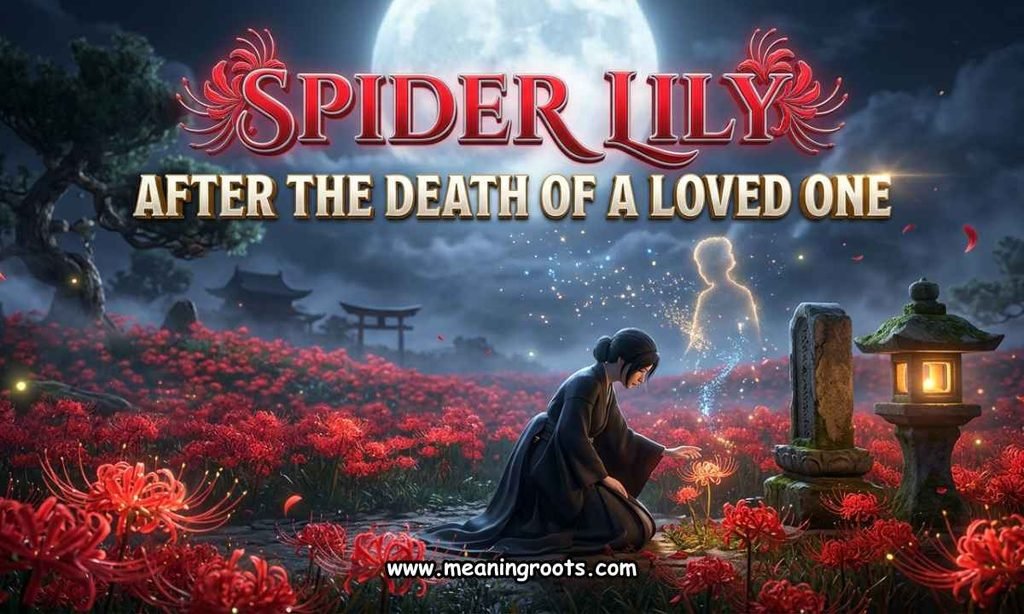
This is the situation behind many searches, and it deserves a gentle answer. After a death, the mind looks for signs. A flower that blooms near a grave, appears on the anniversary of a loss, or shows up in a dream can feel like contact, or at least like a reminder that the bond has not been erased.
In Japanese, Chinese, and Korean stories, the spider lily often stands at the edge between worlds. That image can comfort a grieving person because it suggests passage rather than disappearance. The person is gone from daily life, but love, memory, and influence remain in a changed form.
At the same time, it is wise not to put too much pressure on one flower. Grief does not need proof. If the sighting brings comfort, let it. If it brings fear or guilt, you do not have to accept a harsh reading of it. A red bloom can mean “I remember you” just as honestly as it can mean “goodbye.” For many people, it means both at once, and that mixed feeling is normal in mourning.
If grief feels stuck, overwhelming, or unsafe, the flower is not a substitute for support from people around you or from a counselor or grief group. Symbolism can accompany healing. It cannot replace it.
Spider Lily Symbolism in Japanese Culture
In Japan, the red spider lily is called higanbana. Higan means “the other shore,” a Buddhist term for the far side of suffering, and the flower blooms around the autumn equinox, during the observance known as ohigan, when families visit graves and honor ancestors. The timing alone ties the flower to remembrance.
Japanese tradition gives the flower several other names, including manjusaka, from Buddhist texts, where it appears as a heavenly flower. Folk names link it more bluntly to corpses and graves. That bluntness is not meant as horror. It reflects where the plant grows and what it marks: cemeteries, temples, riverbanks, and the edges of rice fields.
There is also a practical reason for its place near graves and fields. The bulbs are poisonous, and farmers once planted them where they wanted to discourage rats, moles, and insects from digging. A flower that protected the dead and the harvest, while also warning children not to eat it, naturally became a boundary plant. Beautiful, useful, and not to be handled carelessly.
In modern Japan, higanbana still appears in poetry, art, and film as a sign of a final meeting, a lost love, or a parting that cannot be reversed. It can feel mournful, but it is rarely treated as a curse. It is closer to a respectful marker: someone has crossed to the other shore.
Spider Lily Symbolism in Chinese Culture
In China, the red spider lily is often called the flower of the other shore, and it is tied to the underworld in legend. Stories place it along the road souls travel after death, near the Yellow Springs and the river that separates the living world from what lies beyond. In some versions, the flower blooms where the dead pass, a last bright color before forgetting and rebirth.
The best known Chinese story is about the flower and the leaf. In this telling, the flower and leaf are two beings who love each other but are fated never to meet. When the flower blooms, the leaf is gone. When the leaf grows, the flower has faded. Their longing is built into the plant itself, and it gives the spider lily its reputation as a flower of love that cannot be together in this life.
Chinese tradition also connects the flower with farewell and rebirth, not only sorrow. The other shore is not simply a place of loss. In Buddhist thought, crossing over can mean release from suffering. That double meaning matters. The flower can mourn a parting while also pointing toward a new beginning on the far side.
For that reason, a red spider lily is a poor casual gift in a Chinese cultural context, even if the giver means only beauty. The association with death and separation can overshadow the intention, and a thoughtful giver will usually choose another flower for celebrations.
Also Read This: Dreaming of Snakes Spiritual Meaning: What Your Dream Is Really Telling You
Spider Lily Symbolism in Korean Culture
In Korea, Lycoris radiata is known as sangsahwa, which can be translated as the flower of mutual longing. The name comes from the same botanical fact: flower and leaf miss each other. One appears, the other disappears, and they never share the same moment.
Korean symbolism therefore leans strongly toward separation and yearning. The flower can stand for lovers kept apart, family members divided by distance or death, or a longing that continues even when reunion is impossible. It is less about sudden doom than about a sustained ache, the kind of missing that does not resolve quickly.
Like its Japanese and Chinese counterparts, the Korean spider lily also appears near the boundary between life and death in art and story. It can mark a farewell, a memory that will not fade, or a bond that survives separation in a changed form. The emphasis is emotional rather than fearful. The flower does not punish. It remembers.
Red Spider Lily Spiritual Meaning
Red is the classic spider lily, Lycoris radiata, and it carries the strongest and most concentrated symbolism. It means farewell, death, passage, and love that endures after separation.
The color intensifies the message. Red is vivid, urgent, and hard to ignore, which fits a flower that blooms for a short period and then vanishes. It does not whisper about endings. It states them, beautifully.
In spiritual readings, a red spider lily can point to:
- A final goodbye, spoken or unspoken.
- A relationship or phase that has reached its natural end.
- Grief that is still active, not yet softened by time.
- Courage to accept a loss instead of clinging to what cannot return.
- Love that continues as memory after death or separation.
Red does not have to mean anger or danger here. In this tradition, it means intensity. The farewell matters because the connection mattered.
White Spider Lily Spiritual Meaning
White spider lilies, including white forms of Lycoris, soften the message without erasing it. White often means purity, peace, spiritual clarity, and remembrance without bitterness.
A white bloom can suggest a calmer kind of goodbye, one where forgiveness or acceptance is present. It can also point to a new chapter after grief, a clean page that does not pretend the past never happened. In spiritual terms, white often stands for light after darkness, or for a soul at rest.
Context still matters. In East Asian funeral tradition, white is also a mourning color, so a white spider lily can carry grief as well as peace. The difference is tone. Red says farewell with fire. White says farewell with quiet.
Yellow Spider Lily Spiritual Meaning
Yellow spider lilies, such as Lycoris aurea, are sometimes called golden spider lilies. Their symbolism is lighter and more modern than the red flower, because yellow is less bound to grave and underworld stories.
Common readings include hope, friendship, warmth, joy after a hard season, and prosperity. Gold has long been linked with value and good fortune, so a yellow bloom can feel like encouragement rather than warning. For someone coming out of grief or a long separation, yellow can suggest that renewal is not only possible but already beginning.
That lighter tone makes yellow a safer choice for a garden or a thoughtful gift in many Western settings, though the plant itself remains toxic if eaten. Color changes the feeling. It does not change the bulb.
Pink Spider Lily Spiritual Meaning
Pink spider lilies are usually Lycoris squamigera, also called the resurrection lily or surprise lily. This plant blooms in summer rather than autumn, and its pink flowers appear on bare stems after the leaves have died back. The name “resurrection” fits the same theme as the red flower, but in a gentler key: something returns after it seemed gone.
Pink symbolism centers on gentle affection, admiration, gratitude, and tender memory. It can stand for love that is caring rather than passionate, for appreciation of someone who shaped your life, or for a soft goodbye where no bitterness remains.
Because Lycoris squamigera looks different from Lycoris radiata and blooms in a different season, it is easy to confuse the two in photos. The meaning overlaps, especially around rebirth, but pink leans toward affection and renewal, while red leans toward final farewell.
Spider Lily Symbolism and Love
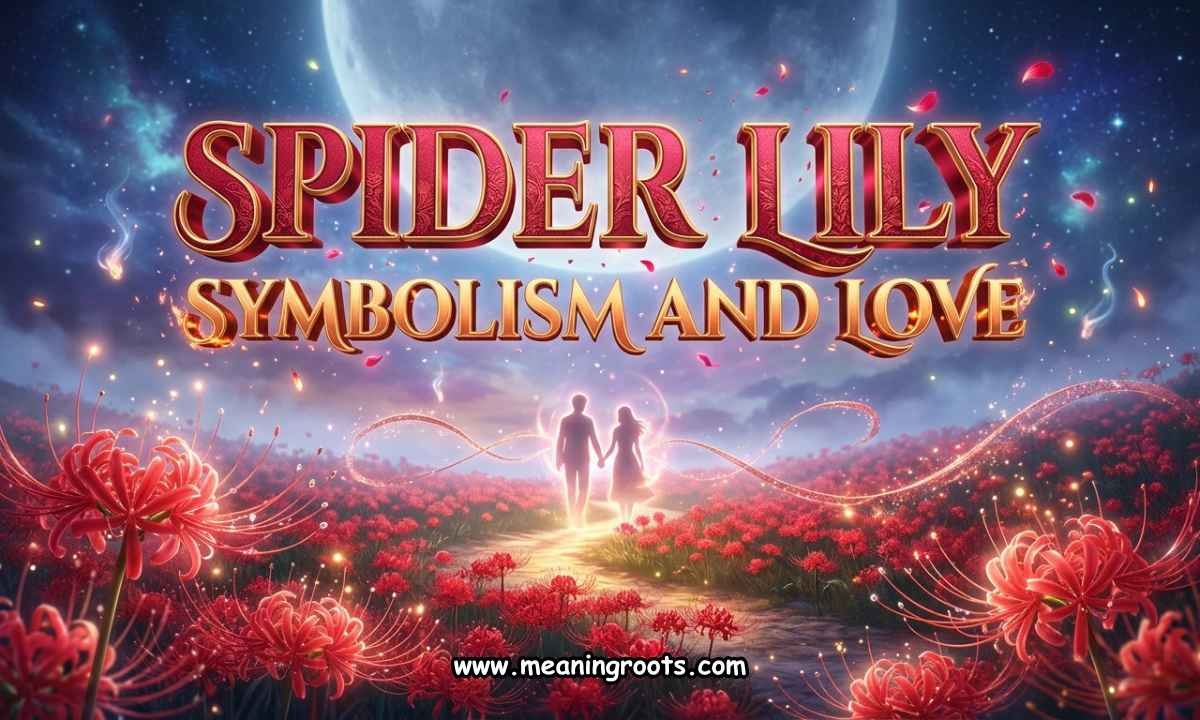
Few flowers carry a love story as directly as the spider lily. The flower and leaf never meet, so the plant itself becomes a picture of lovers separated by fate.
That image can mean unrequited love, love interrupted by death, long distance love, or love that arrived at the wrong time. It can also mean a love that refuses to end with separation. The flower returns each year. The leaf returns each year. They do not meet, but neither disappears for good.
This is why the spider lily is a complicated romantic symbol. In a Western garden, a red spider lily can be a striking, even romantic flower. In an East Asian context, giving one to a partner can be read as a farewell or a bad omen, which is the opposite of what most people intend. If you love the symbolism, it is better shared as a story or a garden plant than as a surprise bouquet, unless you know the recipient will read it the way you do.
A single red bloom can also stand for a goodbye that was never properly said. Some people find that meaning painful. Others find it useful, because it gives a shape to unfinished feelings.
Dreaming About a Spider Lily: Spiritual Meaning

Dreams about spider lilies are usually about endings, memory, and transition, not about literal predictions. A dream does not mean someone is going to die because a red flower appeared in it.
Common dream images and their usual symbolic readings include:
- A field of red spider lilies: grief, a major ending, or a period of life that is closing.
- A single flower in your hand: a personal goodbye, or a memory you are holding closely.
- Picking or giving a spider lily: letting go, or offering forgiveness and closure.
- A withered spider lily: a phase of grief that is easing, or an old attachment losing its grip.
- A spider lily blooming out of season: an unexpected change, or a feeling that returns when you thought it was finished.
The details around the dream matter. Who was present? What were you feeling? Was the flower beautiful, frightening, or calm? A dream that leaves you peaceful is pointing in a different direction than one that leaves you anxious, even if the flower looks the same.
If spider lily dreams repeat after a death or breakup, they often track grief itself. The mind returns to the image while it works through loss. That is a process, not a warning.
Repeatedly Seeing Spider Lilies
Seeing the flower once can be striking. Seeing it again and again can feel like a message, especially if you are already going through a hard time. Before treating repetition as a sign, it helps to check the ordinary explanations.
Autumn is the main one. Red spider lilies bloom in a short window, often along roadsides, cemeteries, and old gardens at the same time. If you drive the same route, you may suddenly notice them everywhere because they are, in fact, everywhere for a few weeks.
Attention is another. Once a flower has meaning for you, your eye finds it more easily. That does not make the sightings false. It means your mind is alert to a theme, often grief, separation, or change.
Anniversaries can play a role too. A bloom that appears near the date of a death, a breakup, or a move can feel timed, because the season itself repeats. The flower returns each year, just as the memory does.
If repetition still feels meaningful, try noting where, when, and what was on your mind each time. Patterns often become clearer on paper. You may find the flower is tracking a decision you have been avoiding, a goodbye you have not finished, or a new beginning you have not yet named.
Also Read This: Itchy Right Palm Meaning: 7 Spiritual Signs, Money Omens & What to Do
Spider Lily in Anime: Demon Slayer, Tokyo Ghoul and the Blue Flower That Does Not Exist
Anime has done more than any other modern medium to spread spider lily symbolism outside East Asia, and it has also created one famous confusion.
In Demon Slayer, the blue spider lily is a legendary flower sought by Muzan, who believes it can give him immunity to sunlight. It is fictional, and its rarity in the story is part of the point. The flower blooms only briefly and is almost impossible to find, which makes it a symbol of an unreachable cure and a dangerous obsession.
There is no natural blue Lycoris radiata, and no blue spider lily waiting to be found in a real forest. Breeders have produced red, pink, white, yellow, and orange-toned Lycoris, but true blue remains outside the plant’s natural color range. If you see a vivid blue spider lily online, it is dyed, edited, or drawn.
In Tokyo Ghoul, red spider lilies appear as a recurring image of death, transformation, and loss. They do not need explanation in the story because the cultural association is already there for many viewers. A red bloom in the background can signal that a character is changing, that someone will not return, or that a part of life has ended.
That is why many viewers search for the flower after watching anime. They are not only asking about botany. They are asking what a visual shorthand meant, and whether the flower in the show carries the same weight in real life. For red spider lilies, the answer is largely yes. For blue ones, the answer is that the show invented a flower to fit its story.
Spider Lily Tattoo Meaning
A spider lily tattoo usually means remembrance, farewell, rebirth, or a love that survived separation. It is a popular choice after a death, because the flower says “goodbye” without needing words, and because its yearly return suggests that memory does not end with burial.
Design changes the emphasis. A single stem can feel personal and quiet. A field of red blooms can feel dramatic, almost like a scene from anime or a memorial landscape. Pairing the flower with a butterfly, a name, a date, or a moth can shift the meaning toward transformation or a specific person.
There are a few practical considerations worth taking seriously. A grief tattoo made in the first raw weeks after a loss can still be the right choice, but many people prefer to wait until the design feels steady rather than urgent. Red ink also behaves differently over time than black ink, so an experienced artist can advise on placement and upkeep.
Cultural context is worth a thought as well. In Japan, tattoos can still draw attention in some baths, gyms, and traditional settings, even though attitudes are changing. That does not make a spider lily tattoo wrong. It only means placement and travel plans are worth considering if Japan is part of your life.
Seeing a Spider Lily Near Your Home, in Your Garden, or Receiving One as a Gift
Near your home
A spider lily near your home is not, on its own, a bad sign. It may be an old bulb from a previous owner, a plant that spread along a boundary, or a roadside bloom that caught your eye on a walk. In many older gardens, red spider lilies are simply heirlooms, passed from one household to another like a recipe.
If the sighting feels heavy, check the context. Is it near a grave or memorial? Did it appear around an anniversary? Is something in your life ending? The flower may be reflecting a feeling you already have, rather than introducing a new threat.
In your garden
Spider lilies can be rewarding garden plants if you respect their cycle. Plant bulbs in late summer in sun or light shade, in soil that drains well. Do not expect leaves at flowering time. After the bloom fades, let the leaves grow undisturbed through winter and spring, because they feed the bulb for next year. Cutting them early weakens future blooms.
Keep the plant away from areas where small children or pets dig and chew. All parts of Lycoris are toxic if eaten, and the bulbs are the most concentrated part. Gloves for handling bulbs, and a planting spot that is not a vegetable bed, are simple precautions.
Receiving one as a gift
Receiving a spider lily can feel awkward if you know its death association, and it can feel beautiful if you do not. Intention matters, and so does culture. A giver in a Western setting may simply think the flower is striking. A giver from an East Asian background is less likely to choose it casually, because the farewell meaning is well known.
If you receive one and feel unsure, a kind response is to thank the giver and, if the relationship allows it, ask what the flower meant to them. Often the answer clears up the confusion. If you are the giver, and you want the rebirth or remembrance meaning to come through, a short note helps: this is for memory, for a new chapter, or for a goodbye that still honors love. Without that note, the flower can speak louder than you intended.
Which Spider Lily Did You Actually See? Lycoris, Hymenocallis and Spider Plant Confusion
“Spider lily” is a common name, not a single plant, and that causes a lot of mistaken symbolism. Three very different plants share the name or get mixed up with it.
| Plant | What it really is | How to tell it apart |
| True spider lily | Lycoris radiata, a bulb in the amaryllis family | Red flowers on bare stems in autumn, leaves appear after bloom and vanish before the next bloom |
| White spider lily | Often Hymenocallis, a different bulb genus | White, spidery flowers, usually in summer, with long green leaves present while it blooms, often near water |
| Spider plant | Chlorophytum comosum, a houseplant, not a lily | Trailing green and white striped leaves with small plantlets on long stems, no large lily bloom |
If you saw a white, fragrant flower with leaves already on the plant, you may have seen Hymenocallis, not Lycoris. Its symbolism is closer to purity and tropical beauty than to graves and farewells. If you saw a trailing houseplant with baby plants hanging from stems, that is a spider plant, and it has no traditional death symbolism at all.
This distinction matters for more than accuracy. Planting advice, toxicity, and cultural meaning all change with the plant. A true Lycoris needs a dormant period and a bulb. A spider plant needs a pot and regular watering. Treating them as the same plant leads to dead bulbs and confused readings.
Lessons We Can Learn From the Spider Lily
The flower and leaf never meet, yet the plant thrives. That is a strange kind of hope. It suggests that separation does not have to mean failure. Some connections continue in a different rhythm, even when they cannot share the same season.
The bloom is brief, and that brevity is part of its power. A flower that lasted all year would not carry the same farewell. The spider lily teaches that endings deserve attention, not avoidance, and that a short, vivid goodbye can be more honest than a long, fading one.
It also teaches patience with return. After the flower dies, the plant looks empty. Then leaves appear. Then they vanish. Then, a year later, the flower returns. Grief and growth often follow a similar pattern, with quiet periods that look like nothing is happening.
Finally, the spider lily reminds us that beauty and sorrow can share the same stem. A flower can mark a grave and still be beautiful. A goodbye can hurt and still be an act of love. Holding both truths at once is, for many people, the real spiritual lesson.
Frequently Asked Questions
Is a spider lily poisonous?
Yes. All parts of Lycoris are toxic if eaten, especially the bulbs, so keep them away from children and pets and seek help promptly if someone ingests any part.
Why does a spider lily bloom without leaves?
It is a survival pattern called hysteranthy: the flower uses stored bulb energy in autumn, and the leaves grow later to rebuild that energy for the next bloom.
Can I grow spider lilies at home?
Yes, in sun or light shade with well drained soil, planted in late summer, but leave the leaves alone after flowering so the bulb can recharge.
Is there really a blue spider lily?
No. The blue spider lily in Demon Slayer is fictional, and no naturally blue Lycoris exists, though red, pink, white, yellow, and orange-toned forms do.
When do spider lilies bloom?
True red spider lilies usually bloom in autumn around the equinox, while pink Lycoris squamigera blooms in summer and white Hymenocallis usually blooms in summer.
Conclusion
The spider lily spiritual meaning is less about fear than about honesty. The flower names a farewell, honors a life or a love that has changed form, and still points toward return. If you saw one and felt something stir, that feeling is probably the point.
Notice what ending, memory, or new beginning it touched, and let the flower be a marker for that moment, not a verdict on what comes next.
Also Read This: Ringing in Right Ear Spiritual Meaning: 9 Signs, Omens & What to Do

My name is Daniel.I am a passionate writer in the meaning niche with over 4 years of experience exploring life purpose and personal growth. I create thoughtful content that helps readers understand deeper meaning in everyday experiences.