
It usually happens in an ordinary moment. A crow lands on a fence as you leave the house, or one crosses the road in front of you, or a loud caw cuts through a quiet morning. Nothing dramatic follows, yet the moment stays with you. That is when the question forms: the bird seemed to arrive at exactly the wrong, or right, time.
Seeing a crow often signals change, heightened awareness, or a message to pay attention in your own life, not a fixed prediction about death, luck, or the future at all.
That question, the spiritual meaning of seeing a crow, has no single answer that fits every person, culture, or moment. Crows have been treated as messengers, warnings, guides, and tricksters in different traditions, and the same sighting can mean very different things depending on what is happening in your life. This article works through those layers slowly: what crows symbolise, what numbers and behaviour may suggest, how dreams and scripture treat them, and how to respond without fear or overreading a normal bird sighting.
Key Takeaways
- A crow sighting is best read as a prompt to notice change, not as a fixed fortune.
- One crow often points to a personal message, while a flock points to community, protection, or shared attention.
- Crows and ravens are different birds, and mixing them up changes the symbolism.
- In most Bible translations, the bird named is a raven, not a crow, which matters for the biblical meaning.
- Natural behaviour explains a lot: crows caw for food, alarms, territory, and family contact, especially in nesting season.
- If a sighting leaves you anxious, focus on the practical question behind it, rather than treating the bird as a verdict.
Also Read This: Spider Lily Spiritual Meaning: Seeing One, Death, Farewell and Rebirth Explained
The Spiritual Symbolism of Crows: Messengers Between Worlds
Crows sit in an unusual place in folklore. They are everyday birds, common in cities, fields, and gardens, yet they are also tied to death, mystery, and the unseen in story after story. That combination is part of why they unsettle people. A crow is not rare or distant. It is close, watchful, and intelligent, and it seems to notice us back.
In many traditions, the crow is a messenger because it moves between places humans cannot easily follow: between day and night, between the living and the dead in myth, between the known and the unknown. That does not mean every crow carries a literal message. It means people have long used the crow as a symbol for information that arrives from outside ordinary thinking. A sudden realisation, an unwelcome truth, a piece of news you were avoiding, all of these fit the messenger image.
Crows are also linked with intelligence and memory in a way that is grounded in real behaviour. They recognise faces, remember people who have treated them well or badly, use tools in some contexts, and pass on learned behaviour within family groups. When spiritual writing calls a crow wise, it is often borrowing from that watchfulness. The bird pays attention. The question the symbolism asks back is whether you are paying attention too, to a decision, a relationship, a habit, or a change you already sense is coming.
There is a darker side to the symbolism, and it should not be smoothed away. Because crows eat carrion, they became linked with battlefields, graveyards, and death in several cultures. That association can make a sighting feel ominous, especially after a loss or during illness in the family. But death in crow symbolism is not always literal. In many readings it means an ending: a job, a phase, a version of yourself, a relationship that has already changed. Reading every crow as a death warning misses that wider, and often more useful, meaning.
Number of Crows and Their Spiritual Meanings
People often ask first about the number, as if one crow means one thing and three crows mean something entirely different. Numbers do shape the reading in folklore, but they are not a code with one correct key. Different regions, families, and traditions count differently, and the same number can be read as good, bad, or neutral depending on context.
The table below gathers the most common traditional associations. Treat them as starting points for reflection, not as predictions.
| Number seen | Common traditional reading |
| One crow | A personal message, a new awareness, or a call to look at your own path |
| Two crows | Partnership, balance, a relationship, or a decision shared with another person |
| Three crows | Change in motion, creativity, or a message that needs action rather than waiting |
| Four crows | Stability, home, foundations, or a need to steady something practical |
| Five crows | Movement, unexpected news, or a shift that disrupts routine |
| A flock, or murder, of crows | Community, protection, shared warning, or many voices asking for attention |
The old English counting rhyme, beginning “one for sorrow, two for joy,” is often quoted in this context. It is worth knowing about, but it is not a universal rule. Versions of the rhyme differ, some count magpies rather than crows, and the rhyme itself was a piece of folk poetry, not a system of divination. If a number in the table feels wrong for your situation, trust the situation more than the number.
Context also changes the count. One crow seen every day at the same time may matter more than three crows seen once by chance. A flock gathering loudly at dusk is often a roosting group, a normal social behaviour, rather than a special event. The number opens the question. It does not close it.
Single Black Crow: A Sign of Personal Awakening
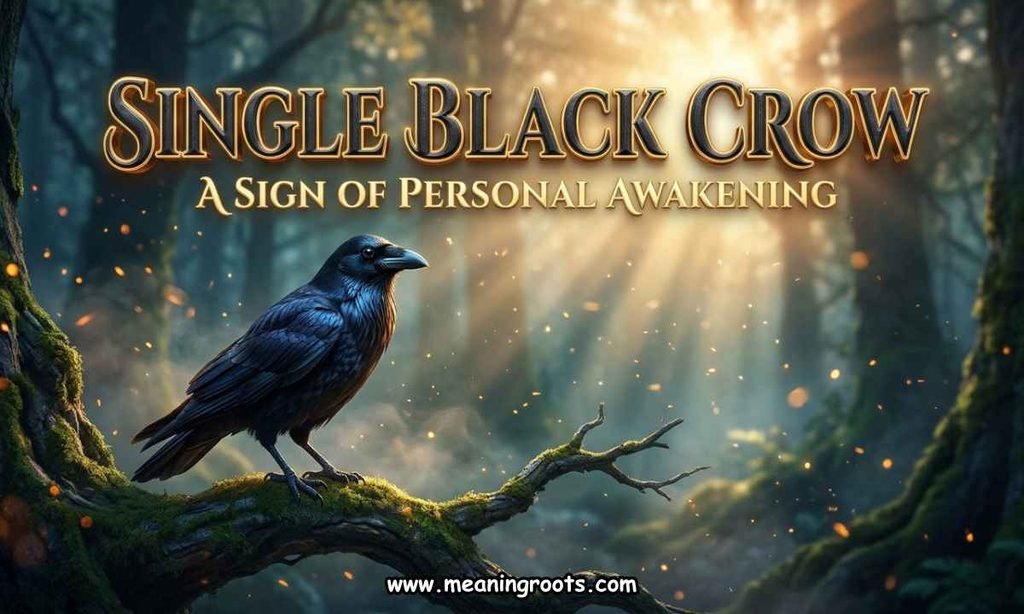
A single black crow draws attention because it is alone, dark, and hard to ignore. In spiritual readings, that solitude is the point. A flock can be about other people. A single crow is more often read as being about you: your thoughts, your direction, and the things you have been putting off.
Awakening here does not have to mean a dramatic spiritual event. It can be quieter. You may notice a pattern in your own behaviour for the first time. You may finally admit that a job, a friendship, or a daily routine no longer fits. You may feel a sharper sense of what you actually want, even if you do not yet know how to get it. The crow, in this reading, marks the moment of noticing rather than the whole journey that follows.
Colour matters in this section because the brief, and most searchers, specify a black crow. Black in symbolism is not automatically negative. It can mean the unknown, the hidden, protection, or a blank space where something new can form. A single black crow can therefore be read as an invitation to look at what is hidden, including parts of yourself you avoid, rather than as a threat. That reading is more honest than a simple good or bad label, and it is more useful. It gives you a question to carry forward: what have I not been looking at?
If the sighting coincides with a major change, a bereavement, or a period of anxiety, the awakening reading can feel too neat. It is fine to hold two truths at once. The bird may simply have been there, and the moment may still have helped you name something important. Meaning does not have to come from the bird to be real to you.
Flock of Crows: Messages About Power, Warning, and Community
A flock changes the feeling completely. One crow watches you. A flock watches each other, calls loudly, moves together, and fills the sky. That shift is why flock symbolism leans toward power and community rather than private reflection.
In folklore, a group of crows is called a murder, a name that comes from old folk associations rather than from the birds being murderous. The word itself can make a flock feel sinister, but the behaviour behind it is social. Crows gather to roost, to feed, to warn each other of danger, and to defend territory. They are, in that sense, a community that looks out for its own. Spiritually, that can be read as protection, strength in numbers, or a reminder to lean on people around you instead of carrying everything alone.
Warning is the other common flock reading, and it deserves care. A flock calling loudly may be warning about a predator, a rival group, or a disturbance, and human observers have long borrowed that alarm as a symbol for their own warnings. If a flock appears during a period of conflict or risk, it can prompt a useful check: is there a warning you have been ignoring from friends, from your body, from a situation at work? That is a practical reading. It is different from treating the flock as proof that something bad will happen.
Power, in this context, does not mean dominance over others. It means collective attention. Many eyes, many voices, many minds noticing the same thing at once. If you feel scattered or unheard, a flock can be a reminder that your voice carries further when it is joined to others, and that you do not have to face a difficult change in isolation.
Also Read This: Moth Spiritual Meaning: 9 Signs, Color Meanings, and Messages From the Spirit World
One Crow Spiritual Meaning
This section sounds like it repeats the single black crow section, and searchers often use the two phrases for the same sighting. The difference is in the question behind the words. “Single black crow” usually comes with a focus on colour and awakening. “One crow” usually comes with a simpler, more urgent question: why just one, and why now?
One crow can feel personal because it breaks the usual pattern. Crows are social birds, so a lone crow stands out. That is often why people remember it. The spiritual reading that fits this best is attention to timing. What were you thinking about when you saw it? What were you about to do? Were you on your way somewhere important, or coming back from a difficult conversation? The crow does not answer those questions, but the moment can bring them into focus.
Repetition matters here more than colour. One crow once may be chance. One crow at the same place, at the same time, over several days, is more likely to be a bird with a routine: a feeding spot, a perch, a territory. That does not cancel the spiritual reading, but it does change it. Instead of asking what the crow predicts, you might ask why this pattern caught your attention now, and what routine in your own life it mirrors.
If one crow crosses your path, the older folk reading is often about a message or a change of direction. A modern, grounded version of the same idea is simpler: pause, notice what direction you were heading in, and check whether it is still the direction you want. That keeps the symbolism useful without turning a bird into a fortune teller.
Crow Symbolism vs. Raven Symbolism
Crows and ravens are related, both belong to the genus Corvus, but they are not the same bird, and their symbolism is not interchangeable. Much confusion in crow articles comes from borrowing raven stories and relabelling them as crow stories. Separating the two makes both symbols clearer.
| Feature | Crow | Raven |
| Size and build | Smaller, slimmer, with a fan shaped tail in flight | Larger, heavier billed, with a wedge shaped tail in flight |
| Voice | Higher, familiar caw, often in repeated calls | Deeper, croaking call, often lower and more varied |
| Social life | Very social, often in family groups and flocks | More often solitary or in pairs, less flock based |
| Common symbolic lean | Community, adaptability, everyday messages, watchfulness | Solitude, deep mystery, prophecy, long memory in myth |
In myth, ravens carry the heavier, more solitary roles. Odin’s ravens in Norse myth, Huginn and Muninn, represent thought and memory and fly out each day to bring back news. Crows, by contrast, are more often the trickster, the messenger in the marketplace, the bird that lives alongside people and notices their business. That closeness is a strength of crow symbolism. A crow message is usually about ordinary life: home, work, family, and daily choices. A raven message, in myth, is more often about fate, death, and the far future.
If you are trying to identify a bird you saw, size and voice help more than colour. Both are black. A large bird alone in wild country, with a deep croak, is more likely a raven. A smaller bird in a town or field, cawing with others, is more likely a crow. Getting the bird right does not make the spiritual reading more true, but it does make it more honest, and it stops a raven myth from being forced onto a crow sighting.
Crow Spiritual Meaning in Love, Relationships, and Emotions
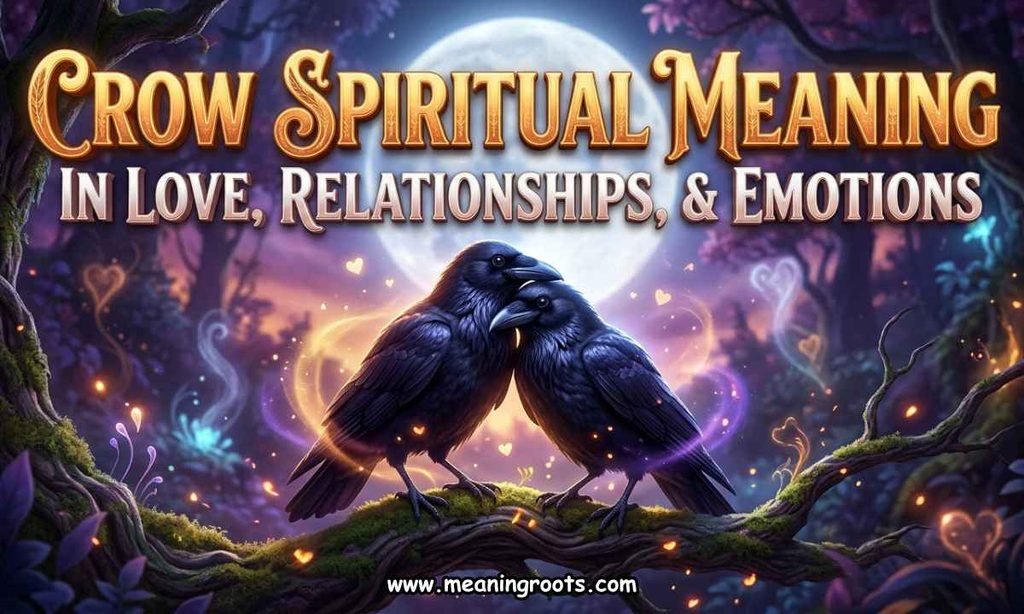
Crows are not the first bird people associate with love. Doves and swans take that role. Crow symbolism in relationships is therefore less about romance and more about truth, loyalty, and what is hidden between people.
In a relationship reading, a crow can point to a truth that needs speaking. Crows are vocal birds, and their call is hard to ignore. That makes them a useful symbol for conversations that have been delayed: a boundary that needs setting, a feeling that needs naming, a secret that is weighing on one person. The crow does not create the tension. It marks the moment when staying silent starts to cost more than speaking.
Loyalty is another thread, drawn from crow family life. Crows stay with family groups, help raise young, and defend their own. In love, that can be read as a reminder to protect what matters, to show up consistently rather than grandly, and to notice who actually stays when things are difficult. It can also be a warning in the other direction: loyalty to a pattern that harms you is not the same as loyalty to a person.
Emotionally, crows often appear in readings about grief, anger, and transformation, because black birds have long been linked with shadow feelings. Shadow here does not mean bad. It means the parts of emotional life that are harder to show: grief after a loss, anger after unfair treatment, fear about a future you cannot control. A crow sighting during such a time can be a prompt to let those feelings be seen, at least by yourself, rather than pushed aside. If grief or anxiety is heavy and ongoing, that prompt is best followed with support from people you trust, not with omen watching alone.
Single Black Crow Meaning in the Bible
This is one of the most searched crow questions, and it needs a careful answer, because the Bible as commonly translated does not usually say “crow” where readers expect it. The Hebrew word often translated as raven covers the wider crow family, and most English Bibles render it as raven. That distinction matters. A biblical meaning built on raven passages should be labelled as such, rather than presented as a crow passage.
The clearest passages are these. In Genesis, after the flood, Noah sends out a raven first, and it flies back and forth until the waters dry. The raven here is a scout, a bird sent into an uncertain world to test whether life can begin again. In the story of Elijah, ravens bring him bread and meat morning and evening while he hides by a brook, a picture of provision arriving from an unexpected and unlikely source. In Luke, Jesus points to the ravens, which neither sow nor reap, and says God feeds them, using the birds as a lesson against anxiety about provision and worth.
Read together, those passages do not present the raven, or by extension the crow, as a demon or a curse. They present it as a creature under God’s care, used for provision and for testing new ground after disaster. That is a very different picture from the horror film crow, and it is closer to the biblical text. A single black crow read through this lens can suggest provision in a lean time, or a first step into a new phase after a flood of trouble, rather than a warning of punishment.
There is also a warning passage worth mentioning honestly. Proverbs speaks of the eye that mocks a parent being picked out by ravens, a stark image about disrespect and consequence. It is poetry and proverb, not a rule that a crow sighting punishes a person. Taking it literally as a personal omen would distort both the text and the bird. The Bible’s crow family symbolism, taken as a whole, is more about God’s provision, human dependence, and the mystery of how help arrives, than about fear.
Spiritual Meaning of a Crow Cawing at You
A crow cawing directly at you feels personal in a way that a distant crow does not. It is loud, it is aimed, and it is hard to ignore. That is why this sighting generates so much anxiety, and why it deserves a grounded answer before a symbolic one.
Naturally, crows caw at people for ordinary reasons. You may be near food, near a nest, near young birds, or in a territory the crow is defending. You may have been recognised from a previous encounter, since crows remember faces and can pass that recognition on. A crow cawing at you is, in the first instance, a bird communicating, often an alarm or a territorial call, not a coded message in human language.
Symbolically, the caw is often read as a call to listen. If a crow’s call stops you, the useful question is what you were not listening to before it. A conversation you cut short, a warning from a friend, a physical tiredness you ignored, a decision you rushed. The caw, in this reading, is less about the future and more about attention in the present. It interrupts. Interruption can be a gift when you have been running on autopilot.
There is a common fear attached to this sighting, that a crow cawing at you means death or bad news is coming. No tradition supports that as a certainty, and treating it as one can cause real distress, especially if you are already grieving or waiting on medical news. If the caw leaves you frightened, it helps to separate the feeling from the fact. The feeling is real. The prediction is not established. Note the time, place, and what was happening, then return to the practical question: is there something I need to attend to today that I have been avoiding?
Spiritual Meaning of Seeing a Crow in a Dream
Dreams change the symbolism, because a dream crow is not a bird you can watch. It is an image your mind produced, shaped by memory, fear, and the day’s residue. Dream dictionaries often give fixed meanings for dream crows, but a more useful approach is to ask what the crow was doing, and how you felt about it.
- A crow watching you in a dream often points to a feeling of being observed, judged, or exposed, or to a part of yourself you are watching closely.
- A crow flying away may reflect a message, opportunity, or relationship moving out of reach, or a fear that it will.
- A crow speaking, or making a humanlike sound, often reflects a truth you have not yet said out loud, or a voice you have been ignoring.
- A dead crow in a dream can symbolise an ending, a lost opportunity, or a part of your life that has already changed, rather than a literal death.
- A friendly or calm crow may reflect a growing comfort with mystery, change, or your own intuition, especially if the dream did not feel frightening.
The emotion in the dream matters more than the bird’s colour or number. A frightening crow dream after a bereavement is often grief working itself out, not a visitation with a verdict. A calm crow dream during a period of change may reflect a mind getting used to a new direction. If crow dreams repeat, keeping a short note of the dream, the feeling, and what was happening in waking life that week often reveals a pattern faster than a dictionary entry will. Repeated distressing dreams, especially after trauma or loss, are worth discussing with a trusted person or professional, rather than treating as omens alone.
Also Read This: Dreaming of Snakes Spiritual Meaning: What Your Dream Is Really Telling You
Crow Symbolism in Religious and Mythological Texts
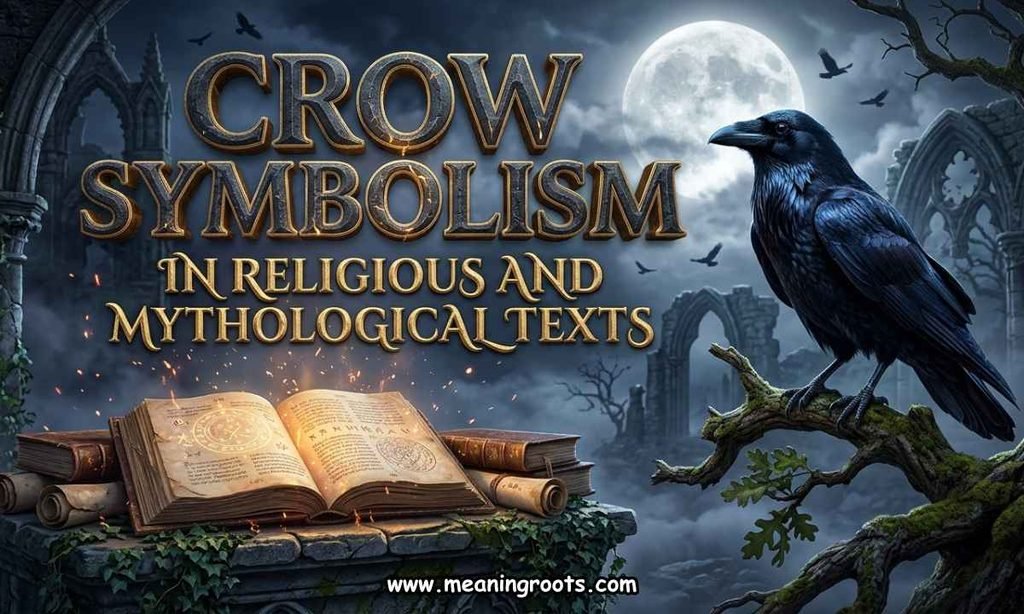
Crow symbolism does not belong to one tradition, and flattening it into a single meaning does it a disservice. The table of traditions below keeps the stories separate, because they are separate.
In Norse myth, the famous birds are ravens, not crows, and they belong to Odin as thought and memory. In Greek myth, a crow is linked with Apollo, and in one well known story the crow, once white, is turned black after bringing bad news, a tale that ties the bird to unwelcome messages and to the cost of speaking them. In Celtic tradition, crows and ravens are associated with the Morrigan, a figure linked with war, fate, and prophecy, and with battlefields where carrion birds gathered. That association explains much of the crow’s ominous reputation in Britain and Ireland.
In Hindu tradition, crows have a gentler and more domestic role. They are treated as messengers connected with ancestors, and feeding crows during Shraddha rites, the rituals for the departed, is an act of remembrance and offering. A crow’s arrival in that context can be read as a link with family who have died, not as a threat, but as a reminder to honour them. In Japan, the three legged crow Yatagarasu is a guide associated with the sun, leading an emperor on his way, a very different image from the battlefield crow: guidance, direction, and divine help on a journey.
Native American traditions vary widely by nation and story, and no single crow meaning covers them. In some Pacific Northwest stories, Raven is a creator and trickster figure, shaping the world and stealing light, while in other traditions crows are messengers, tricksters, or teachers in their own right. The respectful approach is to name the specific tradition when you know it, rather than borrowing a generic “Native American crow meaning” that flattens distinct peoples and stories into one label.
What these traditions share is not a single message, but a pattern. Crows appear where humans face transition: war, death, journey, news, and the boundary between worlds. That pattern is the real common thread, and it is more durable than any one omen list.
Interpreting Crow Behavior: Beyond Just Sightings
Most crow articles stop at “you saw a crow.” Behaviour tells a richer story, because crows do different things for different reasons, and the spiritual reading should follow the behaviour rather than forcing one meaning onto every sighting.
- A crow perched quietly and watching may suggest observation, patience, or a need to pause before acting.
- A crow flying toward you, then away, can be read as a message arriving and leaving, or a change that is passing through rather than staying.
- A crow following you along a path is often a territorial or food related behaviour, but symbolically it can prompt the question of what is following you in life: an unresolved issue, a habit, or a decision.
- A crow at a window or on a roof is often drawn by food, shelter, or a high perch, yet in folklore the window crow is a classic messenger image, a message arriving at the boundary of home.
- A crow carrying an object, food, or a shiny item reflects the bird’s curiosity and tool use, and symbolically it can suggest gathering resources, or carrying something away that you no longer need.
- A silent crow feels different from a loud one. Silence can suggest watchfulness and hidden knowledge, while loud cawing suggests alarm, announcement, or a call to attention.
- A crow in the morning, when crows are most active, is less unusual than a crow active late at night, when most crows are roosting. Unusual timing is worth noting, but it still has natural explanations, including artificial light, disturbance, or a roost being moved.
The best way to interpret behaviour is to note three things together: what the crow did, where you were, and what was happening in your life that day. That small record, kept over a week or two, usually shows whether a pattern is emerging or whether one striking moment simply stuck in memory. It also protects you from the most common mistake in omen reading: remembering the one crow that matched a later event, and forgetting the many crows that did not.
Real-Life Scenarios: When Crows Appear in Daily Life
Sighting lists feel abstract until they meet real life. The scenarios below are the ones people actually describe, and each one benefits from a different reading.
A crow at a funeral or near a grave often feels like a visitation, and for a grieving person it can bring comfort or fear in equal measure. In folklore, the crow at a burial is a boundary bird, present at the edge between life and death. A grounded reading does not deny that comfort. It simply adds that crows are common near open ground, trees, and quiet places, including cemeteries, and that grief makes us notice symbols more sharply. Both can be true: the bird was there for ordinary reasons, and the moment still helped you feel close to someone you lost.
A crow appearing before a big decision, a job change, a move, or a medical result, often gets read as a sign to go ahead or to stop. The more useful reading is as a pause. What does your body feel when you see it? Relief, dread, clarity, confusion? That reaction often tells you more about the decision than the bird does. If the reaction is dread, it may be worth asking what part of the decision frightens you, rather than treating the crow as a veto.
A crow visiting your home or garden repeatedly is usually a bird that has found food, water, a safe perch, or a nest site nearby. Spiritually, home crows are often read as messages about family, protection, or domestic change. Practically, they are also a reminder to check the garden: is there open food, a pet bowl left out, or a nest in a tree? Respect the bird’s space, especially in nesting season when crows can become defensive, and give a wide berth to any nest area.
A crow on a journey, on a road trip, at an airport, or on a walk in a new place, fits the guide and messenger symbolism well. Travellers in myth are often guided by birds, and a crow on a journey can be read as a prompt to stay alert, to notice the route, and to be open to unexpected help or news. It does not guarantee a safe trip, and it should not replace practical preparation, but as a symbol it suits the uncertainty of travel.
A crow in a time of illness, whether your own or a loved one’s, is the scenario where omen reading can cause the most harm if handled carelessly. A crow does not diagnose, predict, or cause illness. If a sighting during illness brings fear, the kindest response is to name the fear, seek medical and personal support where needed, and let the crow be a prompt to care for yourself and others, not a verdict on an outcome.
How to Respond to a Crow’s Message?
Responding well to a crow sighting does not require a ritual, and it does not require belief in omens. It requires a short pause and a few honest questions.
- Pause and notice. What were you doing, thinking, or feeling just before the crow appeared?
- Note the details. How many crows, what were they doing, where were you, and what time was it? Details fade fast, and they are what turn a vague feeling into a clear reflection.
- Ask one practical question. Is there a decision, conversation, or change I have been avoiding? Is there a warning, from a person or a situation, that I need to take seriously?
- Separate symbol from prediction. A crow can prompt reflection without predicting an outcome. Holding that line protects you from fear based decisions.
- Act on the practical part, not the omen. If the reflection points to a conversation, have it. If it points to rest, take it. If it points to a risk, check the facts.
- Respect the bird. Observe from a distance, do not chase, harm, or try to catch a crow, and give nesting birds extra space. A spiritual response that harms wildlife contradicts its own message.
- Let it go if nothing fits. Not every sighting needs a meaning. Sometimes a crow is simply a crow, and forcing a message onto it creates anxiety where none was needed.
If a sighting leaves you with ongoing fear, grief, or intrusive thoughts, that is a sign to talk to someone you trust, not to watch for more crows. Symbols are meant to help you think, not to trap you in a loop of checking.
FAQs
Is seeing a crow always a bad omen?
No. Crows are linked with change, messages, and awareness in many traditions, and with death only in some contexts. A single sighting does not fix a good or bad outcome.
Does a crow cawing at you mean someone will die?
No tradition supports that as a certainty. Crows caw for food, territory, alarms, and family contact, and fear after a caw is understandable, especially during grief, without being a prediction.
Why does the same crow keep appearing near my house?
Usually it has found food, water, a perch, or a nest site nearby. Spiritually it may prompt a question about home or family, but the practical cause is worth checking first.
What is the difference between a crow and a raven in a dream?
A crow in a dream often reflects everyday messages, watchfulness, or community, while a raven in a dream often reflects deeper mystery, solitude, or a larger life change in mythic readings.
Should I be worried if I hear a crow at night?
Not necessarily. Most crows roost at night, so a night call often means disturbance, artificial light, or a moved roost. Note it, but do not treat it as a verdict on its own.
Conclusion
A crow does not need to be a mystery to be meaningful, and it does not need to be a warning to be worth noticing. The spiritual meaning of seeing a crow lives in that middle space: a watchful, intelligent bird, long tied to messages and change, arriving in an ordinary moment and asking, quietly, whether you are paying attention to your own life. Answer that question honestly, act on the practical part, and let the bird go on its way.
Also Read This: Itchy Right Palm Meaning: 7 Spiritual Signs, Money Omens & What to Do

My name is Daniel.I am a passionate writer in the meaning niche with over 4 years of experience exploring life purpose and personal growth. I create thoughtful content that helps readers understand deeper meaning in everyday experiences.
1 thought on “The Spiritual Meaning of Seeing a Crow: Messages, Symbols, and Omens Explained”