

The room is dark, the house is quiet, and your eyes are open. You check the clock. It’s 4:03 again.
If this has happened more than once, you’ve probably typed the question into a search bar, and you’re in good company. Few sleep experiences make people look for meaning the way this one does. The hour feels different from other hours. It’s too early to get up and too late to feel like night.
Spiritually, waking at 4 AM is often read as a call to pause, pray, or pay attention to something you’ve been avoiding. It is also frequently ordinary physiology, so both explanations deserve a fair look.
That’s the approach here. Spiritual traditions have treated the pre-dawn hours as meaningful for thousands of years, and that history is worth taking seriously. But so is your body, which does predictable things at this hour. A good reading of your 4 AM wake-ups holds both.
Also Read This: Spiritual Meaning of Seeing a Firefly: Hope, Inner Light and Hidden Messages
What Does Waking Up at 4 AM Mean Spiritually? (Quick Answer)
In most spiritual frameworks, 4 AM is a threshold hour, the stretch of deep night just before the first light. People who wake then often describe it as an invitation to prayer, meditation, reflection, or honest self-assessment. Others interpret it as a sign of a spiritual awakening, a nudge from intuition, or a prompt to deal with something unresolved.
None of these readings is scientifically verifiable, and no religious tradition says that every 4 AM wake-up is a message. The most defensible way to put it: the hour carries symbolic weight in many traditions, and whether it means something for you depends on what else is going on in your life and your body.
Why Do You Keep Waking Up at 4 AM? Spiritual vs. Physical Causes
Before looking for a message, it helps to know what your body is doing at this hour.
Sleep isn’t one flat block. You move through cycles of roughly 90 minutes, and the later cycles contain more REM sleep and lighter sleep. By the early morning hours your sleep is shallower, so small disturbances, such as a noise, a full bladder, or a racing thought, are far more likely to wake you than they would be at 1 AM. Cortisol, the body’s main alertness hormone, also begins rising in the hours before you normally wake. If you’re stressed, that rise can come early or hit harder.
Common physical contributors include:
- Stress and anxiety, which keep the nervous system primed
- Alcohol, which may help you fall asleep but tends to fragment sleep later in the night
- Caffeine taken too late in the day
- Irregular schedules, including late bedtimes and shift changes
- Sleep apnea, which causes brief awakenings you may not remember
- Hormonal changes, particularly in perimenopause and menopause
- Depression, where early-morning waking is a recognized pattern
- Pain, reflux, or needing the bathroom
The spiritual explanations don’t cancel these out. Someone can have a stressed nervous system and find that the quiet hour opens something real. Many people experience it exactly that way.
9 Spiritual Meanings of Waking Up at 4 AM

These are interpretations drawn from spiritual, religious, and contemplative traditions and from what people commonly report. Treat them as lenses, not diagnoses.
1. An invitation to pray or meditate
This is the oldest reading. Many traditions treat the hours before dawn as the best time for prayer because the world is quiet and the mind is less cluttered. If you wake feeling calm and alert rather than frantic, this may be the one that fits.
2. A sign of spiritual awakening
Some people notice 4 AM wake-ups beginning during periods of intense inner change: questioning old beliefs, leaving a religion or entering one, or feeling a growing dissatisfaction with how life has been running. The waking itself isn’t the awakening. It can simply be where the questions show up.
3. Your intuition asking for attention
In the quiet, thoughts that get drowned out by daytime noise can surface. If you wake with a clear, persistent sense about a decision, a relationship, or a direction, it may be worth writing down and revisiting in daylight.
4. Unprocessed emotion looking for room
Daytime keeps us busy. At 4 AM there’s nothing to distract from grief, worry, or resentment you’ve been pushing aside. Many people find the wake-ups ease once they start dealing with the feeling directly instead of at 4 AM.
5. A call to rest and recalibrate
Not every message is mystical. Sometimes the “spiritual” reading is simply that you’re overextended, and your body is refusing to let you ignore it.
6. Heightened sensitivity or empathy
Some people who describe themselves as empathic or highly sensitive report waking in response to other people’s moods or to stress in the household. This is a self-description, not an established category, but the experience is real to those who have it.
7. A sense of being watched over
Others wake with a feeling of presence or comfort, and read the hour as protection or guidance from God, ancestors, angels, or whatever they hold sacred. Believers often find this deeply meaningful, and it’s reasonable to receive it that way.
8. A push to align with your purpose
Waking while a creative project, a calling, or a long-delayed goal sits heavy on your mind can feel like being nudged. If the thought comes with energy rather than dread, that’s often the distinction.
9. A reminder of impermanence
The stillness before dawn is a classic setting for contemplating time, mortality, and what matters. Some wake with a quiet clarity about how they’re spending their life. It can be uncomfortable but is often clarifying.
Is 4 AM the “Witching Hour”? Myth vs. Reality
Popular culture usually places the witching hour, or “devil’s hour,” at 3 AM, not 4. The idea comes from folklore and horror fiction: because Christian tradition associates 3 PM with the hour of Jesus’ death, 3 AM was imagined as a dark inversion of it. That’s a cultural story, not a doctrine, and there’s no historical or scriptural basis for a demonic peak at that time.
So 4 AM isn’t the witching hour in the traditional sense, though some people lump the two together, especially when they wake frightened. What’s actually happening at that hour is less dramatic. Sleep is lighter, the room is dark and silent, and the mind tends to interpret ambiguous sensations, a creak, a shadow, a vague dread, through whatever beliefs you hold. That can feel uncanny without any external cause.
If you find the witching-hour idea frightening, it’s fair to set it aside. It’s a modern legend, and it shouldn’t be what keeps you awake.
Biblical and Christian Meaning of Waking Up at 4 AM
The Bible never mentions 4 AM as such, since ancient people didn’t tell time that way. But it has plenty to say about the night and the early morning.
The Romans divided the night into four “watches,” and the fourth, roughly 3 to 6 AM, falls where 4 AM sits. In Matthew 14:25, Jesus comes to the disciples walking on the sea during the fourth watch, which some readers connect with help arriving in the darkest stretch before dawn. Mark 1:35 describes Jesus rising very early, while it was still dark, to go off and pray alone. In Psalm 119:147, the writer says he rises before dawn to cry out for help.
Many Christians draw from these passages the idea that early waking can be a time for prayer, and that the quiet hours are a good place to bring worries to God. Some pastors and writers also see it as a prompt to pray for someone who has come to mind.
It’s worth being careful, though. Scripture doesn’t teach that waking at a particular time is a divine summons, and many Christian teachers caution against reading every restless night as a message. Waking with a sense of peace and a desire to pray is one thing. Waking with panic and dread is better treated as a stress or health matter, and bringing that to a doctor or counselor doesn’t conflict with faith.
Also Read This: The Spiritual Meaning of Seeing a Crow: Messages, Symbols, and Omens Explained
Waking Up at 4 AM in Other Spiritual Traditions
Remarkably many traditions mark the pre-dawn hours as special.
- Hinduism: Brahma Muhurta is the period roughly an hour and a half before sunrise. It’s traditionally considered ideal for meditation, yoga, and study. Depending on season and location, it can fall near 4 AM.
- Sikhism: Amrit Vela, the “ambrosial hours” of the early morning, is the recommended time for prayer and meditation on the divine name. It’s usually described as running from around 3 AM until dawn.
- Islam: Tahajjud, the voluntary night prayer, is encouraged in the last third of the night. The obligatory Fajr prayer begins at dawn, which varies widely by season and location.
- Buddhism and Zen: Monastic communities, especially in the Zen tradition, often rise very early, commonly between 3 and 4:30 AM, for meditation and chanting before the day begins.
- Traditional Chinese medicine: The “organ clock” associates roughly 3 to 5 AM with the lungs, and practitioners sometimes link waking at this time with grief or sadness. This is a traditional framework, not a medically tested one.
- Popular “angel number” beliefs: Many people see repeated 4s as signs of stability, protection, or guidance from angels. This is a modern spiritual belief rather than part of any major tradition.
The common thread is that the hour just before dawn is treated as a time when the world is quiet and the mind is more open. These are deliberate practices that people choose, though, which is different from being woken against your will.
Spiritual Awakening Signs That Often Come With 4 AM Wake-Ups
People who connect their wake-ups to a spiritual shift often describe other changes happening alongside them. These aren’t proof of anything, but they’re the patterns that come up most often:
- A growing need for solitude or silence
- Questioning long-held beliefs, goals, or relationships
- Heightened emotions, including crying without an obvious cause
- A pull toward meditation, prayer, nature, or reading spiritual material
- Vivid or meaningful dreams
- Less interest in things that used to feel important
- A sense of seeing life from a wider perspective
A caution is in order here. Several of these, particularly emotional intensity, withdrawal, and loss of interest, overlap with depression or burnout. Spiritual growth tends to bring a sense of meaning, even when it’s painful. If what you feel is mostly numbness, hopelessness, or exhaustion, that deserves attention in its own right.
Waking Up at 4 AM With Anxiety, Fear, or Heaviness: What It Means
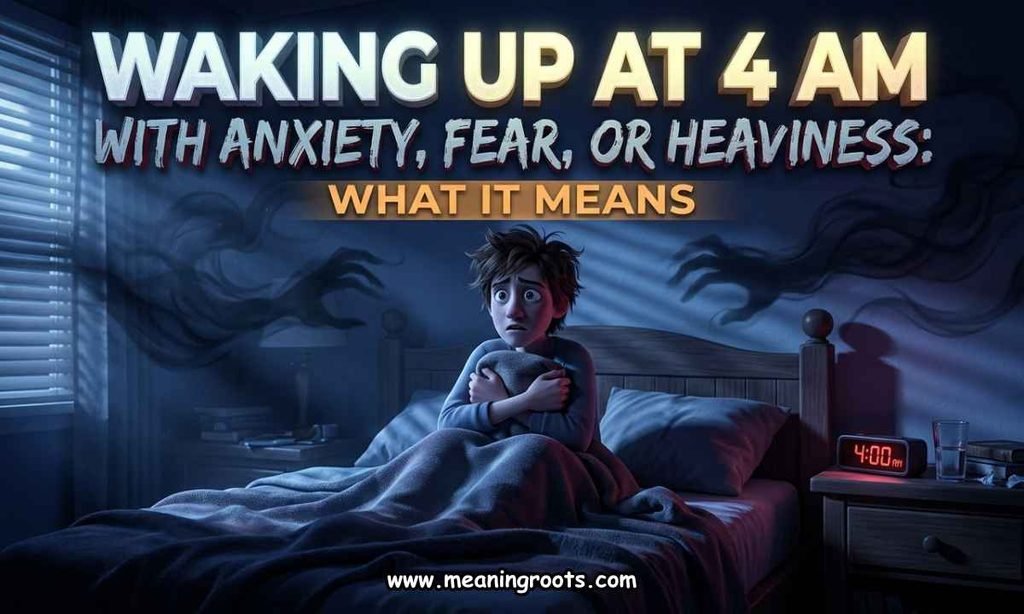
This is probably the most common version of the problem, and people searching for it often aren’t hoping for mystical answers. They want the dread to stop.
Waking with a pounding heart, a sense of doom, or a mind already cycling through worries is most often linked to stress and an overactive stress response. Cortisol rises toward morning, and in an anxious person that can tip into alertness before you’ve had a chance to feel rested. With no distractions around, the mind also tends to catastrophize, and problems feel bigger at 4 AM than they do at noon.
Spiritually minded people sometimes read this heaviness as a spiritual attack or negative energy. That’s a belief some hold sincerely, and prayer or protective rituals bring them real comfort. But it’s wise not to rule out the simpler explanation, because anxiety and depression are common, treatable, and nothing to be ashamed of. If it’s happening regularly, the two approaches can work together: spiritual practice for comfort, and professional support for the underlying cause.
A useful test: notice whether the feeling softens when you slow your breathing and pray or meditate, or whether it escalates. Either answer is informative.
Waking Up at 4 AM Every Night: Is It a Message or a Pattern?
One-off wake-ups are ordinary. Almost everyone has the occasional bad night. But when it happens most nights for weeks, it’s better described as a pattern than as a message.
A few things can help you tell the difference:
- Timing: Is it always the same time, or does it drift? Fixed timing often points to the body clock, alcohol, or stress. Random timing may suggest something different.
- State on waking: Calm and alert, or anxious and drained?
- Triggers: Have there been changes in work, health, relationships, medication, or routines?
- Daytime effects: Are you exhausted, irritable, or unable to concentrate?
A message, if you want to call it that, usually has content: a thought, a feeling, a decision that keeps returning. A pattern is more about the waking itself. Many people find it’s both. A stressful stretch of life triggers the early waking, and the quiet hour is where the stress finally gets heard.
If it has gone on for weeks, it’s reasonable to treat it as a sleep issue first and a spiritual question second.
4:00 vs. 4:04 vs. 4:44 AM: Do the Exact Minutes Matter?
In angel number and numerology circles, repeating digits are given special meaning. 4:44 is popularly seen as a sign of stability, protection, and being supported, with “444” often interpreted as a reassurance that you’re on the right path. 4:04 is sometimes read as a call to look at your foundations. 4:00 is seen as a clean threshold.
These interpretations are modern spiritual folklore. They aren’t from any major scripture, and there’s no scientific evidence that exact minutes carry information. People do find them comforting, and if a 4:44 wake-up leaves you feeling supported, there’s no harm in that.
Practically, though, the exact minute matters far less than the pattern. Waking within a half-hour window most nights tells you something about your sleep rhythm. Whether the clock said 4:04 or 4:14 tells you very little.
How to Tell If Your 4 AM Wake-Ups Are Spiritual or Medical
You don’t have to choose one explanation, but some signs lean toward a medical cause worth checking:
More likely to need medical attention:
- Loud snoring, gasping, or morning headaches, which can point to sleep apnea
- Waking with a racing heart, night sweats, or hot flashes
- Early waking along with persistent low mood, loss of interest, or hopelessness
- Waking in pain, with reflux, or needing the toilet repeatedly
- Heavy daytime sleepiness despite spending enough hours in bed
- New medications or substances that coincide with the change
More consistent with a reflective or spiritual experience:
- You wake calm and alert instead of distressed
- You can fall back asleep, or you feel fine afterward
- Specific thoughts, images, or a sense of presence accompany the waking
- The pattern comes during a period of meaningful personal change
The honest answer is that this isn’t a sharp line, and you can’t determine it yourself with certainty. If the wake-ups affect your daytime life, get them checked. That doesn’t close the door on a spiritual reading.
Also Read This: Spider Lily Spiritual Meaning: Seeing One, Death, Farewell and Rebirth Explained
What to Do When You Wake Up at 4 AM: A Simple Spiritual Practice
You don’t need an elaborate ritual. This takes about ten minutes and can be adapted to any belief or none.
- Don’t reach for your phone. Screens and the news add stimulation and rarely help.
- Notice before you react. Say to yourself, quietly, “I’m awake.” Skip the “why.”
- Breathe slowly. Try breathing in for four counts and out for six, for a minute or two. Longer exhales help settle the body.
- Check in. Ask yourself what, if anything, is on your mind. Let it be named without fixing it.
- Offer it up. Pray, set an intention, or simply hold the concern in your awareness and tell yourself it can wait until morning.
- Rest, even if you don’t sleep. Lying quietly with your eyes closed is restorative in itself.
If thoughts keep arriving, keep a small notebook by the bed. Writing something down is often what lets the mind release it.
Journaling Prompts and Short Prayers for 4 AM Wake-Ups

Prompts to try, in dim light:
- What am I carrying that I haven’t admitted to myself?
- If this wake-up were a message, what would it be asking me to do?
- What is one thing I can set down until morning?
- What am I grateful for, even in the middle of this?
- Who comes to mind, and is there something I could say or do for them?
Short prayers or intentions (adapt to your own tradition):
- “I’m here. I’m listening. Help me see what I need to see.”
- “I place this worry in your hands until morning.”
- “Give me rest, or give me peace in being awake.”
- “Thank you for this quiet. Show me what matters.”
A non-religious version works too: “Whatever this is, it can wait. I’m safe for now.”
How to Fall Back Asleep (or Use the Time Well) After Waking at 4 AM
If you want to go back to sleep:
- Keep the room cool, dark, and quiet
- Avoid checking the time, which can build pressure to “catch up”
- Try a body scan, moving attention slowly from your feet upward
- Use slow breathing or a gentle, repetitive prayer
- If you’ve been awake for roughly twenty minutes and feel wired, get up, sit somewhere dim, and read something calm until you feel sleepy again
To reduce how often it happens:
- Keep a consistent sleep and wake time
- Limit caffeine after midday
- Reduce alcohol, especially in the evening
- Get daylight exposure in the morning
- Wind down without screens for an hour before bed
If you decide to use the time: some people embrace the quiet by meditating, journaling, or reading, then adjust their bedtime earlier to stay rested. That works well for a few, but it isn’t a good habit if it leaves you chronically short on sleep.
When to Talk to a Doctor or Mental Health Professional
Please reach out to a professional if:
- It has continued for more than a few weeks
- You’re consistently exhausted or struggling to function during the day
- You snore loudly or stop breathing during sleep, or someone has noticed this
- You feel persistent sadness, hopelessness, or panic
- You’re relying on alcohol or sleep aids to cope
- You’re experiencing hot flashes, night sweats, or other hormonal symptoms
If you’re having thoughts of harming yourself, please contact a crisis line or emergency services right away. In the US you can call or text 988. If you’re elsewhere, local emergency numbers or a trusted person can help right away.
Seeking help doesn’t undermine a spiritual reading of your experience. Many faith leaders actively encourage it.
Frequently Asked Questions
Is waking up at 4 AM a sign from God?
Some believers experience it that way, and the Bible does connect early rising with prayer. There’s no teaching that it’s a guaranteed sign, so discernment and, where needed, medical advice both have a place.
Does waking at 4 AM mean I’m having a spiritual awakening?
Not necessarily. It can accompany one, but stress, hormones, and lifestyle are just as likely causes.
Why do I wake up at 4 AM and can’t fall back asleep?
Lighter sleep and rising cortisol in the early morning make it harder to drift off again, especially when you’re anxious. Slow breathing, a dark room, and not watching the clock often help.
Is it bad to wake up at 4 AM every night?
It isn’t harmful in itself, but if it leaves you tired or low during the day, it’s worth speaking to a doctor.
Do angel numbers like 444 really mean anything?
They’re a modern spiritual belief without scientific support. Many people find them comforting, which is a valid reason to hold them lightly.
Conclusion
Maybe the most useful way to approach the spiritual meaning of waking up at 4 AM is to stop asking what does it mean and start asking what am I willing to notice.
Sometimes the answer is rest: a body asking for a steadier routine, a break from alcohol, or care for a stress it’s been quietly carrying. Sometimes it’s something quieter and harder to name, a prompt toward prayer, honesty, or change. Often it’s a mix of both, and that’s fine.
You don’t need to settle the question tonight. Try the small practice, write down what comes up, and look at it again in daylight. If the pattern continues, treat it with the same care you’d give any other part of your health. Whatever 4 AM turns out to be for you, it doesn’t have to be a message to be worth listening to.
Also Read This: 7 Spiritual Meanings of Waking Up at 3AM (2026 Guide)

Daniel Mercer is a researcher and writer with over 4 years of experience specializing in comparative mythology, spiritual symbolism, dream interpretation, and traditional cultural folklore. By studying Vedic texts (Saamudrik Shastra), Jungian dream archetypes, and cross-cultural omens, he breaks down the hidden meanings behind everyday signs, animal encounters, and bodily sensations into clear, grounded insights for MeaningRoots.
1 thought on “Spiritual Meaning of Waking Up at 4 AM: 9 Signs, Causes & What to Do”