
A black cat crossing your path is bad luck in some cultures and good luck in others; spiritually, it is usually read as a prompt to pause and pay attention. Most people don’t go looking for this question. It finds them. You’re walking to the bus stop, a small dark shape slips out from under a parked car, and for half a second you feel something odd. Then comes the Google search.
That half-second is worth understanding, because the answer depends on where you grew up, which direction the cat was heading, and what you were already worried about. Here’s what a black cat crossing your path can mean, where the belief came from, and what’s reasonable to do about it.
Related: The Ultimate Guide to Animal & Insect Spiritual Meanings (Signs & Omens)
What Does It Mean When a Black Cat Crosses Your Path?
The Short Spiritual Answer
In most modern spiritual readings, a black cat crossing your path is a moment of heightened awareness rather than a verdict. Cats move quietly and deliberately, and they seem to appear from nowhere. People who read signs in everyday life tend to treat that as a nudge to slow down, notice what’s going on around them, and listen to their intuition.
Spiritual traditions don’t treat it as a prediction of disaster. It’s closer to a tap on the shoulder.
Why the Meanings Conflict?
Ask ten people and you’ll hear “terrible luck,” “wonderful luck,” and “it’s just a cat.” They aren’t all wrong, because they’re drawing on different histories.
In some places the black cat inherited a reputation from medieval fears about witchcraft. In others it never picked up that baggage and was linked with prosperity, protection, or a lucky arrival. A superstition is a piece of local memory, and local memories differ.
Does the Direction the Cat Walks Matter?
Left to Right vs. Right to Left: What the Traditions Say
Direction is where folklore gets contradictory. Some versions say a cat crossing left to right is the unlucky one, and others say the opposite. Even sources that agree on the general idea often disagree on which direction is which, and the rule shifts from region to region and family to family.
Some folk versions say a cat moving toward you brings fortune, while one moving away takes it with it. Others hold that a cat walking directly in front of you is worse than one cutting across at a distance.
Is Direction Real or Just Folklore?
It’s folklore. No tradition handed down a single, consistent rule on direction, which is a good sign that the detail was added over time as people tried to make an omen feel precise.
If you want to use direction as a personal symbol, treat it as a reflective tool rather than a prediction: a cat moving toward you can prompt you to ask what’s approaching in your life, and a cat moving away can prompt you to ask what you’re leaving behind. That’s interpretation, and it works for what it is.
Black Cat Crossing Meaning Around the World

South Asia (India & Pakistan): The “Rasta Kaatna” Superstition
In India and Pakistan, the idea of a cat “cutting the road” (rasta kaatna) is a familiar household belief. The usual advice is to pause before continuing, or to wait until someone else has passed first so they take on the ill luck instead. Some people turn back a few steps or take a different route.
The belief is often applied to cats generally, with black cats treated as the strongest version. In practice it’s more a habit of caution than serious dread. Plenty of people mention it with a smile and then do it anyway.
Japan and East Asia: A Sign of Good Luck
Black cats are often seen more kindly in Japan. Folk belief associates them with warding off evil, and they’re sometimes linked to good fortune, including (in popular tradition) attracting admirers. Cat imagery as a whole, such as the beckoning maneki-neko, is tied to luck and welcome.
Beliefs vary across East Asia, so it’s safer to say black cats are often viewed positively there than to claim a single rule.
Scotland and the UK: Prosperity and Omens
In Britain the tradition leans the other way from the American one. A black cat appearing at your door is widely cited as a sign of good fortune in Scottish folklore, and a cat crossing your path is commonly treated as lucky in the UK. Sailors’ families are also said to have kept black cats in the hope that they would bring ships home safely.
Britain isn’t uniform, though, and you’ll still meet people there who cross their fingers when a black cat passes.
Germany and Western Europe: Bad Luck Beliefs
In Germany and parts of Western Europe, a black cat crossing your path has long been regarded as an omen of misfortune, and this is the version that reached North America. Even within these regions the direction rule is inconsistent, as noted above.
African Beliefs: Conflict and Broken Relationships
Africa is an enormous continent with thousands of communities, so no single belief covers it. In some local traditions, a black cat crossing your path is read as a sign of conflict, strained relationships, or a quarrel to come. In others it carries little weight.
This is an area where honesty matters more than a tidy summary. If you’re researching a specific community, speak to people from it or look for ethnographic sources rather than relying on broad generalizations.
Where Did the Superstition Come From? (Witches and Medieval Europe)
The bad-luck belief is usually traced to medieval Europe, where cats, particularly black ones, became tangled up with fears of witchcraft and the devil. A papal document from 1233, Vox in Rama, is often cited as part of that association, because it describes a black cat in an alleged heretical ritual. Historians debate how much it shaped popular belief afterward.
The idea that witches could turn into black cats, or keep them as familiars, took hold in folklore. Cats are nocturnal and secretive, and anything that moves unseen at night tends to attract suspicion.
It’s worth noting that cats weren’t always feared. Cats of all colors were honored in ancient Egypt, where the goddess Bastet was associated with them. The dark reputation was a later layer.
Spiritual Interpretations: What Might the Black Cat Be Telling You?

These are interpretations, not facts. They’re ways people give a moment meaning, and whether they resonate is up to you.
A Nudge to Slow Down and Trust Your Intuition
The most common modern reading is quiet: a black cat shows up when you’re rushing or ignoring a gut feeling. Black is often tied to the unseen and the subconscious in spiritual symbolism, so the cat becomes a reminder to listen inward. If you were already doubting something, the sighting can feel like a prompt to look at it properly.
A Sign of Change or Transition
Because cats cross thresholds (doorways, roads, walls) so easily, some people read a crossing as a marker of change. That might be the end of one phase of life and the start of another, or just a feeling that things are about to move. It’s not a warning so much as a boundary being crossed.
A Symbol of Protection
In traditions where black cats are lucky, the animal is a guardian rather than a threat. Seen this way, a crossing means you’re being watched over, or that you can carry on with confidence.
Black Cat as a Spirit Animal Message
In spirit-animal language, the cat usually stands for independence, mystery, and self-trust. A black cat adds depth, secrecy, and the pull of what hasn’t been said out loud. If one keeps appearing, the “message” is often about boundaries or about not being afraid to move on your own terms.
What It Means in Different Situations?
Before an Interview or Big Decision
Nerves make signs louder. Before an interview, a black cat can feel like a bad omen if you’re already anxious, or an encouraging one if you’re hopeful. A practical take is to treat the sighting as a cue to breathe, check your preparation, and enter the room steady. The cat has no say in the result. Your preparation does.
While Driving or Walking at Night (Plus a Quick Safety Note)
Here the real issue isn’t luck. A dark animal on a dark road is hard to see, and the biggest danger is a sudden swerve. If a cat runs across the road, brake smoothly and stay in your lane rather than swerving, which can cause a worse accident than hitting the animal would. On foot, slow down and watch for traffic, because cats move unpredictably.
When It Happens Repeatedly or Three Times in a Row
People often read repetition as a stronger message, and “three times” gets an extra charge in folklore. The psychology section below explains why it feels that way. Spiritually, repeated sightings are usually taken as an invitation to reflect on what’s been on your mind. If you’re anxious about it, that’s useful information about your state of mind, not about your future.
When a Black Cat Visits Your Home or Doorstep
In Scottish and British folklore, a black cat arriving at your door is a sign of good fortune, and some people take it as a welcome omen of prosperity. Practically, it’s also worth checking whether the cat is a stray, lost, or someone’s pet. If it looks unwell or wears a collar, contacting a local shelter or vet is the kind thing to do, whatever you believe about omens.
The Psychology Behind Repeated Sightings
Frequency Illusion (Noticing Bias) and Meaning-Making
Once something is on your mind, your brain tunes in to it. This is the frequency illusion, sometimes called the Baader-Meinhof phenomenon. You didn’t suddenly get more black cats. You started noticing them.
Humans are also pattern-seeking by nature. We connect events into stories, especially during stress or uncertainty. A sighting that lines up with a worry feels significant, while the dozens you’ve forgotten feel like nothing. That’s confirmation bias at work.
Why Black Cats Are Easy to Notice?
A black silhouette stands out against pavement, snow, and pale walls, and cats move quickly and quietly, so the appearance feels sudden. Add the cultural weight of the superstition, and a black cat registers more strongly than a tabby ever would. Part of “why do I keep seeing them” is simply that they’re built to be noticed.
What to Do When a Black Cat Crosses Your Path?
A Simple Pause-and-Reflect Ritual
If you’d like to use the moment rather than fear it, try this:
- Stop for a few seconds. Take one slow breath.
- Ask yourself what’s on your mind. The answer is often the real “message.”
- Name one thing you’ve been avoiding or rushing.
- Carry on, with a small intention, such as “go carefully” or “decide calmly.”
It takes less than a minute and turns an uneasy feeling into something useful.
Traditional Ways to “Reverse” Bad Luck
Folk remedies vary by region. Commonly mentioned ones include:
- Waiting for someone else to cross the spot first
- Walking a few steps backward or turning back before continuing
- Crossing your fingers
- Taking a different route
None of these has any proven effect. They’re customs that give people a sense of control, and in that sense they do something: they help you stop worrying.
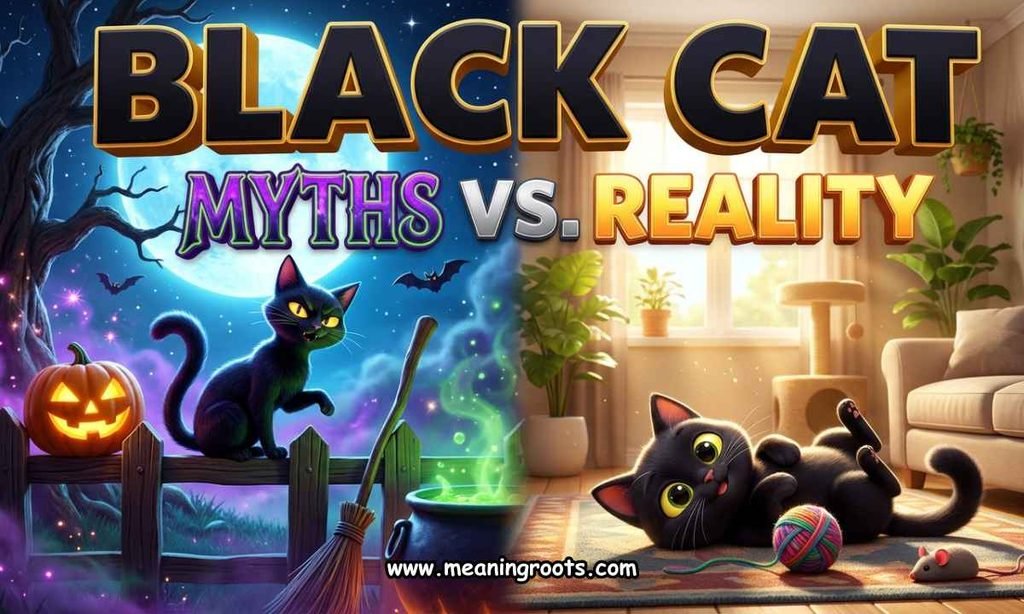
Black Cat Myths vs. Reality
Do Black Cats Really Bring Bad Luck?
There is no evidence that a black cat’s color affects your fortune. Coat color is genetic, and it doesn’t carry information about the future. The superstition reflects human history and psychology, and it says nothing about the animal.
Black Cats and Adoption: What You Should Know
Some shelters and rescue groups report that black cats can take longer to be adopted, a pattern often called “black cat syndrome.” The evidence isn’t uniform, and some of the popular claims about Halloween (for example, widespread harm to black cats) are hard to verify, so treat sweeping statistics with caution.
What’s clear is that black cats are as affectionate, playful, and individual as any other cat. If you’re thinking about adopting, meet the cat rather than judging the coat. Awareness days such as International Cat Day and various national black cat appreciation days exist partly to challenge the stereotype.
Frequently Asked Questions
What does a black cat crossing your path in a dream mean?
Dream interpretation is subjective. It’s often read as intuition, a hidden worry, or a change coming. It isn’t a prediction.
Does it matter which direction the black cat walks?
Only in folklore, and the rules contradict each other from one source to the next. There’s no reliable meaning attached to direction.
What should you do if a black cat crosses your path?
Pause, take a breath, and carry on. If you’re driving, brake smoothly and don’t swerve.
What does it mean if black cats keep crossing your path?
Most often it’s the frequency illusion: once you’re noticing them, you see them everywhere. Spiritually, it’s read as a call to reflect on what’s occupying your mind.
What does it mean when a black cat visits your house?
In British and Scottish folklore it’s a sign of good fortune. Practically, check whether the cat is lost, a stray, or needs help.
Is a black cat crossing your path really just a superstition?
Yes. It’s a cultural belief with no evidence behind it, though it can still work as a prompt for reflection.
Conclusion
A black cat crossing your path says more about the person watching than about the cat. In one country it’s a blessing, in another a bad omen, and in many households it’s a shrug and a smile. The most useful way to take the moment is the simplest: stop, notice how you feel, and decide whether there’s something you’ve been rushing past.
And if the cat sticks around? Say hello. It might just need a home.
Continue reading: The Ultimate Guide to Animal & Insect Spiritual Meanings (Signs & Omens)

Daniel Mercer is a researcher and writer with over 4 years of experience specializing in comparative mythology, spiritual symbolism, dream interpretation, and traditional cultural folklore. By studying Vedic texts (Saamudrik Shastra), Jungian dream archetypes, and cross-cultural omens, he breaks down the hidden meanings behind everyday signs, animal encounters, and bodily sensations into clear, grounded insights for MeaningRoots.
1 thought on “Black Cat Crossing Your Path: Spiritual Meaning, Good or Bad Luck? (Updated 2026)”