
Have you ever felt a sudden twitch in your chin and wondered if it means something beyond the physical? You’re not alone. Across cultures and centuries, chin twitching has been linked to spiritual signals, omens, and hidden messages from the universe.
Whether it happens on your left side or right side, for females or males each twitch carries a unique superstition behind it. In this guide, we explore the spiritual meanings of chin twitching, what different traditions believe, and what you should do when it happens to you.
Also Read This: Shoulder Twitching Superstition & Spiritual Meaning (Right & Left)
What Does Chin Twitching Mean Spiritually?
Spiritually, chin twitching is widely interpreted as a form of communication a message delivered not through words, but through the body itself. The chin is associated with self-expression, personal truth, and the strength to face life’s challenges head-on. When this area of the face twitches involuntarily, many spiritual traditions see it as a nudge from a higher power, a spirit guide, or the universe trying to get your attention.
The spiritual meaning depends on several factors: which side of the chin twitches, your gender, the frequency of the twitching, and what’s currently happening in your life. A right-side twitch is almost universally considered a positive omen a signal of good things approaching. A left-side twitch tends to carry more cautionary energy, urging you to slow down, reflect, or prepare for challenges.
9 Spiritual Meanings of Chin Twitching
1. Good Fortune Is on Its Way
One of the most widely held beliefs about chin twitching is that it signals incoming good luck. This interpretation is especially strong when the right side of the chin twitches. In Eastern traditions rooted in Samudrika Shastra the ancient Indian science of bodily signs the right side of the body channels positive, active energy, often linked to prosperity, success, and forward movement.
This doesn’t always mean a lottery win or a sudden windfall. Good fortune can arrive as a new opportunity at work, an unexpected reconnection with a loved one, or simply a period of ease after a difficult stretch. If your chin has been twitching on the right side lately, many spiritual traditions would say: stay open, stay optimistic, and get ready to receive.
2. Impending Challenges Ahead
Not every chin twitch carries a rosy message. In some traditions, particularly when the left side is involved, a twitching chin signals that you may be approaching a rough patch. This could relate to your relationships, your finances, your career, or your emotional well-being.
It’s important to understand that this isn’t a doom prophecy it’s a preparation signal. Think of it as your spiritual radar picking up on turbulence before the plane hits it. The universe, in this interpretation, isn’t delivering bad news; it’s giving you a heads-up so you can ground yourself, make wise decisions, and navigate the coming storm with more grace than if you’d been caught off guard.
3. Heightened Intuition
The chin is not far from the throat chakra the energy center governing communication, truth, and authentic expression. Many spiritual practitioners believe that chin twitching occurs when your intuitive abilities are being activated or amplified. Your gut feelings are getting louder. Your inner voice is trying to rise above the noise.
If you’ve been second-guessing yourself, struggling to make a decision, or feeling disconnected from your inner compass, a twitching chin may be your body’s way of saying: trust yourself. Your intuition is not broken it’s actually sharpening right now. Pay attention to the gut feelings and quiet nudges you’ve been dismissing.
4. Spiritual Awakening
In many metaphysical and spiritual belief systems, involuntary physical sensations tingles, twitches, sudden warmth are associated with moments of spiritual awakening or growth. When your chin twitches, it may signal that you’re entering a new phase of your soul’s evolution. Old patterns are breaking down. New awareness is rising.
This can feel disorienting from the outside, because spiritual awakenings often coincide with periods of uncertainty or change. But from a higher perspective, they’re deeply positive. You’re not falling apart you’re being rearranged. The twitching serves as a physical marker of this inner transformation, a tangible reminder that something profound is shifting within you.
5. Divine Messages
Across Hindu, African, and Indigenous traditions, the body is seen as a vessel through which the divine communicates. A twitching chin, in this context, carries the weight of a message from spirit guides, ancestors, or a higher power. The message itself is rarely spelled out that’s where personal reflection and meditation come in.
If you believe in spirit guides or divine guidance, a chin twitch might be an invitation to sit in stillness, pray, journal, or meditate. Ask what needs to be heard. The answer may not come immediately, but the twitching itself is confirmation that the channel of communication is open and active. You are not alone in whatever you’re navigating.
6. Emotional Sensitivity
The chin area, close to the jaw and throat, is deeply connected to suppressed emotions. Many people unconsciously clench their jaw when they’re stressed, hold tension in the lower face when they’re grieving, or tighten the chin area when they’re holding back words they need to say. A twitching chin can be your body’s signal that your emotional reservoir is full something needs to come out.
This could mean a conversation you’ve been avoiding, a grief you haven’t fully processed, or a creative feeling looking for an outlet. Spiritually, this twitch is a compassionate reminder: your feelings matter. Don’t swallow them. Find a healthy way to express, release, and honour what you’re carrying.
7. Karmic Lessons
Some spiritual frameworks, particularly those rooted in Hindu and Buddhist philosophy, connect involuntary bodily movements to karma the spiritual law of cause and effect. A twitching chin, from this perspective, may indicate that a karmic cycle is completing itself or that a lesson from a past experience is rising up for resolution.
This doesn’t mean something negative is coming as punishment. Karmic lessons are actually opportunities for growth, clarity, and soul advancement. The twitch is a gentle tap on the shoulder from the universe saying: something important is being processed at a deeper level. Stay mindful. Act with integrity. Be honest with yourself about patterns in your life that may need to change.
8. Protection from Harm
In certain West African and Caribbean spiritual traditions, a twitch anywhere on the body can be interpreted as a protective warning your spiritual guardians alerting you to unseen danger before it materializes. For the chin specifically, this protection is often linked to your voice and your truth. Someone may be speaking unkindly about you, or there may be a situation where your integrity or reputation is at risk.
Rather than fear, the right response to this kind of twitch is awareness and discernment. Be mindful of who you share sensitive information with. Trust your instincts about the people around you. And take comfort in the belief that your guardians are watching over you the warning itself is evidence of their protection.
9. Repressed Creativity
This interpretation is particularly interesting because it bridges the spiritual and the psychological. The chin and jaw area are deeply connected to expression, and many creative people experience physical tension or twitching in this area when they’ve been suppressing their creative voice for too long. Painters who haven’t painted, writers who haven’t written, musicians who’ve stopped playing all know the frustration that builds when creativity is bottled up.
Spiritually, a twitching chin may be your soul’s way of saying: create something. The energy inside you needs an outlet. Don’t wait until conditions are perfect or until you feel worthy enough. Pick up the brush, open the journal, press the keys. Your creative spirit is knocking.
Also Read This: Spiritual Meaning of Mole on Forehead for Females & Males Revealed
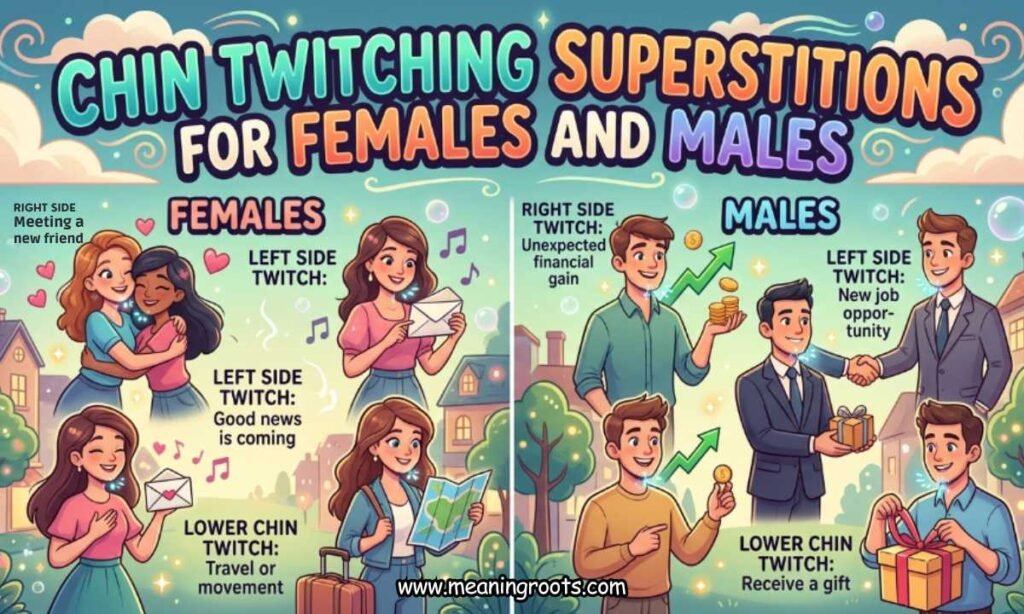
Chin Twitching Superstitions for Females and Males
Superstitions for Females
Across many cultural traditions, chin twitching in women is linked to emotions, relationships, and intuitive sensitivity. Here are the most commonly held superstitions:
- Romantic news is coming: A twitching chin in females is widely seen as a positive omen for love life a sign that romantic opportunities, a new connection, or deeper commitment may be approaching.
- Someone is talking about you: In several Asian and African traditions, a twitching chin for women means gossip is circulating particularly about personal or romantic matters. Some say this gossip is unkind; others believe it’s simply attention.
- Unexpected visitors: Some folk traditions interpret female chin twitching as a sign that surprise guests will arrive soon. The advice? Keep your home and heart open.
- Financial abundance: Certain superstitions tie a woman’s chin twitch to incoming financial blessings prosperity coming through unexpected channels or a breakthrough in material stability.
- Creative awakening: A twitching chin nudges women toward their unexplored creative potential a reminder that an artistic or expressive pursuit has been neglected and is calling for attention.
Superstitions for Males
For men, chin twitching superstitions tend to center around themes of leadership, reputation, and external challenge:
- Test of character approaching: Many folk beliefs suggest that a man’s twitching chin signals an upcoming situation that will test his courage, integrity, or decision-making ability.
- Career advancement: A chin twitch is seen in some traditions as a positive sign of progress in professional life recognition, promotion, or a new opportunity may be imminent.
- Strength and resilience: The twitching is sometimes interpreted as a physical confirmation of inner fortitude the body acknowledging that the person has the strength to face what’s coming.
- Rivalry or competition: Some male-specific superstitions warn of a jealous rival or competitor entering the picture, urging the person to stay focused and not be distracted by others’ envy.
Superstitions of Right Side Chin Twitching Vs. Left Side Chin Twitching
| Feature | Right Side Chin Twitching | Left Side Chin Twitching |
| General energy | Positive, active | Cautionary, reflective |
| Common interpretation | Good fortune, success | Challenges, emotional tension |
| Relationship meaning | New love, harmony | Conflict, gossip, misunderstanding |
| Financial meaning | Relief from money stress, gains | Financial caution, potential loss |
| Spiritual meaning | Blessings, divine favour | Karmic lesson, inner healing needed |
| Best response | Stay open, receive with gratitude | Reflect, protect energy, prepare |
Right Side Chin Twitching
The right side has long been associated with positive, outward energy across Eastern and Western traditions alike. A twitch on the right side of the chin is commonly linked to relief from financial troubles and the arrival of good fortune and prosperity. Beyond finances, it’s seen as a sign of success in interpersonal matters new relationships forming, wishes being granted, or a period of harmony and alignment approaching in your life.
In Samudrika Shastra, the ancient Indian science of reading bodily signs, the right side of the body is governed by solar energy which is warm, expansive, and life-giving. A right chin twitch is therefore read as solar confirmation: the universe is saying yes to you right now.
Left Side Chin Twitching
The left side of the body is associated with lunar, receptive, and inward energy. A left chin twitch doesn’t necessarily mean disaster but it does invite deeper attention. It may signal unresolved emotional tension, a relationship that needs honest communication, or a situation where someone around you may not be entirely trustworthy.
In African spiritual traditions, a left chin twitch sometimes warns that someone in your social circle is speaking negatively about you. In some Chinese folklore, it indicates upcoming difficulties in relationships. The wisest response isn’t panic it’s groundedness. Protect your energy, speak your truth carefully, and trust your gut about the people in your environment.
Cultural and Spiritual Beliefs Around the World
Chin twitching has captured the imagination of cultures across every continent. Here’s a look at how different traditions interpret this phenomenon:
Hindu/Indian (Samudrika Shastra): This ancient Vedic system interprets every bodily twitch as a planetary signal. The chin is associated with Venus and Saturn planets governing relationships, karma, and discipline. Right-side twitches are auspicious; left-side twitches call for caution and self-reflection.
Chinese Culture: In traditional Chinese belief, the body’s left and right sides carry different energies for men and women what’s positive for one may be cautionary for the other, depending on gender. A twitching chin in Chinese folk tradition is often linked to incoming communication either a visit from someone, or news that will require your attention.
African Traditions: Many West African spiritual systems view bodily twitches as messages from ancestral spirits or protective guardians. A chin twitch, close to the mouth and voice, often relates to truth, communication, and who is speaking about you in your absence.
Native American Beliefs: Some Indigenous traditions interpret physical sensations including twitches as signals from the natural world or the spirit realm. A chin twitch may indicate that an important message or visitor is approaching, and it calls for a state of heightened receptivity and calm.
Greek and Mediterranean Folklore: Ancient Greek and Roman traditions linked facial movements to omens and divine communication. The chin specifically, as a sign of determination and will, was associated with challenges to one’s strength either a coming trial or a confirmation of inner power.
Scientific Causes of Chin Twitching
Before diving deeper into spiritual interpretations, it’s essential to understand that chin twitching very often has entirely physical, medically explainable causes. Knowing the difference can help you respond appropriately whether that means a lifestyle change, a visit to the doctor, or simply reassurance that you’re fine.
Common scientific causes of chin twitching include muscle fatigue, stress, caffeine intake, and nerve irritation. Dehydration can also lead to muscle twitches and spasms, as inadequate hydration depletes electrolytes necessary for healthy muscle activity.
Here are the most common medical explanations:
Stress and Anxiety: Psychological tension is one of the most frequent culprits. When you’re anxious or under prolonged stress, your nervous system becomes hypersensitive, and facial muscles particularly around the lower face and jaw can begin to twitch involuntarily.
Caffeine Overconsumption: Too much caffeine overstimulates the nervous system, causing muscles throughout the body, including facial muscles, to fire without conscious instruction.
Fatigue and Sleep Deprivation: When you’re exhausted, your body’s ability to regulate neuromuscular activity decreases. This is why facial twitches often appear during or after periods of poor sleep.
Electrolyte Imbalances: Low levels of magnesium, potassium, calcium, or sodium can disrupt nerve-to-muscle signaling, causing involuntary contractions anywhere in the body, including the chin.
Hemifacial Spasm (HFS): HFS is a neurological condition in which frequent involuntary muscle twitches occur on one side of the face. The main cause is chronic irritation of the facial nerve the seventh cranial nerve which branches out across the face to the temple, cheek, nose, mouth, chin, and upper neck.
Bell’s Palsy: This condition involves sudden weakness or paralysis of the facial muscles on one side, sometimes preceded by involuntary twitching or spasms.
Tourette Syndrome and Other Tic Disorders: Repetitive, involuntary movements of the face including the chin area are associated with several tic disorders.
Also Read This: Thigh Twitching Superstition & Spiritual Meaning (Right, Left)
What Deficiency Causes Chin Twitching?

Nutritional deficiencies are a surprisingly common and often overlooked cause of facial twitching. Vitamin B12 deficiency has been associated with facial muscle spasms. This vitamin plays an important role in the nervous system, and low levels can cause nerve damage and muscle spasms.
Here are the key deficiencies to be aware of:
| Deficiency | How It Causes Twitching |
| Magnesium | Disrupts nerve signaling, leading to misfiring of muscle fibers |
| Potassium | Impairs nerve signal transmission and muscle relaxation |
| Calcium | Essential for proper muscle contraction; deficiency causes spasms |
| Vitamin B12 | Supports nerve health; low levels lead to nerve damage and involuntary movements |
| Vitamin D | Supports neuromuscular function; deficiency can contribute to muscle cramps and spasms |
If your chin has been twitching frequently and you can’t pinpoint a clear lifestyle cause, it’s worth having a blood panel done to check these key levels. Many people are surprised to discover that a simple dietary adjustment or supplement can eliminate the twitching entirely.
How to Stop Chin Twitching?
Whether your chin twitching is spiritual, stress-related, or nutritional in origin, there are practical steps you can take to reduce or eliminate it:
Lifestyle and Natural Approaches:
- Reduce caffeine intake: Cut back on coffee, energy drinks, and tea, especially in the afternoon and evening.
- Prioritize sleep: Aim for 7–9 hours of quality sleep per night. Fatigue is one of the most common triggers.
- Stay hydrated: Drink adequate water throughout the day to maintain healthy electrolyte balance.
- Manage stress: Practices like meditation, deep breathing, yoga, or even regular walks in nature can dramatically reduce the nervous system’s hypersensitivity.
- Magnesium supplementation: Magnesium glycinate or magnesium citrate is well-tolerated and helps regulate neuromuscular function. Always check with a healthcare provider first.
- Limit alcohol: Alcohol dehydrates the body and disrupts sleep quality, both of which can worsen twitching.
When to See a Doctor: If a facial twitch persists, gradually increases in frequency or intensity, and occurs on only one side of the face, it could indicate hemifacial spasm a condition that will not improve on its own and requires a neurologist’s evaluation.
Seek medical attention if:
- The twitching has lasted more than a few weeks
- It’s getting progressively worse
- It’s accompanied by facial weakness, numbness, or difficulty speaking
- Other parts of your face are also beginning to twitch
Medical Treatments Available:
- Botulinum toxin (Botox) injections: Botox has become a first-choice treatment among clinicians due to its efficacy and minimal side effects, achieving notable symptomatic improvements in 85% to 95% of patients in various clinical trials.
- Oral medications: Muscle relaxants or anticonvulsants may be prescribed for mild to moderate cases.
- Microvascular decompression surgery: For severe or persistent hemifacial spasm caused by nerve compression, this surgical procedure can provide long-term relief.
Chin Twitching Meaning: Usage Guide
Use this guide to correctly interpret your chin twitching experience:
- Step 1: Note the Side: Was it your left chin or right chin? Each side carries a different spiritual meaning.
- Step 2: Note Your Gender: Male and female superstitions differ across cultures check the relevant section above.
- Step 3: Check the Timing: Did it happen during a conversation, a decision moment, or randomly? Timing adds context.
- Step 4: Observe Frequency: A one-time twitch may be physical. Repeated twitching over days is considered spiritually significant.
- Step 5: Cross-Reference Culture: Different cultures interpret chin twitching differently Indian, African, and Chinese traditions all have unique meanings.
Common Mistakes When Interpreting Chin Twitching
- Ignoring the side: Many people miss that left vs. right chin twitching have completely opposite meanings spiritually.
- Confusing it with a medical condition: Not every twitch is spiritual; stress, caffeine, and magnesium deficiency are common causes.
- Applying male superstitions to females: Gender-based superstitions are different; always check the correct one.
- Overthinking a single twitch: One random twitch is usually physical. Spiritual significance builds with patterns and repetition.
- Ignoring cultural context: A meaning in Indian tradition may differ from an African or Chinese belief. Don’t mix them without context.
Real-Life Examples of Chin Twitching Superstitions
Example 1 — Job Interview Win: Sarah’s chin twitched on the right side the morning before her big job interview. She remembered the superstition that right-side twitching signals good fortune. She went in confident and got the job.
Example 2 — A Warning Ignored: Raj noticed left-side chin twitching for three days straight but dismissed it. Shortly after, he faced an unexpected financial setback something the superstition had warned about.
Example 3 — Spiritual Awakening Signal: A woman in her 40s reported chin twitching during her first meditation retreat. Her spiritual guide interpreted it as a sign of an opening third eye and heightened intuition.
Example 4 — Cultural Perspective: In certain West African traditions, an elder woman’s chin twitching before a family gathering is seen as an ancestral message a warning or a blessing depending on the side.
Is Chin Twitching a Good or Bad Sign?
The honest answer? It depends on the context both spiritual and physical.
Spiritually, right-side chin twitching is almost universally seen as a positive omen across cultures. It signals incoming blessings, good fortune, positive change, or divine confirmation that you’re on the right path. Left-side twitching tends to carry a more cautionary tone not necessarily bad, but a prompt to pay closer attention to your inner world, your relationships, or your current decisions.
Overall, most spiritual traditions agree that any twitch in the chin area is a sign of significance, not disaster. Even the cautionary interpretations are meant to be empowering they’re warnings given with love, invitations to reflect, not sentences of doom. The key is to meet the twitch with curiosity rather than fear.
From a medical standpoint, occasional chin twitching is almost always benign a temporary response to stress, fatigue, or lifestyle factors. However, persistent, progressing, or one-sided twitching warrants attention.
Quick Reference: Good or Bad?
| Scenario | Spiritual Reading | Medical Reading |
| Right chin twitch, brief | Good fortune sign | Usually benign |
| Left chin twitch, brief | Caution signal, self-reflection | Usually benign |
| Frequent right/left twitch | Active spiritual message | Check for deficiencies |
| Persistent, one-sided twitch | Karmic lesson or protection signal | See a neurologist |
| Accompanied by other symptoms | Strong spiritual alert | Medical evaluation needed |
What Should You Do When Your Chin Twitches?
Here’s a practical, balanced approach that honours both the spiritual and physical dimensions of this experience:
- Notice without panic. Take a breath. A chin twitch is rarely a medical emergency and rarely a catastrophic spiritual omen. Start from a place of calm.
- Check in with your body. Are you stressed? Sleep-deprived? Have you had too much caffeine? Often, the cause is simple and the solution is even simpler.
- Reflect spiritually. If you’re open to the spiritual dimensions, ask yourself: What is going on in my life right now? Which side is twitching? What major changes, decisions, or emotions are present? Let the twitch be an invitation to tune inward.
- Journal your experience. Write down when the twitch happens, what you were thinking or feeling at the time, and how long it lasts. Patterns often emerge that are illuminating.
- Take care of your nutritional basics. Make sure you’re getting enough magnesium, potassium, and B12. These three deficiencies account for a significant portion of unexplained twitching.
- Consult a doctor if needed. If the twitching persists beyond a few weeks or worsens, get a medical evaluation. Don’t let spiritual curiosity delay necessary medical care.
- Trust your gut. Whether you see the twitch as spiritual communication, a stress signal, or both your body is always trying to tell you something. Listen to it.
Related Words and Topics
| Term | Meaning |
|---|---|
| Body Twitching Superstition | General spiritual beliefs about body part twitching |
| Eye Twitching Meaning | Omens related to left or right eye twitching |
| Lip Twitching Superstition | Spiritual meaning of upper or lower lip twitching |
| Nose Twitching Meaning | Signs and superstitions around nose twitching |
| Ear Ringing Spiritual Meaning | What it means when your ears ring spiritually |
| Cheek Twitching Superstition | Beliefs about cheek muscle twitching |
| Body Signs from Universe | How the body communicates spiritual messages |
Frequently Asked Questions
Is chin twitching a good or bad spiritual sign?
Chin twitching can be both it depends on the side and your gender. Right-side twitching is generally positive, while left-side often signals a warning.
What does it mean when your chin twitches repeatedly?
Repeated chin twitching is spiritually considered more significant than a one-time occurrence. It may indicate a strong message from your spiritual guides or the universe.
Does chin twitching have different meanings for males and females?
Yes, many cultural superstitions assign different meanings based on gender. For females, it may relate to relationships or emotional signals, while for males it often points to career or financial changes.
Can chin twitching be caused by a vitamin deficiency?
Yes, magnesium and calcium deficiencies are among the most common physical causes of chin twitching. If twitching is frequent, consult a doctor to rule out any medical reasons.
Also Read This: Spiritual Meaning of Mole on Cheek for Females & Males Revealed
Conclusion
Chin twitching is more than just a random muscle spasm it carries deep spiritual meaning, cultural superstitions, and hidden messages that people across the world have believed in for centuries. Whether it signals good fortune, a warning, emotional sensitivity, or a spiritual awakening, the meaning often depends on the side, your gender, and your cultural background. Understanding these signs can help you become more aware of the energy and signals your body is trying to communicate.
If your chin keeps twitching, take a moment to reflect on what is happening in your life spiritually and physically. Rule out any medical causes like magnesium deficiency or stress, and then consider the deeper meaning behind it. Trust your intuition, stay open to the universe’s messages, and use this guide whenever you need clarity on chin twitching superstitions and spiritual meanings.

My name is Daniel.I am a passionate writer in the meaning niche with over 4 years of experience exploring life purpose and personal growth. I create thoughtful content that helps readers understand deeper meaning in everyday experiences.
1 thought on “Chin Twitching Superstition and Spiritual Meaning”