
If you’ve typed “Tristan meaning in Hebrew” into a search engine, you’ve probably landed on a mix of vague spiritual blogs and half-answers that leave you more confused than when you started. This guide does something different: it gives you the truth first, then takes you somewhere genuinely meaningful.
Here’s the honest headline Tristan is not a Hebrew name, and it does not appear in the Bible. That’s the factual starting point every serious resource agrees on.
But here’s what’s equally true: the themes woven into the name Tristan sorrow, tumult, warrior courage, passionate love, and transformation are among the most deeply explored themes in all of Hebrew Scripture. Once you understand where this name actually comes from, and how its meanings map onto biblical and spiritual vocabulary, the name carries extraordinary depth.
Whether you’re a parent considering the name, a believer exploring its spiritual weight, or simply someone curious about names and faith this guide covers it all. By the end, you won’t just know what Tristan means. You’ll know what it can mean when carried with intention and faith.
Does Tristan Have a Hebrew Meaning?
The short, clear answer is no Tristan does not have a direct meaning in the Hebrew language. There is no ancient Hebrew word from which it derives, no biblical character who bore the name, and no entry for “Tristan” in any Hebrew lexicon or Scripture concordance.
However, this answer deserves important context.
When people search for the Hebrew meaning of Tristan, they’re rarely asking a linguistic question. They’re asking a spiritual one: Does this name carry meaning that aligns with biblical values and faith? And to that question, the answer is a compelling yes as long as we’re honest about what we’re doing. We are exploring thematic connections, not linguistic origins.
Hebrew naming culture was rich and intentional. A name in the biblical world wasn’t just a label it was a declaration of identity, a reflection of character, or even a prophetic statement about destiny. When parents today seek Hebrew resonance in a name like Tristan, they’re tapping into that same spirit of intentional, faith-driven naming. That impulse is good and worth honoring but it should be grounded in truth, not invented etymology.
The True Etymology: Where Tristan Really Comes From
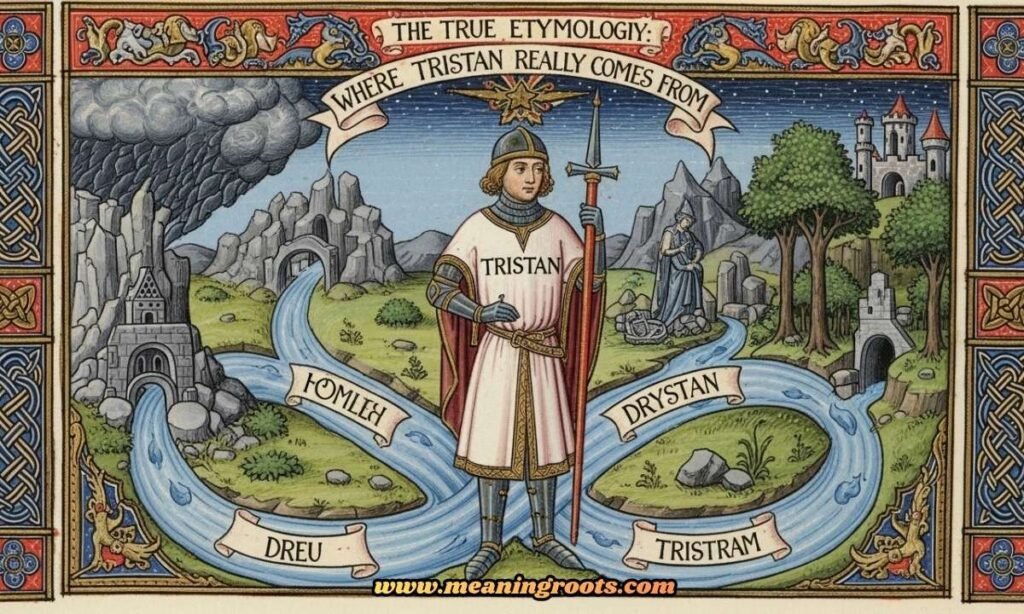
To understand Tristan’s spiritual meaning, you first need to understand its real roots. Tracing the actual history of this name reveals something far more interesting than a simple translation.
Celtic Britain Origins
Tristan’s oldest traceable form comes from Celtic and Pictish Britain, where the name appeared as Drust or Drustan. This form is found in early Pictish king lists and inscriptions dating back to at least the 6th century AD. The Brythonic Celtic root carried meanings of “tumult,” “noise,” “riot,” or “commotion.” Picture a battlefield or a stormy sea that restless, powerful energy is what the original name evoked.
This is a warrior name in its oldest form. It described someone with force, energy, and presence not a quiet figure, but one who stirred things up.
Old French Transformation
The name entered mainstream European consciousness through Old French literary tradition, specifically through the medieval legend of Tristan and Iseult (also written as Isolde). French poets and storytellers linked the name to the Old French word triste, meaning “sad” or “sorrowful.” This gave the name a second, more romantic layer of meaning the passionate, grief-touched lover who endures impossible heartbreak.
So Tristan arrived in the modern world carrying two distinct meanings: tumult and sorrow warrior energy meeting emotional depth.
Why People Search for Hebrew Connections?
There are a few reasons this question keeps appearing online:
- Spiritual naming trends have become common in Christian communities, where parents want names with faith-rooted meaning
- Some online content incorrectly implies Tristan has Hebrew roots, creating confusion
- Many believers assume that a “meaningful” name must have biblical or Hebrew origins
- The internet amplifies this confusion by circulating poorly researched articles
The truth is, a name doesn’t need Hebrew etymology to carry biblical significance. Names like Grace, Faith, Hope, Christopher, and Patrick have no Hebrew roots yet they are deeply beloved by Christian families worldwide.
Is Tristan Found in the Bible?
Hebrew Scripture Check
No. Tristan does not appear in the Old Testament not in the Torah, the Prophets, the Wisdom literature, or any of the historical books. It is absent from every Hebrew manuscript of Scripture, with no phonetic approximation or variant spelling found anywhere in the canonical text.
New Testament Analysis
Nor does the name appear in the New Testament. It is not found in the Gospels, the Epistles, the Acts of the Apostles, or the Book of Revelation. There is no Greek form of Tristan hidden in the text.
Addressing Common Misconceptions
Some online articles claim Tristan has “biblical meaning” in a way that implies direct scriptural roots. To be clear:
- Tristan is not derived from Hebrew
- Tristan is not a Greek New Testament name
- Tristan does not appear in the Apocrypha either
- No credible linguistic scholar or Bible scholar connects the name to Scripture directly
What this does not mean: It does not mean the name is spiritually empty, inappropriate for Christian use, or unsuitable for a believer’s child. The absence of a name from Scripture has never been the measure of its spiritual worth.
Hebrew Words That Echo Tristan’s Themes
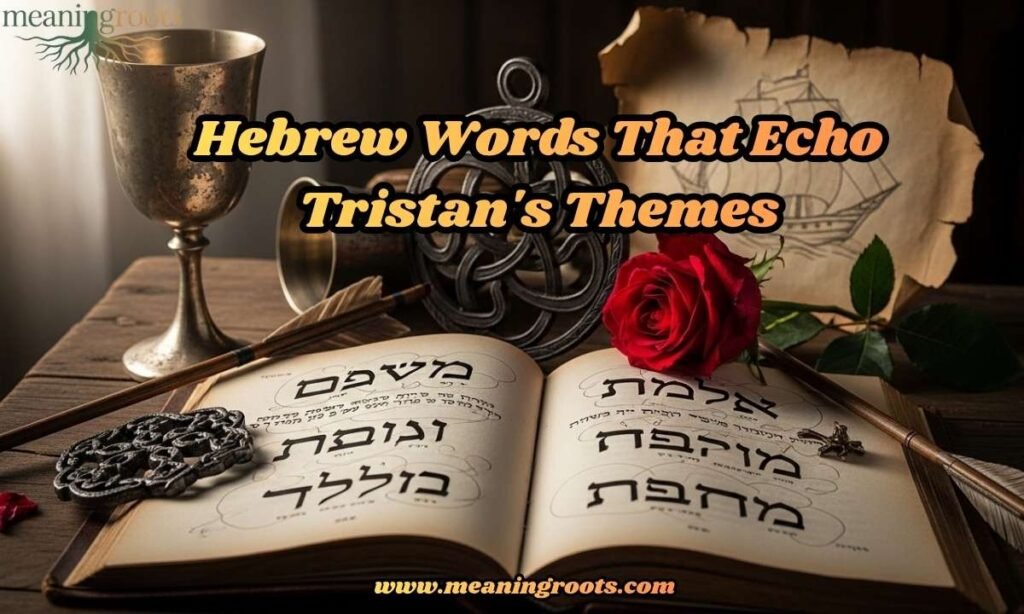
Even without a direct linguistic connection, several Hebrew words and concepts resonate powerfully with Tristan’s layered meaning. These are not translations they are thematic echoes that bring genuine depth to the name.
Sorrow and Suffering
The most widely recognized meaning of Tristan is sorrow. Two key Hebrew words illuminate this:
- עָצֵב (Atzev): meaning grief, sorrow, pain. This word appears throughout the Psalms and the Prophets in the context of spiritually meaningful suffering not despair, but the kind of grief that opens the heart to God.
- יָגוֹן (Yagon): meaning sorrow, anguish. Used in Psalm 31 and Jeremiah, this word describes the raw emotional weight of trial and loss.
- קָעַס (Ka’as): meaning vexation, distress. Found in Ecclesiastes and Samuel, this word captures inner turmoil.
In Hebrew spirituality, sorrow was understood not as defeat but as a gateway to divine encounter. David wrote Psalms drenched in grief. Hannah wept so deeply she could not eat. Jeremiah was called the weeping prophet. In every case, sorrow led deeper into God not away from Him.
Tumult and Chaos
Tristan’s original Celtic root tumult or noise finds a striking Hebrew parallel:
- הָמוֹן (Hamon): meaning tumult, noise, uproar, a great stirring. This word appears in Isaiah and the Psalms, often describing either the roaring of nations or the rushing movement of God’s Spirit. The fact that Tristan’s oldest meaning connects to this same concept gives the name unexpected biblical resonance.
Warrior Spirit
The earliest form of Tristan was a warrior’s name Drust, the bold and forceful one. Hebrew Scripture has rich vocabulary for this:
- גִּבּוֹר (Gibbor) mighty warrior, man of valor. This word describes Boaz, David’s mighty men, and even God Himself in battle. It speaks of courageous strength used in service of something greater.
- חָזַק (Chazak) strong, firm, courageous. God commands Joshua “Chazak ve’ematz” “Be strong and courageous” in Joshua 1:9.
Bold and Brave
- עָז (Oz): strength, boldness, might. This noun is often used for God’s strength given to His people.
- אָמַץ (Amatz): to be strong, to be brave. Found in Psalm 27:14: “Wait for the Lord; be strong, and let your heart take courage.”
Tristan Meaning in Greek
While Tristan has no Greek origin, exploring it through the lens of Greek the language of the New Testament adds another layer of reflection.
The Greek concept most aligned with Tristan’s sorrow-meaning is πάθος (pathos) deep emotional feeling, suffering, endurance. This word family gave us “compassion,” “sympathy,” and “empathy” in English. A person who has known genuine sorrow often develops the capacity for profound compassion a deeply biblical virtue.
Another relevant Greek concept is μεταμόρφωσις (metamorphosis) transformation, change of form. Romans 12:2 uses the verb form (metamorphoo): “Do not conform to the pattern of this world, but be transformed by the renewing of your mind.” The journey from sorrow to strength that Tristan represents is, at its core, a metamorphosis exactly what Scripture promises to every believer who walks through darkness toward God’s light.
Tristan Meaning in English
In plain English, Tristan carries two primary meanings depending on the historical layer you draw from:
| Origin Layer | Language | Meaning |
| Oldest Celtic form (Drust/Drustan) | Brythonic Celtic | Tumult, noise, commotion |
| Medieval romance tradition | Old French (triste) | Sorrowful, sad, full of longing |
| Combined modern interpretation | English | One who carries deep emotion; sorrowful yet brave |
Neither meaning is negative when viewed through a spiritual lens. Tumult and sorrow are not curses they are experiences that, in the hands of God, become the raw material of character, compassion, and faith.
Biblical Themes That Align With Tristan
Sorrow to Strength: The Redemption Pattern
Joseph is the defining biblical example. Sold into slavery by his brothers, falsely accused, forgotten in prison his sorrow was deep and prolonged. Yet Genesis 50:20 reveals the truth: “You intended to harm me, but God intended it for good.” Joseph’s grief became the pathway to saving nations.
David, Hannah, Job, Jeremiah the biblical narrative is full of people whose sorrow was not wasted. It became the very ground where faith grew deepest.
Psalm 30:5 promises: “Weeping may endure for a night, but joy comes in the morning.”
Tumult to Peace: Divine Calm in Chaos
Tristan’s Celtic root tumult finds its biblical counterpoint in the recurring scriptural theme of God bringing peace into disorder. Elijah fled through the wilderness in turmoil. Jonah was thrown into a stormy sea. Jesus walked on water toward the storm.
Isaiah 26:3 speaks directly into this: “You will keep in perfect peace those whose minds are steadfast, because they trust in you.” The promise is not the absence of tumult it is a steadiness within it.
Warrior to Servant: Biblical Leadership Model
The warrior energy in Tristan’s Celtic roots finds its highest biblical expression not in conquest but in servant leadership. Ephesians 6:12 reframes the whole concept of battle: “Our struggle is not against flesh and blood.” The Christian warrior fights with truth, righteousness, faith, and prayer.
Jesus is the ultimate model called the Lion of Judah, He entered Jerusalem on a donkey. He is King of Kings, yet He washed His disciples’ feet. True biblical strength is not about dominance. It is about laying down your life in love and obedience.
Passionate Love to Divine Love
The legend of Tristan and Iseult is built on intense, consuming romantic devotion. Scripture takes love to a higher register. 1 Corinthians 13 defines love as patient, kind, not self-seeking, and enduring through all things agape love, covenant love rooted in self-giving sacrifice rather than emotion alone.
Song of Solomon 8:6 captures the passionate intensity the legend embodies: “Love is as strong as death… It burns like blazing fire, like a mighty flame.” The Bible doesn’t dismiss this depth of feeling it elevates and redirects it toward something eternal.
Loyalty to Faithfulness
One of Tristan’s most celebrated qualities in the legend is unwavering loyalty. Scripture honors this in the form of chesed the Hebrew word for covenant faithfulness, steadfast love, and loyal devotion. This is the word used to describe God’s love for His people throughout the Old Testament. It is the highest form of the loyalty Tristan represents.
Spiritual Significance for Modern Believers
Christian Perspective on Non-Hebrew Names
Christianity has never required Hebrew names for faithful living. The early church spread across Greek, Latin, Celtic, Germanic, and Slavic cultures, and believers in every language honored God with names from their own heritage. What matters is not the linguistic origin of a name but the character developed by the person who carries it.
Proverbs 22:1 offers the clearest biblical wisdom here: “A good name is more desirable than great riches; to be esteemed is better than silver or gold.” The “good name” Scripture speaks of is built through character and conduct not etymology.
Jewish Cultural Perspective
From a traditional Jewish standpoint, Tristan would be understood simply as a foreign, Western name without connection to Hebrew naming tradition. Jewish names typically carry direct references to God (El or Yah), describe divine attributes, or commemorate spiritually significant events.
That said, the themes embedded in Tristan sorrow as refining, tumult as prelude to peace, strength through endurance are thoroughly at home in Jewish thought. The Hebrew Bible is saturated with these ideas, from the Psalms to the prophetic literature to the wisdom books.
Creating Spiritual Meaning Through Intention
God himself is the pattern-setter for renaming with intention. He changed Abram to Abraham (father of many nations), Sarai to Sarah (princess), and Jacob to Israel (one who wrestles with God). Each renaming wasn’t a change of letters it was a declaration of transformed identity and purpose.
Parents who choose Tristan with faith and intention are doing something authentically biblical: they are speaking a declaration over their child’s life. The name becomes a prayer and a prophecy not because of its linguistic roots, but because of the faith invested in it.
Is Tristan a Good Name Spiritually?
Yes with full awareness of what it is and what it isn’t.
Tristan is not a biblical name, does not have Hebrew roots, and does not appear in Scripture. But it carries meanings sorrow, tumult, warrior spirit, passionate loyalty that connect powerfully to the central themes of the biblical narrative. When those meanings are intentionally framed through faith, the name becomes spiritually rich.
A child named Tristan who grows in courage, compassion, faithfulness, and reliance on God honors the name far more than any etymology could. Character is the true measure of a name’s spiritual worth.
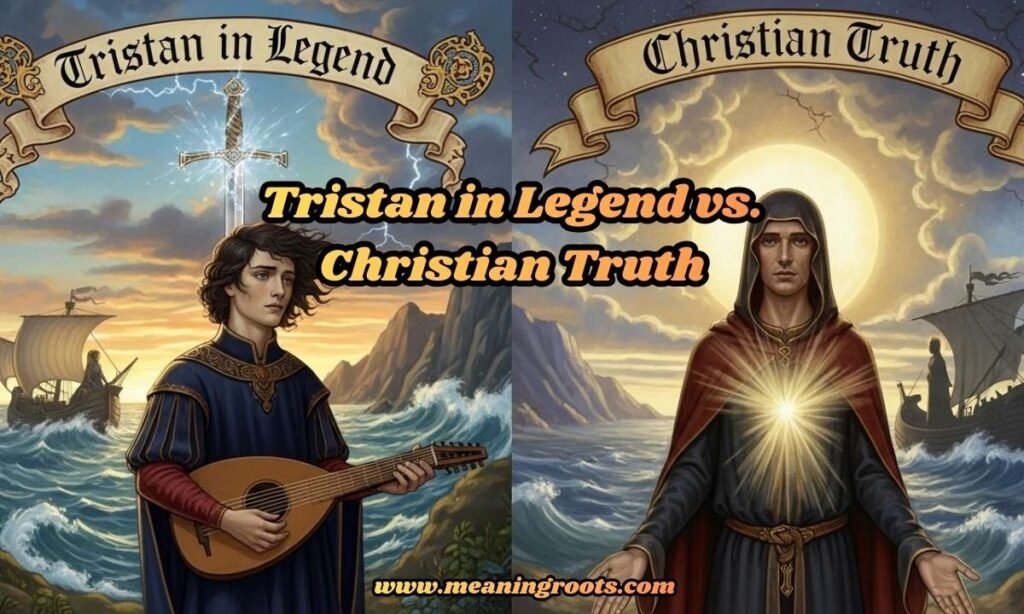
Tristan in Legend vs. Christian Truth
The Medieval Romance Story
The legend of Tristan and Iseult, popularized in 12th-century Old French and Arthurian romance traditions, tells the story of a knight and a princess bound by an accidental love potion, torn between duty and passion, and ultimately undone by their consuming devotion. It is a story of beauty, tragedy, loyalty, and grief powerful and timeless.
Biblical Counterpoints
The legend, while resonant, differs from biblical love in key ways:
- The legend celebrates eros passionate, consuming romantic love at the expense of covenant commitment
- It frames deception and betrayal as romantic rather than consequential
- Its resolution is tragic, with sorrow having no redemptive arc
Biblical love especially as modeled in Ruth and Boaz, or in the Song of Solomon held within covenant combines passion with faithfulness, depth with integrity. The biblical love story always moves toward restoration, not just tragedy.
Redeeming the Name
For Christian families, naming a child Tristan is an opportunity to redeem and redirect the legend’s themes. Rather than a name that ends in sorrow, it becomes a name that moves through sorrow into the joy that Scripture promises. The warrior becomes a servant. The lover becomes faithful. The tumult finds peace.
Personality Traits Associated With Tristan
People named Tristan are often described with consistent qualities across naming traditions, personality studies, and cultural associations:
- Emotionally deep: a capacity to feel and empathize that runs beneath the surface
- Courageous: especially in facing difficulty head-on rather than avoiding it
- Intensely loyal: relationships are taken seriously; commitments are held firmly
- Reflective: a tendency toward inner thought, introspection, and spiritual searching
- Resilient: the ability to walk through hard seasons without losing hope
- Romantic and idealistic: a belief that love and beauty matter and are worth pursuing
From a faith perspective, these are qualities that align closely with the biblical virtues of faithfulness, perseverance, compassion, and spiritual depth.
Name Symbolism in Hebrew Thought
The Power of Names in Scripture
In the Hebrew Bible, naming was one of the most significant acts a person could perform. When Adam named the animals in Genesis 2, he was exercising God-given authority and insight understanding and declaring the nature of each creature. When God renamed people, He was marking a moment of covenant transformation.
Names in Scripture function as:
- Declarations of identity (Isaac = laughter; Moses = drawn out of water)
- Prophetic statements (Jesus/Yeshua = the Lord saves)
- Memorials of divine encounter (Israel = wrestled with God)
- Reflections of character (Nabal = fool; Barnabas = son of encouragement)
Applying This Principle to Tristan
When you apply Hebrew naming theology to Tristan, the question shifts from “Does this word appear in Hebrew?” to “What declaration are we making when we give this name?”
A Tristan named with faith can carry the declaration: “This child will walk through sorrow with grace, face tumult with courage, and emerge with the strength that only God can forge in the fire of difficulty.”
That’s not linguistic invention. That’s intentional, faith-filled naming the most Hebrew thing you can do.
Speaking Life Over Your Tristan
Hebrew culture understood that words spoken over a person carried genuine power. Proverbs 18:21 says “The tongue has the power of life and death.” Parents can speak a living blessing over their child named Tristan not despite the name’s association with sorrow, but because of it, and because of what God promises to do with sorrow.
Practical Guidance for Parents Considering Tristan
Questions to Consider
Before choosing Tristan for your child, consider these spiritually grounded questions:
- What meaning do you want to invest in this name for your child’s identity?
- Are you comfortable explaining that it’s not a biblical name, while still celebrating its spiritual themes?
- What biblical verse or promise do you want to associate with this name as a personal blessing for your child?
- Does the combination of sorrow, courage, and transformation resonate with your own story of faith?
Meaningful Combinations
Pairing Tristan with a middle name that carries explicit biblical meaning is a wonderful way to anchor the name spiritually:
| First Name | Middle Name | Combined Meaning |
| Tristan | Elijah | Sorrow + “My God is the Lord” |
| Tristan | Josiah | Tumult + “God heals/supports” |
| Tristan | Levi | Warrior + “Joined, attached” |
| Tristan | Nathaniel | Sorrow + “Gift of God” |
| Tristan | Micah | Courage + “Who is like God?” |
Sample Blessing for Your Tristan
“May you walk through every sorrow with the knowledge that God is near the brokenhearted. May your storms produce peace that surpasses understanding. May your warrior spirit be surrendered to the service of others. And may your life tell the story of a God who turns every mourning into dancing.”
Frequently Asked Questions
What is the Hebrew meaning of the name Tristan?
Tristan has no direct Hebrew meaning or origin. It comes from Celtic and Old French roots, meaning “tumult” or “sorrow,” but these themes connect spiritually to Hebrew biblical concepts of refined grief and courageous faith.
Is Tristan a biblical name?
No. Tristan does not appear anywhere in the Old Testament, New Testament, or Apocrypha. However, its associated themes of sorrow, endurance, and transformation are central throughout Scripture.
Can a Christian use the name Tristan?
Absolutely. Many beloved Christian names Grace, Faith, Christopher, Patrick have no Hebrew or biblical roots. What matters is the character and faith of the person who carries the name, not its linguistic origin.
What Hebrew words are closest to Tristan’s meaning?
The closest Hebrew parallels are Atzev (sorrow/grief), Hamon (tumult/noise), Gibbor (mighty warrior), and Chazak (strong/courageous) all spiritually rich words found throughout Scripture.
What Bible verse fits the name Tristan best?
Psalm 30:5 is widely considered the most fitting: “Weeping may endure for a night, but joy comes in the morning” capturing the journey from sorrow to strength that defines Tristan’s deepest spiritual meaning.
Conclusion
Tristan is not a Hebrew name. It does not appear in Scripture. Those are facts worth stating plainly, because honesty is the foundation of any trustworthy spiritual reflection.
But here is what is equally true: the name Tristan carries themes sorrow, tumult, warrior courage, passionate loyalty, and resilient endurance that are woven through the entire narrative of the Bible. From David’s Psalms to Joseph’s prison cell to Job’s whirlwind to Christ’s cross, Scripture is a story about people who walked through darkness and found that God was already there.
When a child named Tristan walks that same path honestly feeling sorrow, courageously facing chaos, serving with strength, and loving with faithfulness the name takes on a depth that no etymology can give and no absence from Scripture can take away.
The most Hebrew principle of all isn’t about which names appear in the concordance. It’s about the declaration made over a life, the character shaped by faith, and the God who makes all things including sorrow itself work together for good.

My name is Daniel.I am a passionate writer in the meaning niche with over 4 years of experience exploring life purpose and personal growth. I create thoughtful content that helps readers understand deeper meaning in everyday experiences.
1 thought on “Tristan Meaning in Hebrew: Biblical Significance & Spiritual Meaning Explained”