
If you are searching for what it means when a bird flies into your house, you are not alone in that held-breath moment. One second it is a soft, wrong-sounding flutter in the hallway, a shape cutting past the kitchen doorway where no shape should ever be, and the next your pulse is doing two things at once: surprise, obviously, and underneath it, meaning.
Here is the honest answer before we go deeper. Most traditions do not treat a bird flying into your house as an automatic bad omen. It is usually read as a message: change, guidance, or a visit from someone who cares about you. The darker readings exist, but they belong to specific details, not to the simple fact that a bird crossed your doorway. Grandmothers warned about it and strangers post about it at two in the morning for the same reason: a bird in the house never feels random.
Key Takeaways
- A bird entering your house is most often interpreted as a message or sign, not a guaranteed bad omen.
- The details change the reading: how the bird behaved, whether it left, what species it was, and what color.
- The “it means death” fear comes from specific old folk traditions, not from most world religions.
- Practically, birds enter because of open doors, reflections, light, and nesting instincts, and you can release one safely in minutes.
- How you respond matters more than the event itself: stay calm, let it out, and notice what was on your mind when it happened.
Also Read This: Seeing a Coyote: Spiritual Meaning, 11 Signs & Messages
Is It a Bad Omen? The Honest Answer
No, not automatically. This is the single most important thing to know, because the internet will not always tell you this plainly. Folk superstition built the fear; the broader spiritual picture is far kinder.
Across cultures, a bird inside a home is read far more often as a messenger than as a threat. In many traditions the home is the most protected, most personal space a person has, so an uninvited wild bird arriving there is treated as a communication that could not wait. Messages are not curses. Sometimes they are warnings, yes. Far more often they are reminders, visits, and announcements of change.
Think of it the way you would think of an unexpected knock at the door. The knock itself is neutral. Who is standing outside, and what they came to say, is what matters. The rest of this article is about figuring out who was at your door.
When the Old Traditions DO Call It a Warning
Honesty requires this section, because burying it would be worse than facing it. A few old traditions do attach a grave meaning to a bird entering the house, and you deserve the specifics.
In Irish and Scottish folklore, a bird that enters the house and circles the room, especially if it lands on a chair or the back of a chair, was long taken as a sign of a death in the family. The tradition is very old, predating electricity, and it shows up in story after story from rural Ireland. Some versions narrow it further: the bird must come down the chimney, or it must be a specific bird like a crow or a thrush.
Parts of rural England carried a similar belief about a dove or pigeon entering the house, and in some Native American traditions, particularly those involving owls or crows inside a dwelling, the visit was treated as a death warning.
Here is the context that almost never gets mentioned alongside the fear. These were pre-modern beliefs formed in worlds where death visited homes constantly and people searched for patterns in everything. The same traditions that called a bird a death omen also called a crowing hen, a dog howling at night, and an unseasonable owl call omens. They were not describing a spiritual fact about birds. They were describing the anxiety of people who lived close to loss.
So yes, the warning tradition exists. It is real, and it is specific, and it deserves respect as folk history. It does not make every sparrow that follows you through an open patio door a death notice.
The 4 Things That Can Happen (Find Your Scenario)
This is where most articles fail you. They give you a list of meanings for “a bird in the house” as though every visit is the same visit. It is not. The bird’s behavior is the single biggest clue about what the moment is trying to tell you. Find your scenario.
It Flew In and Left on Its Own
This is the most common and the most reassuring scenario. A bird slipped through an open door, explored for a few minutes, and found its own way out, sometimes within the hour.
Spiritually, this reads as a message delivered and received. It came, it made its presence known, and it returned to the sky. Nothing is stuck. The traditional reading is simple: something in your life is about to pass through, not settle. A visitor, a piece of news, a brief season of change. Pay attention to what was on your mind during the visit. The message often connects to the thought you were holding when the wings started.
It Is Trapped and Panicking
A bird beating against a window, thrashing between walls, flying in frantic loops. This one upsets people the most, and not only for spiritual reasons. Watching a frightened animal panic is genuinely distressing.
The spiritual reading follows the bird’s own state. Panic inside a closed space mirrors panic inside a closed life. This scenario is read as a sign that you, or someone close to you, feels trapped in a situation with no visible exit: a job, a relationship pattern, a decision that keeps getting postponed. The bird found the entry but not the exit. That is the part worth sitting with.
Notice too that the practical solution and the spiritual lesson are the same. Open the widest exit, step back, and give it space. Trapped things, birds and people both, need room and calm more than they need chasing.
It Died Inside the House
This is the scenario the old omens were really about. Finding a dead bird indoors shakes people, especially in households where the death-omen story runs in the family.
Take a breath before assigning meaning. Birds die indoors for ordinary reasons: exhaustion, old age, illness, striking a window before anyone noticed. A death in your living room does not equal a death in your family. What it can mean, in honest spiritual terms, is an ending. Something has run its course. A phase, a hope, a version of you that no longer flies. Some traditions read it as a sacrifice, the small death that marks a threshold.
Handle the bird gently, dispose of it with respect (local rules for wildlife disposal apply in some places), and let yourself feel whatever comes up without forcing a prophecy out of it.
It Hit the Window But Never Entered
A sharp thud on the glass. The bird never crossed the threshold, maybe stunned on the sill for a minute, maybe gone before you reached it.
This is a different sign from an entry, and it deserves its own reading. The bird came to your boundary and stopped. Traditionally this is read as a message you are not receiving, or an opportunity that is knocking without being let in. Some people also read the stunned bird as a nudge about clarity: you are seeing your own reflection instead of the world outside. Clean the glass, literally and otherwise. And for what it is worth, window strikes are also the most common way birds “visit” houses in the modern world, because glass reflects sky. Decals and screens prevent repeat visits.
12 Spiritual Meanings of a Bird Flying Into Your House
Now the main list. Each of these is a genuine tradition or interpretation with a real reading behind it. None of them are filler. Read through and notice which ones land with a thud of recognition. That physical reaction is, in the old language of this subject, part of the method.
A Message From the Spirit World
This is the root meaning underneath almost all the others. In traditions from Siberian shamanism to Celtic lore to many African and South American beliefs, birds are the natural messengers between worlds because they live in the sky and touch the ground. They move between realms every day.
A bird inside your home, the most private of all human spaces, is read as a message that refused to stay outside. The message is not written down anywhere. It is the impression you got while it was there, the thought you were having, the worry that surfaced the moment you saw it. People who work with this seriously keep a simple practice: write down exactly what was on your mind in the hour the bird visited, then read it back in a week.
A Deceased Loved One Visiting
This is the meaning people search for through tears, and it deserves to be handled with care. In many cultures, birds carry the souls of the dead or act as their visitors. Robins, cardinals, doves, and sparrows are the usual suspects in these stories, often because the bird appeared after a specific person’s passing and behaves unusually: perching close, lingering, seeming to watch.
Nobody can prove this or disprove it. That is not a dodge; it is the truth of the matter. What can be said honestly is that grief researchers recognize these experiences as common and normal, and that many people report the visit feeling unmistakably personal. If the bird reminded you of someone, that is the reading to sit with. Grief does not need permission to be comforted.
Change or Transition Is Coming
This is the most statistically common meaning in modern spiritual writing, and for good reason. A bird crosses a threshold you do not normally cross; you are about to cross one too. Moves, new jobs, relationships beginning or ending, children arriving or leaving: the archetype fits them all.
The old phrase “a change is in the air” almost writes itself here. Note the nuance, though. This meaning is about transition, not disaster. Birth is a transition. Graduation is a transition. The bird did not fly in to ruin your life. It flew in to announce that your life is moving.
Also Read This: Spiritual Meaning of a Deer Crossing Your Path: 9 Signs & Messages
Good News Is on Its Way
Some traditions are flatly cheerful about this. In parts of China and Southeast Asia, a bird entering the house is welcomed as a fortune sign, especially a bright-colored or songful bird. The logic is sweet: a creature that can go anywhere chose your house. That is, in a sense, an endorsement.
Readers from cultures with this tradition often report the visit followed, within days or weeks, by an offer, an acceptance, a recovery, a yes. Again, no mechanism is provable. But the pattern of reported experience is strong enough that dismissing it outright would be its own kind of superstition.
A Warning to Slow Down
Not every message is good news, and honest spirituality includes the uncomfortable ones. A bird blundering into walls and furniture can read as a mirror: this is what your pace looks like from the outside.
This meaning tends to surface for people in overdrive. If you have been running on too little sleep, carrying too many obligations, or ignoring your body’s signals, the trapped-bird scenario in particular is read as an early warning. Slow down voluntarily, the saying goes, or something will slow you down.
Spiritual Awakening
In many mystical traditions, birds represent the soul’s movement toward the light. A bird inside your house can mark the beginning of a period where spiritual questions suddenly matter more than they used to: questions about purpose, about what you believe, about what all of this is for.
People report this one coming with strange timing. They had just picked up a spiritual book, or had a conversation that cracked something open, or were sitting quietly wondering if there was more than the routine. Then a bird. The visit gets read as confirmation: keep going. The door you are knocking on is real.
Freedom You Are Not Using
Birds are the universal symbol of freedom, which makes a bird indoors an immediate visual paradox: freedom, contained. The reading writes itself. There is a freedom available to you that you are not taking.
This one stings because it is usually specific. The unused degree. The trip never taken. The truth never said. The bird in your house is the part of you that knows you could fly somewhere new and has not yet done it. People who take this meaning seriously report a useful exercise: finish the sentence “I would, if only…” and notice what comes out.
New Beginnings / A Fresh Start
Closely related to change, but different in flavor. Change can be imposed; a fresh start is chosen. When a bird enters during a period when you have been considering a restart, a move, a new venture, a reconciliation, the visit is read as a green light.
Nesting season adds a layer here. Birds enter houses in spring searching for nest sites. If your visit happened in spring, the fresh-start reading has a double foundation: the spiritual symbol and the natural behavior lining up. Symbolism that the natural world backs up tends to feel the most convincing to people, and for good reason.
Protection Over Your Home
Some traditions flip the whole question around. Instead of asking what the bird brought, they ask what the bird is doing. A bird choosing your house, flying through it, even roosting briefly in it, is read as a sign that the house itself is watched over.
This reading is common in traditions where certain birds are protectors: swallows in many European folk beliefs, wrens in Celtic lore, sparrows in Indonesian and Middle Eastern stories. If the visit felt peaceful rather than frightening, if the bird seemed calm and at home, the protection reading is the one to trust.
Love or Family News
Birds nest. They pair-bond. They feed their young with almost absurd dedication. So when a bird enters a home, some traditions read it as news about the family living there: an engagement, a pregnancy, a reconciliation, a new person joining the household.
The Lithuanian tradition about a wren in the house foretelling a new baby is the most specific version of this. But the broader version is widespread: birds belong to the domain of home and hearth. A bird in your home points attention at your home, at the people in it, at what is growing there.
You Are Being Watched Over
Distinct from protection, though they overlap. Protection is about the house; being watched over is about you. In this reading, the bird is an emissary of guidance: a spirit guide, a guardian, an ancestor checking in.
This meaning tends to attach to visits that happen during hard stretches. People report birds arriving in hospital waiting rooms, on the morning of a difficult decision, in the week after a loss. The bird does not fix anything. It witnesses. In the economy of spiritual meaning, being witnessed is worth a great deal.
An Invitation to Look Inward
The final meaning is the quietest and, for many readers, the most useful. A bird inside your house forces a strange thing: you stop and watch. You stand still in your own hallway, tracking a small life with your eyes, and for three minutes the noise of the day goes silent.
Some teachers read the visit as exactly that: an invitation to the inward gaze. What in your inner life needs the same still attention you just gave the bird? The meditation is built into the event. You already did the practice. Now do it again, on purpose, with your eyes closed.
What the Bird Species Tells You?
Species matters. A crow and a hummingbird do not carry the same weight in any tradition on earth, and lumping them together is how generic articles fail. Here is the in-house reading for the birds people most often ask about.
Cardinal
The cardinal is the grief bird of North America. “When cardinals appear, loved ones are near” is not an ancient proverb; it is a modern folk saying, but it is repeated with such consistency and feeling that it has earned its place. A cardinal in the house is almost always read as a visit from someone who has passed, often a parent or grandparent. Bright red against your walls is hard to mistake and harder to forget.
Robin
The robin is the renewal bird. In European folklore it carries associations with new beginnings, spring, and the soul’s passage, and in the house it is read as a gentle announcement: something is being reborn in your life. Robins are also famously bold around humans, so expect this one to perch and look at you directly. That boldness is part of the message. Pay attention.
Dove / Pigeon
Peace, obviously, but more specifically: reconciliation. A dove in the house is read as a sign that a conflict is ready to be laid down, or that calm is returning after a storm. Doves also carry Holy Spirit symbolism in Christianity, which gives this visit an extra layer for Christian readers: a sense of divine presence in the home. Pigeons are the same family, humbler, and their reading runs practical. Home, loyalty, return. Pigeons always come home. The question is what is coming home to you.
Crow / Raven
Here is where people tense up, so let us be precise. Crows and ravens are the most symbolically loaded birds in the Western world: death, mystery, intelligence, magic, trickery, transformation. All of it is real tradition. A crow in the house is not a death sentence. It is a serious visit.
The raven and crow carry the heaviest meanings in the heaviest traditions. Norse, Celtic, and several Native American traditions treat them as birds of omen and insight, sometimes dark, sometimes protective. The honest reading: something significant is underway, and it demands your full attention. Do not ignore the crow. But do not fear it either. Fear is not the message.
Sparrow
The small, overlooked bird carries one of the warmest readings. In Indonesian and Middle Eastern traditions, a sparrow in the house foretells marriage or a new baby. In the Christian tradition, the sparrow is the bird God notices: not one falls without the Father’s knowledge. A sparrow in your house is read as a reminder that the small things, the small people, the small worries, are seen and held. Humility, community, and the sacredness of ordinary life.
Owl
An owl indoors is rare and genuinely startling, which is why it carries the strongest “pay attention” charge of any common bird. Owls are night birds, wisdom birds, and in some traditions death birds. The balanced reading: hidden knowledge is coming to light. Something you have not been seeing is about to become visible. In several Native American traditions the owl’s appearance is treated with real gravity, so if this one rattles you, that rattling is part of many people’s experience, not a sign you are overreacting.
Blue Jay
The blue jay is the loud truth-teller. Jays are intelligent, social, territorial, and extremely vocal. In the house, a blue jay is read as a call to speak up: something needs saying in your life, and the jay’s whole being is the argument for saying it. Blue jays also carry associations with clarity and fearlessness. If you have been swallowing words, the jay noticed.
Hummingbird
Joy, lightness, and the sweetness of the present moment. A hummingbird in the house is about as close to an unambiguous blessing as this subject gets. Hummingbirds live on nectar; they find the sweet thing in every flower. The reading: you are being reminded to find the sweet thing in your own days, especially if you have been heavy lately. In several Native American traditions, the hummingbird is a healer and a bringer of love. Let this one land lightly.
Wren
The tiny bird with the enormous reputation. In Celtic tradition the wren is the king of birds, honored in midwinter festivals, and a wren in the house is a powerful good sign. The Lithuanian version, noted above, ties the wren specifically to new babies. Wrens are also fierce, loud singers for their size. The reading: small things carry great power. Do not underestimate what is small in your life right now.
Swallow
The homecoming bird. Swallows return to the same nesting sites year after year, crossing continents to get back to one eave, one barn, one house. A swallow in the house is read as a sign of return and fidelity: someone is coming home, something is coming back, or you are being called back to where you belong. In many European traditions swallows nesting on a house were actively protected as good-luck guardians. This is one of the warmest readings in the whole subject.
Finch
Finches are social, cheerful, persistent little birds, and their in-house reading follows their nature: joy in community, celebration, the sweetness of shared life. Goldfinches in particular carry old European associations with health and vitality. A finch in the house is read as an encouragement to enjoy your people, to sing in company, to let happiness be uncomplicated for a while.
Magpie
The magpie needs its famous rhyme handled honestly. “One for sorrow, two for joy” is British folklore, and by that counting a single magpie indoors leans ominous while a pair leans joyful. But magpies are also among the most intelligent birds on earth, and many modern readers treat a magpie visit as a sign about perception: look twice, notice what glitters, be clever about a situation that is not what it seems. Take the rhyme as history, not as law.
What the Bird’s Color Tells You?
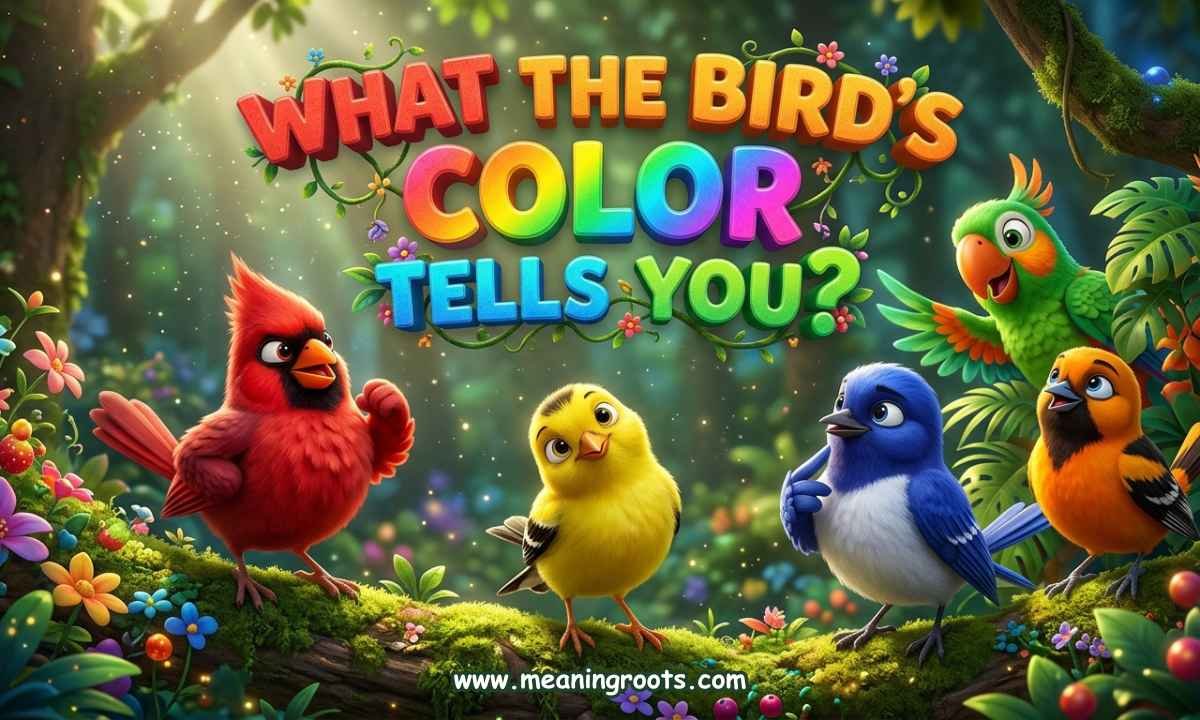
When the species is uncertain, and it often is in the half-second of a real visit, color carries the reading.
- White: Peace, purity, spiritual presence. A white bird indoors is widely read as the gentlest of signs, often tied to blessing or a loved one’s peaceful visit.
- Black: Mystery, the unknown, the shadow side. Not evil, despite the reputation. Black birds ask you to look at what you have been avoiding.
- Red: Passion, vitality, urgency, and in the cardinal’s case, the presence of the dead. Red is the color that says “this matters, now.”
- Blue: Calm, clarity, communication. Blue birds are read as signs about truth-telling and mental peace.
- Yellow / Gold: Joy, optimism, prosperity. A yellow bird indoors is about as sunny as omens get.
- Brown / Grey: Grounding, humility, the ordinary sacred. These birds carry the sparrow and wren readings: small, steady, real.
- Green: Growth, healing, new life. Less common indoors, but a green bird is read as a sign of something healthy beginning.
“My Grandmother Said It Means Death” – Where the Fear Comes From
Almost everyone who fears this omen inherited the fear from one specific person. A grandmother, a mother, an aunt. She said it with total certainty, usually right after it happened, and the words stuck for decades. It is worth asking: where did she get it?
She got it from folk tradition, and folk tradition got it from a time when the line between house and wilderness was thin. In pre-modern Ireland, Scotland, and rural England, houses had open chimneys, thatch, and no screens. Birds entered constantly. When someone in the village died within days of a bird’s visit, the coincidence was remembered and retold. When nobody died, the visit was forgotten. This is how superstitions are built: not from evidence, but from memorable hits and forgettable misses.
The fear also traveled with immigration. Irish and Scottish families carried the bird omen to America, Australia, and beyond, where it rooted in new soil. That is why a belief from rural County Cork can be quoted with confidence by a grandmother in Ohio who has never been to Ireland.
None of this makes your grandmother wrong about everything. Folk traditions often encode real observations; birds do behave strangely before storms, and animals do sense things we miss. But the specific claim, that a bird indoors predicts a human death, has no mechanism and no evidence behind it. It has stories. Stories are powerful, but they are not verdicts.
If the fear is yours, inherited and heavy, here is a practical reframe that many people find genuinely freeing. Ask what your grandmother feared in general. Usually the bird was one item in a whole catalogue of warnings, which tells you the fear belonged to her worldview, not to the bird. You are allowed to keep her love and release her fear. They were never the same thing.
Also Read This: Praying Mantis Spiritual Meaning: 9 Signs, Symbols & Messages
What Different Cultures and Religions Say?
No single tradition owns this symbol. Here is how the major ones read a bird in the house, because the differences are as instructive as the agreements.
Christianity and the Bible
The Bible never says a bird in the house is an omen of death. What it does say about birds is consistently tender. The dove brings Noah the olive leaf, the sign that the flood is ending. The Spirit descends like a dove. Sparrows are the proof of God’s attention to small things. Ravens feed Elijah in the wilderness.
Christian interpretation of a bird indoors, where it exists at all, leans toward divine message or the presence of the Holy Spirit, particularly with doves. Many Christian pastors and writers actively discourage omen-reading as superstition while still honoring the moment as a prompt to pray and reflect. Both instincts can coexist: you can decline the superstition and keep the wonder.
Islam
Islamic tradition treats omens, called tiyarah, with real caution; the Prophet is reported to have disliked pessimistic omens. A bird entering the house is not assigned a doom meaning in mainstream Islamic teaching. Birds in the Quran and hadith appear positively: the hoopoe as Solomon’s messenger, birds as creatures glorifying God.
Folk beliefs vary by region, and some Muslim cultures do attach meanings to specific birds, but the religious mainstream answer is clear. Do not take it as a bad sign. Some scholars suggest using the moment as a reminder of God’s creation and providence. The bird is a creature, not a curse.
Hinduism
In Hindu tradition, birds are deeply symbolic and the reading depends heavily on species and context. Crows are associated with ancestors, particularly during Pitru Paksha, the fortnight of honoring the departed; a crow’s visit can be read as an ancestral presence. Parrots, mynas, and doves carry their own associations with love, speech, and peace.
A bird entering the home is generally not feared in Hindu folk belief. Depending on the bird, it may be welcomed as a good sign, fed, and treated with respect. The emphasis is on dharma and right relationship with living things rather than on omen-reading.
Native American Traditions
This is not one tradition but hundreds, and generalizing does them a disservice. With that caution: many Native traditions treat birds as messengers and spirit guides with real seriousness. The specific meaning depends on the tribe, the bird, and the circumstance.
Some traditions, particularly involving owls, do treat a bird’s appearance as a grave warning. Others read the same event as guidance or protection. The common thread is respect: the bird is not random, the message deserves attention, and the proper response is thoughtful rather than fearful. Readers from these traditions should look to their own tribal teachings first, because generic summaries cannot replace them.
Celtic, Irish, and British Folklore
This is the source of the death-omen fear, and it deserves its full due. In Irish folklore, a bird entering the house, circling, and landing, particularly on a chair, was a death sign. The wren was the honored exception, a king among birds. Swallows were protected as luck-bringers.
British folklore adds the magpie rhyme, the robin’s association with the soul, and the wren’s midwinter kingship. The overall Celtic picture is more nuanced than “birds mean death.” It is closer to: birds mean something, and you had better pay attention to which bird and what it did.
Chinese Tradition
Chinese folk belief is refreshingly positive about this. Birds entering the house are often read as fortune arriving, especially songbirds and brightly colored ones. The magpie, feared in Britain, is a bird of joy and good news in China; its name in Chinese is a pun on happiness.
Swallows nesting under the eaves are welcomed as prosperity signs. The general principle in Chinese tradition is that a home attractive to living things is a home with good feng shui. A bird choosing your house is, in this reading, a compliment to the house.
Appalachian and European Folk Beliefs
Appalachian folk belief, carried from Scots-Irish and German settlers, holds some of the strongest bird-omen traditions in America. A bird flying into the house, especially a dove or a wild bird that cannot get out, was widely taken as a death warning in mountain communities. These beliefs were held sincerely and passed down with the same certainty as recipes.
Continental European folklore varies: in parts of Germany and Eastern Europe, specific birds carry specific news, and the stork’s presence near a home is the famous fertility sign. The throughline is that the old European countryside read nature as a bulletin board, and birds were the headlines.
Norwegian and Indonesian Folk Beliefs
In parts of Norway and Scandinavia, birds at the window or in the house were traditionally read with gravity, sometimes as warnings, sometimes as soul-birds. The old Norse world gave ravens the highest symbolic honor as Odin’s own birds, thought and memory made feathered.
In Indonesia, as noted, the sparrow in the house is a happy omen of marriage or a new baby, one of the most specific and cheerful readings in any tradition. The contrast is the point: the same small brown bird is a death warning in one tradition and a wedding announcement in another. The bird did not change. The story around it did.
What the Details of the Visit Tell You?
Beyond species and scenario, the small details refine the reading. Not all of these will apply to your visit. The ones that do are the ones to keep.
At Night vs During the Day
A daytime visit is the ordinary kind: the bird was out living its life and wandered in. The reading stays in the messenger-and-change family. A nighttime visit is rarer and stranger, because most small birds do not fly at night. A bird entering after dark is read as a more urgent or more spiritual message, sometimes connected to dreams, the subconscious, or matters you have been avoiding in the daylight of your attention. Owls are the exception; a night visit from an owl is simply an owl being an owl.
It Keeps Coming Back
One visit is a message. Repeated visits are an insistence. If the same bird, or birds, keep entering your house over days or weeks, the traditions are unanimous: you have not received the message yet. Look for the pattern. What is unresolved in your life right now? What have you been postponing? The bird will keep knocking until the door of your attention opens. Also, practically: find and fix the entry point, because a bird that keeps returning may be nesting nearby and following a learned route.
Two Birds Entered Together
Pairs change the reading toward relationship. Two birds in the house are read as a sign about partnership: a relationship deepening, a marriage, a reunion, or a bond that needs attention. In the Chinese tradition this is especially auspicious. In the magpie rhyme, two is literally joy. If you are in a relationship, the visit points at it. If you are not, some traditions read it as a herald.
The Entry Route: Door, Window, or Chimney
How the bird got in adds a layer. Through an open door: the straightforward reading. An opportunity, a message, or a change arrived through an open channel in your life. Nothing sneaky about it.
Through a window: boundaries and perception. The bird came through the place you look out of. The reading points at how you are seeing things, or failing to.
Down the chimney: this is the route the old Irish death omens specified, which is why it unsettles people. But chimneys are also simply how birds, especially swifts and swallows, have entered houses for centuries. If the chimney route frightens you, get a chimney cap. Practical protection is also spiritual protection.
It Will Not Leave
A bird that enters and stays, perching, roosting, refusing every open exit, is read as a message that has moved in. This is not a passing announcement; it is a resident truth. Something in your life is not visiting. It lives there now, and it wants acknowledgment. People report this scenario less often, but when they do, the reading they settle on is usually about an undeniable change: a diagnosis, a new family member, a truth that can no longer be un-known.
Could It Mean Pregnancy or a New Family Member?
This question comes up constantly, so here is the direct answer. Yes, several traditions connect a bird in the house with pregnancy, birth, or new family members: the Lithuanian wren, the Indonesian sparrow, the general nesting symbolism. If you are trying to conceive, or hoping for family news, the visit will naturally feel significant, and many people in that situation report it as a hopeful sign.
Honesty requires the other half. Birds enter houses all year for ordinary reasons, and a bird is not a pregnancy test. Take the hope if it comforts you. Do not take the bird as a medical announcement.
The Practical Side: Why Birds Actually Fly Into Houses
Spiritual meaning and practical fact are not enemies. Knowing why birds do this makes the spiritual reading richer, not poorer, because it grounds the symbol in real behavior.
Birds enter houses mostly by accident and instinct. Open doors and unscreened windows are the main routes; a bird chasing an insect or fleeing a predator does not check for thresholds. Glass is the great deceiver: windows reflect sky and trees, and birds fly toward the reflection at full speed. This is also why window strikes happen.
Light draws them. A lit house at dusk looks like shelter. In spring, nesting instinct drives birds to explore cavities, and your open vent, chimney, or garage looks like a premium nesting site. In cold weather, the search for warmth does the same. Fruit trees near doors, feeders near windows, and houseplants visible through glass all increase visits.
None of this cancels the meaning. In the old way of thinking, the practical cause is the mechanism, not the contradiction. The message arrives by sparrow, not instead of one.
What to Do Right Now: Calm Steps + a Small Ritual
First, the bird. Then, you.
For the bird:
- Stay calm and move slowly. Panic is contagious across species.
- Close interior doors to contain it in one room with the largest window or door.
- Open that window or door wide. Remove screens if you can do it safely.
- Turn off ceiling fans and dim the lights, leaving the exit as the brightest opening. Birds fly toward light.
- Leave the room for ten to fifteen minutes. Most birds find the exit once the scary giant leaves.
- If it is perched and exhausted, you can gently contain it with a light towel and release it outside. Wash your hands after.
- Call a wildlife rehabilitator if it is injured, very young, or a protected species.
For you, a small ritual:
Once the bird is out, stand where it was. Take three slow breaths. Say, silently or aloud, whatever thanks feels natural; many traditions include a spoken acknowledgment, and it costs nothing. Then ask yourself one question and answer it honestly: what was I thinking about when it arrived?
Write the answer down, with the date, the bird’s description, and what happened. Tuck it away. If the meaning becomes clear later, and it often does, you will be glad you kept the record. This is the entire practice. No candles required, no special words, no purchase. Attention is the ritual.
What Happened After: An Honest Note
People always want to know what happened next in other people’s stories. Did the omen come true? So here is the honest accounting of what people actually report.
Most report nothing dramatic. The bird left, life continued, and the visit became a story told at dinner. A large number report a change within weeks that the visit seemed to foreshadow: a job offer, a move, a reconciliation, a birth, a death in an elderly relative that was already expected. A smaller number report the visit coinciding with genuinely startling timing, the kind of story that gives you chills to hear.
Here is what almost nobody reports: the bird arriving, and then a bolt-from-the-blue catastrophe with no connection to anything already in motion. The catastrophic version lives in horror movies, not in people’s lived accounts.
Read that pattern however you like. The skeptical reading is confirmation bias plus the base rate of life events. The spiritual reading is that messages arrive ahead of motion that was already underway. Both readings agree on the practical advice: pay attention to what is already moving in your life. The bird was pointing at it.
Dream vs Reality: A Quick Clarifier
This article is about a real bird in a real house. But many readers arrive here after dreaming about it, so a brief distinction is in order.
A dream of a bird in the house belongs to dream interpretation, not to this event. Dream dictionaries generally read it as thoughts or desires seeking expression, news arriving, or the dreamer’s own spirit wanting freedom. The feelings in the dream matter more than the bird.
If you dreamed it and then it happened in waking life, that is a different category of experience, and people who report it describe it as profoundly significant. Whether you read that as synchronicity or coincidence, it is worth the same practice: write down what was on your mind, and watch.
FAQs
Is it bad luck if a bird flies into your house?
In most traditions, no. It is read as a message, a visit, or a sign of change, not as automatic bad luck.
What does it mean when a bird flies in and out of your house?
A bird that enters and leaves on its own is read as a delivered message: news or a brief change passing through your life.
What does a dead bird in the house mean spiritually?
It is read as an ending, a phase or version of your life that has run its course. It does not predict a human death.
Why does a bird keep coming into my house?
Repeated visits are read as an unreceived message: something you have been postponing needs attention. Practically, fix the entry point.
Should I be worried if a bird hits my window?
A window strike is read as a message at your boundary, something you are not letting in. Add decals or screens to prevent repeats.
Conclusion
A bird flew into your house, and you felt something. That feeling is the beginning of the meaning, not the end of it. The old fear calls it a warning; the wider world of tradition calls it a messenger.
So let the bird out, write down what you were thinking when it arrived, and notice what was already moving in your life. The next time someone’s grandmother warns them about a bird in the house, you will have something better than fear to offer.
Also Read This: Blue Jay Spiritual Meaning: 9 Signs, Symbols, and Messages

My name is Daniel.I am a passionate writer in the meaning niche with over 4 years of experience exploring life purpose and personal growth. I create thoughtful content that helps readers understand deeper meaning in everyday experiences.
3 thoughts on “What Does It Mean When a Bird Flies Into Your House? 12 Spiritual Meanings & Signs”