
You were driving home when it happened. Headlights swept the roadside and there it was, a coyote trotting across your lane, unhurried, glancing back once before melting into the dark. Or maybe it was broad daylight on a trail, and the animal simply stopped and stared at you until you forgot to breathe.
Seeing a coyote is a spiritual nudge from the trickster: lighten up, trust your instincts, and look twice at what is not as it seems. It is a catalytic sign, not a bad omen.
This guide to the spiritual meaning of seeing a coyote starts with the honest verdict on the good-or-bad-luck question, then decodes your exact encounter, from the roadside crossing to the 2 a.m. howl. Find your moment below and read what it was saying.
Key Takeaways
- A coyote is a catalytic messenger, not a sign of doom. Worry is the wrong response; attention is the right one.
- The core of the symbolism is the trickster, who teaches through surprise, humor, and paradox. Expect the message to involve lightness, illusion, or adaptability.
- The stare is the moment most people feel “seen.” Minutes of mutual eye contact ask for unguarded honesty with yourself.
- In Diné (Navajo) tradition, a coyote crossing your path means turn back and reconsider your journey. It is counsel, not a curse.
- At the end of this article you will find a 48-hour practice that turns the encounter from a lingering question into something you can actually use.
Also Read This: Spiritual Meaning of a Deer Crossing Your Path: 9 Signs & Messages
Is Seeing a Coyote Good or Bad Luck? (The Honest Verdict)
Neither, and that is the honest answer. A coyote is not a lottery ticket and it is not a curse. Across most modern spiritual readings it is a catalytic messenger: it shows up to disrupt a pattern, not to punish you for having one.
Two real traditions pull in different directions here, and both deserve respect. Many contemporary readers treat the coyote as a trickster guide, a sign to loosen your grip and pay closer attention. In Diné (Navajo) tradition, a coyote crossing your path is taken more seriously. It is read as a sign to turn back and reconsider the journey you are on. That is counsel about your direction, not a prophecy of disaster. A warning and a doom are different things, and most traditions hand you the first, not the second.
You may also run into faith-based dream interpretations that read the coyote as deception or spiritual attack. That is one lens among others, and it says more about the interpreter’s framework than about your encounter. Take what is useful and leave the fear.
So no, it is not bad luck. It is a tap on the shoulder. The rest of this article is about figuring out what it was tapping you for.
What Does It Mean When You See a Coyote? (11 Core Messages)
Every coyote encounter carries the same trickster signature, but the message underneath changes with your life. Read through these the way you would read a set of letters, and notice which one stings a little. That is usually the one addressed to you.
1. Lighten up
The coyote’s first lesson is almost always aimed at your seriousness. Somewhere in your life you have gone rigid: replaying a conversation for the fortieth time, bracing for outcomes you cannot control, treating an ordinary Tuesday like a courtroom. The trickster finds rigidity funny, not because your concerns are silly, but because your grip on them is. Loosen it by ten percent and watch what changes.
Ask yourself: what am I treating as life-or-death that is really just life?
2. Trust your instincts
You already know the thing you keep asking other people about. The coyote hunts by reading the ground, the wind, the smallest sound in the brush, and it does not second-guess the read. This message tends to arrive when you have been overriding your gut with logic, politeness, or committee opinions. Your first read was probably right. The coyote is asking why you needed a second, third, and fourth.
3. Something is not as it appears
This is the reading behind half of all coyote encounters, and it deserves a full paragraph. The trickster is the patron of illusion: the charming new friend with an agenda, the too-good offer, the story you keep telling yourself that edits out the inconvenient parts. None of this means assuming the worst of everyone you meet. It means looking twice at one specific thing that has felt slightly off, the detail you noticed and then talked yourself out of noticing. The coyote does not ask you to become suspicious. It asks you to become observant, which is a kinder and far more useful skill.
4. Adapt
The coyote is North America’s great adapter. It began as a creature of the western plains and instead learned deserts, forests, farmland, suburbs, and freeway medians. It now ranges from Panama to Alaska, mostly because it refused to specialize itself into a corner. When it crosses your life, the plan has changed or is about to, and the message is not to mourn the old plan. Learn the new terrain the way the coyote did: quickly, cleverly, and without complaint.
5. Play is a spiritual practice
Watch coyote pups wrestle for thirty seconds and the sermon writes itself. Somewhere along the way you filed play under “unproductive” and scheduled it for never. The trickster disagrees with your filing system. Delight is not the reward you get after the work is done; for the coyote, it is part of how the work gets done. Do one unserious thing today, on purpose.
6. Be resourceful
Coyotes eat rodents, rabbits, fruit, insects, and whatever the suburbs leave out. They raise pups in abandoned burrows dug by other animals and make them home. Nothing is wasted and nothing is beneath use. If you have been waiting for better resources, better timing, or a better version of yourself before you start, the coyote votes against your timeline. Start with what is already in the room.
7. The sacred disruptor
Sometimes the coyote arrives right after everything fell apart: the breakup, the layoff, the plan that collapsed in a week. Spiritual communities have started calling this the divine detour, and the coyote is its mascot. The teaching is uncomfortable but worth sitting with. Chaos is not always the opposite of order. Sometimes it is order rearranging itself while you are still watching the old arrangement burn. The trickster does not break things to be cruel. It breaks the shape that was keeping you small, which feels exactly like cruelty until the new shape appears.
Ask yourself: if this disruption turned out to be protective, what would it be protecting me from?
8. Find your voice
The howl is the coyote’s signature: a public announcement of presence, territory, and belonging, thrown at the night without apology. If you have been swallowing words, softening opinions, or making yourself smaller in rooms where you belong, this is the message. Say the thing. Claim the space. Let the neighborhood know you are here.
9. Check your boundaries
A coyote in your space is a boundary question wearing fur. Who or what has wandered past the fence lately? The uninvited opinion you keep entertaining, the demand on your time you never actually agreed to, the habit that keeps slipping back in through the side gate. Boundaries are not walls. They are the fence that lets the garden grow, and the coyote is asking when you last walked yours.
10. Face what you are avoiding
The trickster specializes in the lesson you keep dodging. It will circle back, night after night, encounter after encounter, until you turn around. Whatever you flinch from when your mind goes quiet, the conversation you rehearse but never have, the drawer you do not open: that is the curriculum. The coyote did not come to punish the avoidance. It came because the avoidance has started costing you more than the confrontation would.
11. A cycle is ending
Not every coyote message is about action. Sometimes it is about compost. Something in your life has finished, a role, a relationship, a version of you, and it is breaking down so something else can grow. Endings that involve the trickster rarely look dignified. They look messy, absurd, or strangely funny in hindsight. Let it decompose. Grief and relief are allowed to show up at the same time.
Your Exact Encounter, Decoded (Scenario Guide)
A coyote that darts across your headlights on the highway is not the same message as one that holds your gaze on a morning trail. Use this navigator to find your moment, then read its full meaning below.
| Your encounter | The core reading | Find it |
| Crossed your path while driving | An interruption with a message; tap the brakes on a life decision | The crossing |
| Stared at you, locked eyes | Unguarded presence; stop performing and be honest | The stare |
| Seen in the daytime | Visibility; the message is not hiding | Daytime |
| Seen at night | The shadow and the intuitive; listen to the quiet | Nighttime |
| In your yard | The wild entering your personal space; a boundary question | The yard |
| Heard howling at night | Voice, belonging, and boundaries; speak up | The howl |
| Two coyotes together | Partnership and mirroring; doubled attention | Two coyotes |
| A pack of coyotes | Community and social strategy; check your pack | The pack |
| A lone coyote | Independence and self-trust; your own timing | The loner |
| You keep seeing them | The message is repeating because it has not landed | Repeat visits |
| A dead coyote | An ending and a release; not a curse | The dead coyote |
| Watching or following you | Sustained attention; something wants to be noticed | The follower |
A coyote crossed your path while driving
This is the single most common coyote encounter, and the reading is beautifully literal: your movement was interrupted, so the message is about movement. Something in your life is being asked to slow down before it goes further. Think about what you were rushing toward when it happened. A decision you were about to force. A conversation you were about to have at full speed. A phase you are pushing through too fast to see clearly.
In Diné tradition this specific moment carries the old counsel: turn back and reconsider the journey. Read it as an invitation to review your direction, not as an order to abandon the trip. Before the spiritual part, the practical part matters. Brake firmly, stay in your lane, and do not swerve for wildlife. The coyote that crossed is rarely traveling alone in spirit, and neither are the consequences of a swerve.
A coyote stared at you / locked eyes with you
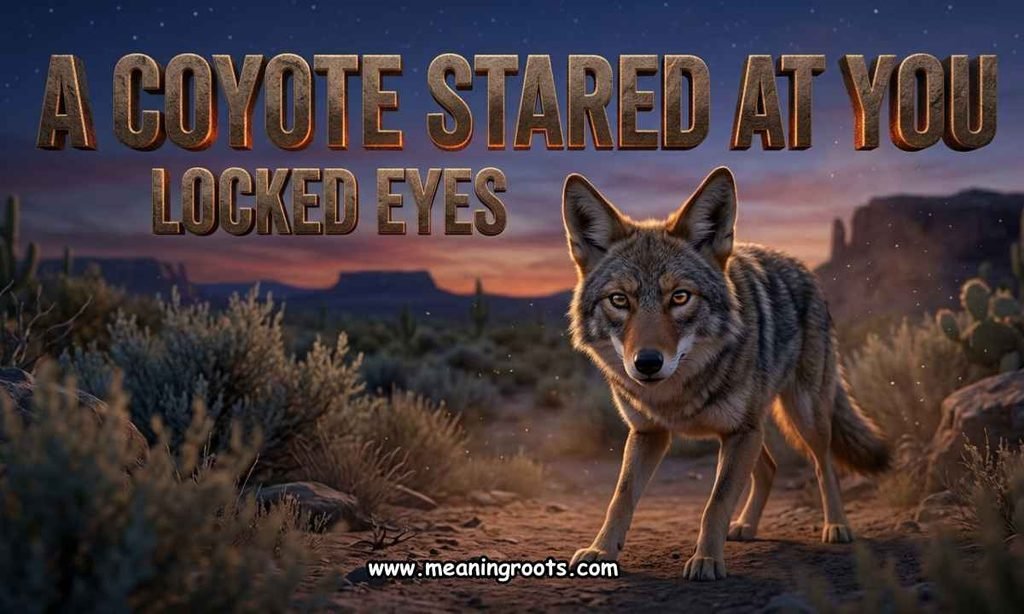
Of all the coyote moments, this is the one people describe as life changing. The animal stops, looks directly at you, and does not look away. Seconds stretch. You feel, with complete irrational certainty, that you have been seen.
The reading matches the sensation. This is unguarded presence, the wild looking back at you without flinching, and it asks for the same in return. Stop performing for one minute. Be honest about what you want, what you fear, and what you have been pretending is fine. The stare is not a threat. It is a mirror held very still.
Seeing a coyote in the daytime
A daytime sighting is the trickster in broad daylight, and the message follows: whatever this is about, it is not hiding. The illusion in your life is obvious if you look straight at it. The self-deception you have been conducting after dark does not survive noon.
One honest note, because this question comes up constantly: a coyote out during the day is normal. Coyotes are most active at dawn and dusk, but they have grown increasingly comfortable moving through suburbs and exurbs in daylight, especially where people unintentionally feed them. Daytime alone is not a sign of rabies or a supernatural event. It is a wild animal living its life, and the meaning lives in your attention to it.
Seeing a coyote at night
Night sightings lean lunar and inward. The coyote has long been linked with the moonlit hours, the time when instincts sharpen and the polished daytime self steps aside. If yours appeared after dark, the message tilts toward dreams, the unconscious, and whatever has been moving in you quietly. Pay attention to what surfaces in the next few nights: the dream you almost remember, the thought that arrives at 3 a.m. Trust the information that comes when the world is quiet, because that is when it is most honest.
A coyote in your yard
This is the uncanniest context of all, because it collapses the distance between the wild and the domestic. Your yard is your territory, your private life made visible, and the trickster just strolled through it. The question it brings is personal: what part of your private life needs more wildness, more honesty, or a firmer boundary? Something you keep indoors, literally or emotionally, wants out.
A calm practical note belongs here. Do not feed it, not once, because a fed coyote is a coyote that stops fearing people, and that ends badly for the coyote. Bring pet food inside, secure trash, and keep small pets supervised outdoors, especially at dawn and dusk. If one acts bold, wildlife agencies advise the same move everywhere: be big, bad, and loud. Wave your arms, make noise, and walk toward it until it retreats. Respecting the animal includes keeping it wild.
Hearing coyotes howl at night
First, the question everyone asks: yes, hearing them counts. You do not need to see the messenger to receive the message. The howl is the coyote’s voice in its purest form, and its meanings are voice, belonging, and boundaries. The pack announces itself to the night: we are here, this is ours, we are together. If you have been silent about something that matters, the 2 a.m. chorus is asking what your version of the howl would sound like.
Here is the biology that makes the symbol sharper. A howling group almost always sounds larger than it is. Two or three coyotes, with their yips and overlapping voices, can sound like eight. So when the night fills with sound and it feels overwhelming, remember the trickster’s math: what feels huge may be smaller than it sounds. That applies to the worry that woke you, too.
Seeing two coyotes
Two is the doubled message. In the symbolism of numbers, pairs point to partnership and mirroring, and the coyote doubles down on both. A relationship is the lesson here: romantic, business, friendship, family. Something between you and one other person needs the trickster’s honesty, the playful kind that says the unsaid thing with a grin. Alternatively the pair is a mirror. The coyote is showing you yourself, twice, because once was not enough. Pay doubled attention to whatever was on your mind when they appeared.
Seeing a pack of coyotes
A group of coyotes is almost always a family, usually a mated pair with their offspring from the last year or two. The message is social: who is your pack, and are you running with the right one? The trickster in group form asks about your alliances, your friendships, the people you strategize with. It can also point to social cleverness itself. There is a season for solitary moves and a season for coordinated ones, and the pack suggests this is the latter. Choose your companions the way coyotes do: loyal, adaptable, and unbothered by what the neighborhood thinks.
Also Read This: Praying Mantis Spiritual Meaning: 9 Signs, Symbols & Messages
Seeing a lone coyote
The solitary coyote is the independence card. This is the animal comfortable in its own company, hunting alone, answering to no pack, and the message is self-trust. Your path, your timing, your judgment. If you have been waiting for consensus or permission, the loner withdraws both options. It is also worth saying plainly: a lone coyote is completely normal. Coyotes hunt alone far more often than people expect. Solitude is not loneliness here. It is competence.
You keep seeing coyotes
Four sightings in a month, on your commute, near your office, outside your window. The distinct anxiety of the repeat visitor deserves its own reading: the message is repeating because it has not landed. Go back to the eleven messages above and ask which one you have been avoiding. Repeat encounters cluster around the lessons we flinch from, especially message 10.
There is a gentler possibility, too, and it belongs to everyone who whispered “give me a sign” before bed. Sometimes the repetition is simply confirmation. You asked, and the trickster, who loves a direct request, answered in the most on-brand way possible: repeatedly, unmistakably, and with a sense of humor about the whole thing.
A dead coyote
Finding a dead coyote on the roadside stops most people cold, and the first fear is that it means something terrible. It does not. In the symbolic language, death is rarely about literal death. It is about endings, release, and cycles closing. Something trickster-shaped in your life has run its course: the chaotic job, the deceptive dynamic, the version of you that survived on wit alone. Let it be over. If you feel unexpected sadness at the sight, that is worth honoring too. It is possible to grieve something and be relieved it ended.
A coyote watching or following you

Different from the single stare, this is sustained attention. It watches from the tree line. It keeps a curious distance on your walk and does not quite leave. The reading is persistence: something wants to be noticed and it is not giving up. What keeps circling your thoughts, the idea that returns every quiet moment, the decision that follows you from room to room? The coyote is doing in the physical world what that thought is doing in your head. Turn and face it. The follower almost always turns out to be a messenger that got tired of waiting.
Coyote vs Wolf: Which One Did You See?
At a distance, in bad light, with your heart pounding, a coyote and a wolf can look like the same animal. Spiritually they are near opposites, so getting the identification right matters. This is the quickest disambiguation on the subject.
| Coyote | Wolf | |
| Spiritual role | The trickster: disruption, paradox, holy mischief | The teacher: loyalty, instinct, the wild path |
| Energy | Playful, clever, improvising | Solemn, devoted, enduring |
| Social pattern | Solitary or small family groups; the outsider who thrives | The pack; belonging, hierarchy, and loyalty |
| Core lesson | Lighten up, adapt, see through illusion | Trust your instincts, stay true to your path |
| Shadow side | Deception, chaos for its own sake | Rigidity, pressure to conform to the group |
| If the moment felt… | uncanny, funny, or puzzling | grave, moving, or deeply loyal |
A rough rule of thumb: if the encounter felt solemn, you may be in wolf territory. If it felt mischievous, like the universe playing a joke only you would get, that is coyote energy. One identification tip worth having: eastern coyotes run noticeably larger than their western cousins, sometimes twice the weight, which is why so many “wolf sightings” in the eastern US turn out to be coyotes after all.
Coyote Dreams: What Each Scenario Means
Dreams speak the coyote’s native language, which is indirection. A coyote in a dream rarely means what it appears to mean on the surface, which is exactly the point. These are the scenarios dreamers report most, with the readings that hold up across traditions.
Chased by a coyote
You are avoiding a truth or a tricky situation, and the dream is done being subtle. Stop running in the dream and, more importantly, in the waking life it points to. Turn and face it.
Attacked or bitten
A deception stung you, or a boundary was crossed and you felt it in your body. This is a call for vigilance, not panic. Check where you left the gate open.
Friendly coyote
Charm that may not be what it seems. Enjoy the friendliness, verify the friend. The dream is asking you to separate warmth from trustworthiness in one specific relationship.
Talking coyote
The unconscious speaking plainly, which is rare enough to take seriously. Write down what it said, word for word, before the day edits it. Talking animals in dreams tend to say the thing you would never say to yourself.
Coyote staring at you
Being seen, the dream version of the waking stare. An unflinching look at yourself is overdue. There is something you know about yourself that you have not said out loud yet.
Howling coyote
Your voice wants out. Something needs saying, singing, or announcing, and the dream turned up the volume because the waking you keeps turning it down.
Coyote pups
Playfulness and new beginnings. Pups are the trickster at its most innocent: protect what is young in your plans, and let yourself enjoy the early, clumsy, joyful stage of something.
Dead coyote in a dream
A deceptive pattern ending. Where the waking version of this symbol can carry grief, the dream version leans toward relief. Something that kept fooling you has lost its power.
Killing a coyote
Overcoming trickery, yours or someone else’s. Read the feeling of the dream carefully. Triumph means a real win over deception. Unease means the victory cost more than it should have.
Running with coyotes
Joining the adaptable. This is one of the most positive coyote dreams: a season of clever, flexible moves, taken in good company. You are learning to thrive the way they do.
Coyote Colors: White, Black, Red, and Gray
An honest note before the colors: coat-color meanings in coyote symbolism are modern attributions, not ancient doctrine. No tribe handed down a field guide to black versus white coyotes. Treat these as amplifiers. The color shades the base message; it does not rewrite it.
White coyote
Rarity made visible. A white or very pale coyote is uncommon enough that the sighting itself feels like an event, and the reading follows: spiritual illumination, the sacred showing itself plainly. If the standard coyote asks you to look twice, the white one suggests you are finally seeing clearly.
Black coyote
The shadow made fur. Dark-coated coyotes occur naturally, more often in the southeastern US, and they carry the symbolism of mystery, the unseen, and protection through obscurity. This is the trickster operating at night: hidden influences, unspoken dynamics, the parts of your own psyche you keep in the dark. It is also, in some readings, a protective sign. What is hidden can also be what is guarding you.
Red coyote
Vitality with its sleeves rolled up. The reddish or rust-colored coyote amplifies the life force: passion, energy, appetite, forward motion. The trickster here is not subtle. If you have been running on empty or playing it safe, the red coyote is the color of the engine restarting. (A naming caution: the red wolf is a separate, endangered species found in North Carolina. A rust-colored coyote is not the same animal.)
Gray coyote
The classic messenger, in the coat most coyotes actually wear. Gray is the balance between the extremes above: not the illumination of white, not the shadow of black, but the everyday trickster doing its everyday work. If your coyote was gray, read the standard meanings first. The color is telling you the message is the message, with no special effects.
Also Read This: Blue Jay Spiritual Meaning: 9 Signs, Symbols, and Messages
Coyote as Spirit Animal, Totem, and Power Animal

These three terms get used interchangeably and they are not interchangeable. A spirit animal is a guide for a season of your life; it shows up around a specific lesson and may move on when the lesson lands. A totem is a lifelong relationship, often tied to family or clan identity, an energy you carry rather than visit. A power animal is one you call on deliberately, invoking a specific quality when you need it. You can have a single coyote sighting without the coyote being any of the three, and that distinction saves a lot of confusion.
People who carry coyote energy tend to share a recognizable pattern. They are witty in hard times, resilient after setbacks, adaptable to the point that others find it slightly suspicious, and comfortable in chaos that sends everyone else looking for the exits. They learn through mistakes, preferably funny ones, and they have a habit of saying the true thing as a joke first.
How to know if the coyote is your spirit animal
A single sighting is a message, not a membership. The signs point to something deeper when they stack up: coyotes keep appearing across months and contexts, not just once. You dream of them repeatedly. You recognize yourself in the trickster’s methods, finding the loophole, laughing mid-crisis, adapting while others freeze. And there is usually a moment of recognition, the stare, where you feel less like an observer and more like you have been claimed. If three or more of those are true, you are probably not dealing with a one-time sign.
Coyote tattoo meaning
Small but real search, so here is the compact answer. A coyote tattoo generally marks the wearer as a survivor with a sense of humor about it: wit, adaptability, and pride in having outsmarted hard times. In trickster-positive circles it also signals comfort with paradox, someone who holds two truths at once. Placement and style change the flavor, a snarling coyote reads differently from a howling silhouette, but the core stays the same. The wearer got through something and refused to become bitter about it.
Coyote Symbolism in Native American and Aztec Traditions
This section names real traditions and resists the urge to invent details. Native coyote stories are diverse, tribally specific, and often sacred. No single page can speak for them, and this one does not try. What follows is the well-documented surface, with the depths left where they belong.
Navajo (Diné) tradition
In Diné tradition, Coyote, called Maii, is a Holy Person, a powerful and ambivalent figure in the creation stories. The trickster here is not a cartoon. Maii is clever, sacred, and dangerous to underestimate, which is why the crossing-path teaching carries real weight: when a coyote crosses your path, turn back and reconsider the journey. The tradition also includes the Coyoteway, a healing ceremony, and it all sits inside the larger Diné value of hozho, the harmony, balance, and beauty that the trickster disrupts and, in the old stories, ultimately helps restore.
The teaching is alive enough to open a television season. The third season of AMC’s Dark Winds begins with a coyote crossing a character’s path, and the Navajo characters read it exactly the way the old teaching says: as a sign to turn back.
Shoshone, Maidu, Hopi, Comanche
Coyote the trickster-creator appears across the West in tribally distinct stories. In Shoshone storytelling there is a well-known tale in which Wolf out-tricks the Trickster himself, and death enters the world through Coyote’s loss, a story that makes the trickster the butt of the joke for once. Among the Maidu, Hopi, and Comanche, Coyote appears in creation and teaching stories as a creator figure, a buffoon, a culture hero, or all three at once, depending on the telling. That multiplicity is the point. The trickster refuses to be one thing, in the stories and in your life.
Aztec: Huehuecoyotl
South of the border, the coyote becomes a god. Huehuecoyotl, whose name means “Old Coyote,” is the Mexica (Aztec) deity of music, dance, and revelry, depicted with a coyote’s head in codices including the Codex Borbonicus. He is the patron of exactly the energies this article has been describing: play, sensuality, mischief, and the kind of celebration that loosens everything rigid. If the northern trickster teaches through pranks, Huehuecoyotl teaches through the drum.
Biblical Meaning of Seeing a Coyote
Honesty first: coyotes are not named in the Bible. They are a New World animal, unknown to the biblical writers, so any “biblical meaning of the coyote” is interpretive, a devotional lens rather than doctrine. That has not stopped readers from finding the coyote’s themes in the text, and the three passages people reach for most are worth naming.
The prophets’ images of desolate places inhabited by wild creatures (Isaiah 13:21, 34:14) give some readers a frame for the coyote as a creature of the wilderness seasons, the stretches of life that feel empty but where God is still present. The “little foxes that spoil the vines” (Song of Songs 2:15) get applied to the coyote’s signature theme: small deceptions and neglected details that quietly ruin something good. And the call to vigilance (1 Peter 5:8) resonates with the coyote’s other signature: stay alert, because something prowls.
Read these as devotional reflections, not as claims about what the verses meant to their authors. The Bible has no coyote verse. It has plenty to say about watchfulness, and the coyote is a vivid reminder of it.
Coyote Meaning in Love and Relationships
Almost nobody covers this, which is a shame, because the biology hands us the anchor for free: coyotes often mate for life. They are devoted parents, raising pups together season after season. So the trickster, for all its mischief, is loyal underneath.
In relationships, the coyote asks two questions. First, is there playfulness here, or only performance? Trickster energy in love looks like honesty delivered with humor, adaptability when life changes the plan, and the ability to laugh together at the absurdity of it all. A relationship with no play in it is a relationship the coyote would find suspicious. Second, what is not as it appears? The coyote’s illusion theme applies to partners too, not as an accusation but as an invitation to look closer. The gap between what is shown and what is real is where intimacy either deepens or dies. The most coyote thing a couple can do is close that gap and laugh about what they find.
What People Get Wrong About Coyote Omens?
This is the section to bookmark, because the internet is full of confident claims about coyote omens and several of them are simply made up. Here is the honest version.
| The claim | What is actually documented | The verdict |
| Trickster means evil | Across traditions the trickster teaches through irony, surprise, and paradox, not through malice | A teacher, not a villain |
| The Navajo warning means disaster is coming | The teaching is to turn back and reconsider the journey | Counsel about your direction, not a prophecy |
| A coyote out in daytime must be rabid | Daytime movement is normal and increasingly common near suburbs | A wildlife fact, not an omen |
| Dreaming of a coyote attack means betrayal is coming | The dream signals vigilance about deception | A prompt to look closer, not a guaranteed event |
| The direction it crossed changes the meaning | No consistent tradition documents left-to-right versus right-to-left readings | Honestly undocumented; do not invent it |
| Seeing one means the universe chose you | Coyotes live near people now; suburbs, golf courses, city parks | The meaning lives in your attention, not in the animal’s rarity |
That last row deserves emphasis because it is the beginner mistake in every community thread. Treating every coyote as a cosmic emergency exhausts the wonder out of it. Coyotes are common, clever neighbors. The sacred part is not that one appeared. It is that you noticed, and that you are willing to ask what the noticing is for.
What to Do After Seeing a Coyote?
Wondering is not a practice. This one is, and it takes less than ten minutes spread over two days.
1. Write it down within the hour. Where you were, what time it was, what the coyote did, how long it lasted, how you felt, and what was on your mind right before. Memory edits encounters fast. The detail you think you will remember, the glance back, the direction it went, is the detail you will lose by tomorrow.
2. Ask three questions. Not twenty. Three: What am I taking too seriously right now? What am I pretending not to see? What would the playful version of me do about this week? Write the answers without grading them.
3. Take one small action within 48 hours. The laugh you have been postponing, the call you have been avoiding, the boundary you need to set, the plan you need to change. The trickster respects motion. A tiny, concrete move counts more than a week of contemplation.
4. If it repeats, escalate. A second or third encounter is the message resending itself. Go back to your notes and find the question you answered dishonestly. Start there.
FAQs
Is it dangerous if a coyote keeps coming into my yard?
Usually not, but take it seriously. Secure trash and pet food, supervise small pets outdoors, and never feed it. If one acts bold, stand tall, wave your arms, and make noise until it leaves. A coyote that fears people is a safe coyote.
I asked the universe for a sign, then saw a coyote. Was that it?
By the logic of every sign-seeking tradition, yes. You asked, and the trickster answered in the most on-brand way possible. Read it as confirmation and check which of the eleven messages fits the question you asked.
Does it matter which direction the coyote was moving?
No tradition documents this consistently, despite what some pages claim. Direction-of-crossing meanings are modern inventions. The encounter itself is the message, not its compass bearing.
Is one sighting enough to call the coyote my spirit animal?
No. One sighting is a message, which is already plenty. Spirit animal is a longer relationship, built on repeated encounters, recurring dreams, and a felt recognition over time. Let the relationship prove itself.
Do coyotes really howl at the moon?
They howl at night, and the moon is often up, but the two are not connected the way the image suggests. Coyotes howl to communicate: to announce territory, regroup the family, and check in with each other. The moon just makes a good backdrop.
Conclusion
Here is the thing about the coyote as a teacher: it arrives as a joke and leaves as wisdom. It trots across your road, holds your gaze a beat too long, wakes you at 2 a.m. with its wild choir, and then it is gone, leaving you with the distinct feeling that you have been told something important in a language you almost speak.
You do speak it. Lighten up where you have gone rigid. Trust the read you made before you talked yourself out of it. Look twice at the thing that is not as it seems. Adapt the way the animal does, quickly and without self-pity. And when the old shape breaks, let it break, because the trickster has never once broken something that was working.
Seeing a coyote is not a warning about your luck. It is an invitation to your aliveness. Take the 48-hour practice, take the one small action, and let the messenger know the message arrived.
Also Read This: Red Cardinal Spiritual Meanings: 9 Signs & Hidden Messages

My name is Daniel.I am a passionate writer in the meaning niche with over 4 years of experience exploring life purpose and personal growth. I create thoughtful content that helps readers understand deeper meaning in everyday experiences.
1 thought on “Seeing a Coyote: Spiritual Meaning, 11 Signs & Messages”