
There’s a particular moment a lot of people can recall: a sunset that seemed unusually vivid, a stranger wearing an orange coat who somehow caught their attention, a fruit bowl that stood out on a counter for no clear reason, or a single leaf clinging to a branch in late autumn that looked almost lit from within. Colors rarely announce themselves like that unless something in us is already paying attention. And out of every color in the spectrum, orange seems to show up at exactly the moments when people are searching for change, direction, or a bit of courage they didn’t know they needed.
Maybe that’s why so many people eventually stop and wonder if it means something. Orange sits at an interesting crossroads. It’s energetic like red, but warmer and more social. It’s grounded like the earth tones that surround it in nature, but far livelier. It doesn’t ask to be taken as seriously as deep purple or as reverently as white, yet it keeps surfacing in dreams, in meditation practices, in religious robes worn for thousands of years, and in casual conversations where someone says, half-joking, “I don’t know why, but I keep seeing orange everywhere lately.”
This piece is for anyone in that position not to hand you a rigid answer, but to walk through what orange has meant across different spiritual systems, what its shadow side looks like, and how to think about your own experience of it without forcing a conclusion that doesn’t fit.
Also Read This: Color Black Spiritual Meaning: Symbolism, Transformation, and Spiritual Wisdom
Why Orange Holds Spiritual Significance Across Traditions?
Color symbolism didn’t appear out of nowhere. Long before psychology had language for mood, perception, and emotional response, cultures were already assigning meaning to colors based on where they showed up in the natural world and how people felt in their presence. Fire. Harvest. Dawn and dusk. Ripened fruit hanging heavy on a branch. Clay pulled from the earth. These recurring visual experiences became the raw material for symbolic systems that eventually turned into spiritual frameworks, religious color codes, and folk beliefs passed down through generations.
Orange earned a distinct place in that symbolic vocabulary because of how it behaves relative to the colors around it. It carries some of red’s intensity its connection to the body, to drive, to the kind of urgency tied to survival but it tempers that heat with yellow’s lightness and mental clarity. The result is a color that feels alive without feeling aggressive, and grounded without feeling heavy.
Where red is often read as purely physical, almost primal, and yellow is often read as purely mental logic, clarity, the intellect at work orange tends to be interpreted as the meeting point between the two. It’s the moment the body wakes up to a sense of purpose, or the instant a spiritual insight stops being abstract and turns into something you actually do. Many traditions describe orange as the color of embodied spiritual energy: not detached, not purely intellectual, but alive, in motion, and rooted in lived experience rather than theory.
That’s really the throughline running under almost every interpretation you’ll come across, no matter which tradition or practice you’re looking at: orange as the color of spirit meeting matter, of insight meeting action, of feeling something and then actually doing something about it. It’s less a color of quiet contemplation and more a color of engaged, embodied presence which is part of why it tends to appear so often during periods of transition, when people are being asked to move from thinking about a change to actually making it.
There’s also a practical reason orange shows up so consistently across unrelated traditions that never had contact with one another. It’s a color the human eye is drawn to almost involuntarily warm, high-visibility, impossible to ignore in a landscape of muted tones. Spiritual systems built around observation of the natural world would have had every reason to notice orange and assign it significance, simply because it refused to blend into the background. That visibility, in a sense, became part of its meaning: orange as the color that gets your attention, whether in a sunset, a flame, or a moment of your own life demanding to be noticed.
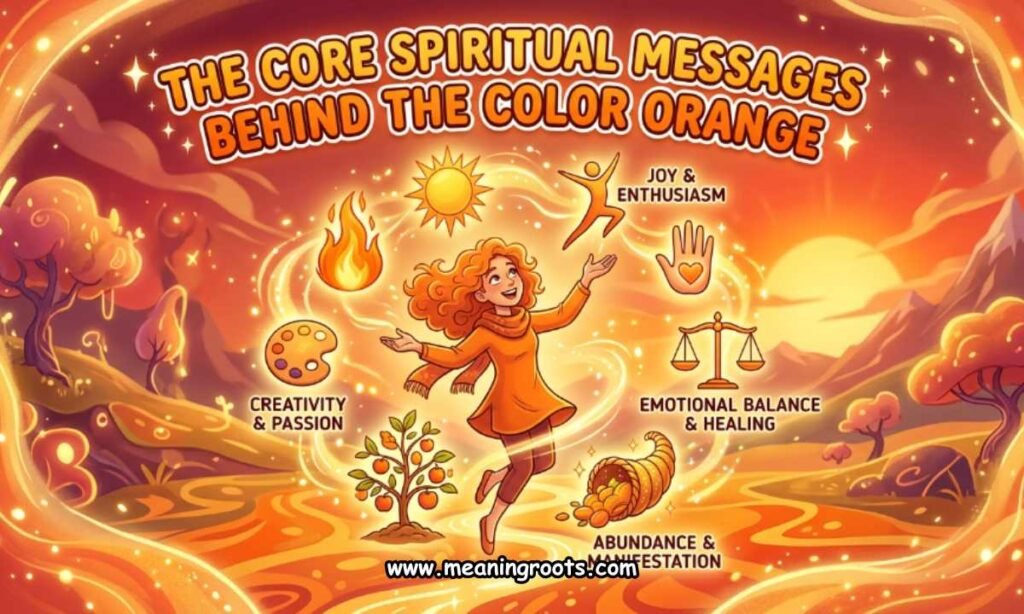
The Core Spiritual Messages Behind the Color Orange
Creative life force and inspired action
Orange is frequently tied to creativity, but not the passive, daydreaming kind of creativity. It’s less about simply having ideas and more about the urge to actually build something out of them. Many spiritual frameworks associate orange with the specific energy required to take an idea off the page and turn it into a finished painting, a difficult conversation finally had, a business finally started, or a piece of music finally recorded.
This distinction matters because a lot of color symbolism stops at vague generalities “orange means creativity” without explaining what kind of creativity it actually represents. The orange version of creativity is active and somewhat impatient. It doesn’t want to sit in a notebook forever. It wants motion. People who describe feeling a pull toward orange during a creative slump often describe it less as inspiration arriving and more as a kick to finally act on inspiration they already had sitting around unused.
Emotional healing and healthy expression
There’s also a strong association between orange and emotional processing, particularly the ability to feel something fully rather than suppress it. Traditions that link orange to the body’s lower-center energy the same region associated with the Sacral Chakra, discussed in more detail further down often connect the color to emotional release: the capacity to let a feeling move through you instead of storing it away for later.
This is one of the more practically useful interpretations of orange, because it maps onto something a lot of people recognize in themselves. There’s a familiar pattern of intellectualizing emotions instead of actually feeling them, analyzing a difficult moment instead of letting it move through the body. Orange, in this context, is often described as an invitation to stop analyzing and start feeling to cry when something is sad, to laugh when something is funny, and to trust that emotional expression is not the same thing as emotional excess.
Courage during periods of transformation
Orange doesn’t carry red’s edge of aggression or confrontation, but it does carry a steadier, warmer kind of bravery the courage to try something unfamiliar, to speak honestly in a moment that calls for honesty, or to step into a chapter of life that doesn’t yet have a clear shape. It’s a color frequently noticed by people navigating a real transition: a career change, a move to a new city, a relationship ending or beginning, a shift in identity that hasn’t fully settled yet.
What makes this particular association interesting is that orange’s courage isn’t loud. It’s not the courage of a dramatic leap off a cliff. It’s closer to the quieter, sustained courage of showing up to something uncertain day after day and choosing to keep going. That’s a subtler kind of bravery, and it’s one a lot of color systems undersell in favor of more dramatic imagery.
Joy, optimism, and inner vitality
At a simpler, more immediate level, orange is just a happy color to most people, and spiritual interpretations largely agree with that plain observation. It’s associated with enthusiasm, playfulness, and a general sense that life is worth engaging with rather than simply enduring. Think of the color’s presence in things people naturally associate with pleasure and celebration citrus fruit, autumn festivals, warm lighting in a room meant to feel welcoming.
This joy isn’t described as shallow or naïve in most traditions. It’s treated as a genuine form of vitality the kind of energy that keeps a person moving forward, curious, and open to new experiences rather than closed off and guarded. Some traditions specifically distinguish this from the more serene, settled joy associated with colors like green or soft blue. Orange’s joy has motion in it. It’s less about peace and more about aliveness.
Healthy relationships and connection with others
Because orange sits close to the body’s emotional and social center in a number of spiritual frameworks, it’s also linked to intimacy, friendship, and the ability to connect authentically with other people not out of obligation or social performance, but from genuine warmth. People associated with strong orange energy, in aura reading and related traditions, are often described as naturally sociable, easy to talk to, and quick to make others feel comfortable.
This social warmth is frequently distinguished from something more superficial, like charm used strategically. The orange version of connection is described as more instinctive less about managing how others perceive you and more about genuinely enjoying the presence of other people. It’s the difference between working a room and simply being glad to be in it.
Spiritual confidence without ego
Unlike colors more commonly tied to dominance, authority, or control deep reds, certain shades of purple orange’s confidence is usually described as quieter and less performative. It’s associated with a sense of being comfortable in your own skin and your own spiritual path, without needing external validation or the need to convince anyone else that your way is the right way.
This particular thread shows up a lot in discussions of spiritual maturity. A person who has done real inner work often stops needing to broadcast that work loudly. Orange’s version of confidence reflects that kind of settled self-assurance grounded rather than showy, secure rather than status-seeking.
Also Read This: Color Green Spiritual Meaning, Symbolism & Psychology
The Shadow Side of Orange Symbolism
No color symbolism is purely positive, and orange has a well-documented shadow side across the traditions that study it closely. In fact, some practitioners argue that a color’s shadow qualities tell you just as much about its deeper meaning as its positive associations do, because the shadow is usually just the same energy taken too far or left unchecked.
Emotional imbalance
The same openness that makes orange a color of healthy expression can tip into volatility when it’s left unchecked. Mood swings, oversensitivity, reacting to a situation before there’s been any time to reflect on it these are all described as orange’s shadow when its emotional fluidity turns into emotional instability rather than emotional honesty. The line between “feeling things fully” and “being at the mercy of every feeling that shows up” is a thin one, and orange’s symbolism sits right on top of that line.
Overstimulation and impulsiveness
Orange’s high energy can also translate into restlessness that doesn’t serve anyone well. In excess, it’s associated with impulsive decisions made without enough thought, a difficulty sitting still or settling into anything for long, and a pattern of chasing the next stimulating thing rather than finishing what’s already been started. This is often described as the shadow version of orange’s creative drive lots of starts, few finishes, and a growing pile of half-completed projects left behind in pursuit of the next exciting idea.
Attachment to pleasure
Because orange connects so closely to sensation, enjoyment, and physical experience, several traditions specifically warn about overattachment to pleasure using comfort-seeking or indulgence as a way of avoiding harder emotional or spiritual work that actually needs attention. This isn’t a judgment against enjoying life; it’s a caution about using pleasure as a permanent escape hatch rather than a genuine part of a balanced life.
Burnout from excessive ambition
The same creative drive and courage that make orange energizing can also push someone toward overextension taking on too much, moving too fast, and building without the structural patience needed to sustain any of it. This particular shadow quality is often described as the reason bursts of orange energy can feel unsustainable if they aren’t paired with some grounding influence, whether that’s a slower color like green or blue, or simply a deliberate practice of pacing.
Orange and the Sacral Chakra
Why orange represents the second chakra
In the chakra system, orange is the color most consistently assigned to the Sacral Chakra, known in Sanskrit as Svadhisthana, located roughly in the lower abdomen, just below the navel. This chakra is traditionally associated with creativity, sexuality, emotional fluidity, and the capacity to experience pleasure themes that line up closely with orange’s broader symbolic profile described above.
The logic behind the pairing isn’t arbitrary. The Sacral Chakra is often described as the seat of movement and change within the body’s energetic system, governing how a person relates to their own desires, creative impulses, and emotional life. Orange, sitting between the grounded intensity of red (associated with the Root Chakra just below it) and the confident clarity of yellow (associated with the Solar Plexus Chakra just above it), fits naturally into that middle position the point where raw energy starts to take shape as feeling, desire, and creative expression.
Signs of a balanced Sacral Chakra
A balanced Sacral Chakra is often described through a handful of recognizable qualities: emotional flexibility that doesn’t tip into instability, healthy creativity that flows without needing to be forced, and a comfortable relationship with pleasure and intimacy the ability to enjoy life fully without being ruled by cravings or compulsions. People with this chakra in balance are often described as easy to be around, spontaneous without being reckless, and generally at ease with change.
Symptoms of blockage
When this chakra is considered blocked or underactive, common descriptions include emotional numbness, a persistent sense of creative stagnation, difficulty feeling pleasure even in situations that should provide it, and a general disconnection from one’s own body. On the opposite end, an overactive or imbalanced Sacral Chakra is often described through the same shadow qualities discussed above: emotional overwhelm, difficulty setting boundaries in relationships, or an unhealthy dependence on pleasure and stimulation.
Spiritual practices to restore balance
Practices commonly recommended for restoring balance in this area include gentle, hip-opening movement such as certain styles of yoga, since the physical location associated with this chakra sits in the hips and lower abdomen. Journaling focused on emotional honesty rather than judgment is another frequently mentioned practice writing about what you actually feel rather than what you think you should feel. Creative work done without a fixed outcome in mind, like free drawing or unstructured writing, is also commonly suggested, since it allows the creative energy associated with this center to move without being immediately judged or filtered.
Time spent near water is another practice that shows up repeatedly across different sources, since water is frequently associated with the flow and emotional fluidity this chakra represents. None of these practices are presented as guaranteed fixes; they’re described more as ways of gently inviting more balance into an area of life that might feel stuck.
What an Orange Aura May Reveal
Personality traits
In aura interpretation, a dominant orange aura is often linked to a personality that’s warm, expressive, and drawn toward adventure and new experience. These individuals are frequently described as natural motivators people who bring energy into a room rather than absorbing it, and who tend to draw others toward action rather than hesitation.
Emotional strengths
Emotionally, orange auras are commonly associated with resilience specifically, the ability to bounce back from setbacks with what looks like genuine optimism rather than forced positivity. This resilience is often distinguished from simple stubbornness; it’s described more as a natural inclination to see possibility even after something has gone wrong, rather than an unwillingness to acknowledge that something went wrong at all.
Spiritual gifts
Spiritually, this aura color is frequently tied to a strong intuitive sense of timing knowing when to act and when to wait, when to push forward and when to let something develop on its own. It’s also commonly associated with a natural gift for encouraging other people, sometimes described as an ability to see potential in others before they see it in themselves.
Challenges associated with an orange aura
The challenges tend to mirror orange’s shadow side fairly directly: impatience with slower processes, difficulty following through once the initial excitement of a project fades, and a tendency to seek out excitement or novelty even in situations where stability and consistency would actually serve better. People with a strong orange aura are sometimes described as needing to deliberately cultivate patience, since it doesn’t come as naturally to them as enthusiasm does.
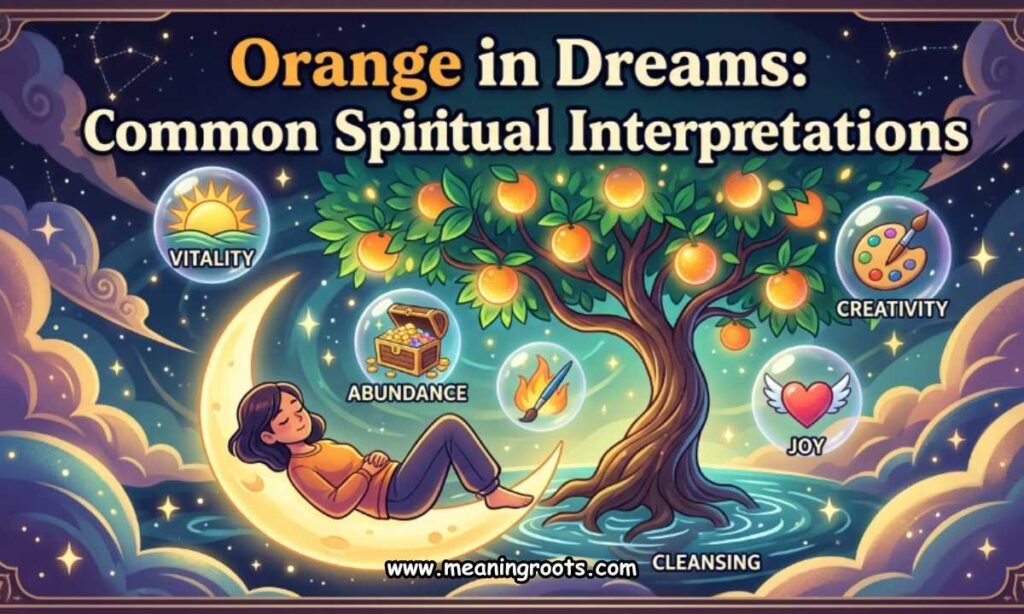
Orange in Dreams: Common Spiritual Interpretations
Seeing bright orange
A vivid orange appearing prominently in a dream whether as an object, a wall, or simply a wash of color across the scene is often interpreted as a nudge toward creative or emotional expression that’s been delayed or postponed in waking life. It’s frequently read less as a warning and more as an encouragement: something in you wants to be expressed, and the dream is surfacing that pressure in visual form.
Wearing orange
Dreaming of wearing orange clothing is sometimes read as a sign of stepping into greater confidence or visibility, particularly around something you’ve created or something you’re proud of but haven’t fully shared with others yet. This interpretation often shows up around dreams that happen right before a public moment in waking life a presentation, a performance, a launch of some kind.
Orange animals
Animals appearing in unusual orange tones within a dream a fox, a bird, even an ordinary animal rendered in an orange that doesn’t match its real coloring are frequently tied to messages about instinct. The suggestion, in most interpretive traditions, is to trust a gut feeling about something rather than overanalyzing it into paralysis.
Orange sky or sunset
An orange sky or a vivid sunset appearing in a dream often carries themes of closure and transition one phase of life ending so that another can begin. This is one of the more consistent dream interpretations across different traditions, likely because the imagery mirrors something people already witness in waking life: the sun setting doesn’t mean darkness forever, just the close of one particular stretch of time.
Orange fire
Fire rendered in orange tones is commonly associated with transformation, particularly the kind of transformation that clears out what’s no longer useful in order to make space for something new. Unlike a dream involving destructive or frightening fire, orange-toned fire in dreams is often interpreted more gently less about danger and more about necessary change.
Spiritual Meaning of Different Orange Shades
Not every orange carries the same symbolic weight. The specific shade matters quite a bit in most interpretive systems, since undertones shift the emotional register of the color considerably.
Soft peach
Peach carries orange’s underlying warmth without its full intensity, and it’s often linked to gentleness, nurturing, and a sense of emotional safety. It’s a shade frequently associated with early stages of healing, where a person needs comfort more than they need a jolt of energy.
Coral
Coral blends orange with noticeable pink undertones, and it’s frequently associated with playful affection and social warmth — a shade that shows up in symbolism tied to friendship and light-hearted connection rather than deep intensity.
Amber
Amber, with its golden depth, is often tied to protection and grounded wisdom, associated with a kind of steady, earned confidence rather than youthful exuberance. It’s a shade that appears in symbolism connected to experience and hard-won insight.
Golden orange
This brighter, sun-leaning shade is commonly linked to abundance and optimism, and it appears often in symbolism around prosperity and generosity the sense of having enough to share rather than scarcity.
Burnt orange
A deeper, more muted tone, burnt orange is often associated with maturity specifically the kind of confidence that comes from lived experience rather than raw enthusiasm. It’s a shade frequently connected to autumn symbolism and the wisdom associated with later stages of a cycle.
Deep rust orange
Rust tones lean earthy and grounded, and they’re frequently tied to resilience, particularly the ability to stay steady and rooted through difficult seasons of life. Where brighter oranges are associated with energy and motion, rust is associated with endurance.
Orange Across Religions and Cultural Traditions
Hindu symbolism
In Hindu tradition, saffron a distinctive shade of orange holds deep religious significance. It’s often associated with purity, sacrifice, and spiritual seeking, and it appears prominently in religious clothing worn by monks, sadhus, and other practitioners pursuing a life dedicated to spiritual practice. The color is closely tied to the deliberate renunciation of material attachment and worldly status.
Buddhist robes and renunciation
Buddhist monastic robes in many regions are traditionally dyed in shades of orange or saffron, historically linked to themes of simplicity, humility, and the deliberate letting go of worldly status and possessions. The specific origins of this practice trace back to practical considerations around available dyes in different regions, but the color came to carry deep symbolic weight tied to renunciation over time.
Christian symbolic interpretations
Orange holds a less central, though still present, role in various strands of Christian symbolism. It’s occasionally associated with themes of endurance and spiritual conviction sometimes described metaphorically as a kind of fire representing steadfast faith. That said, orange doesn’t carry the fixed, widely recognized liturgical meaning that colors like white, red, purple, or green hold within more formal Christian traditions, so its symbolic use tends to be more regional or personal rather than universally standardized.
Indigenous and seasonal symbolism
In various indigenous and seasonal traditions, orange is closely tied to harvest time a color of gratitude, abundance, and the natural rhythm of gathering before winter’s rest. This association shows up in seasonal festivals and celebrations across many cultures, where orange’s presence in the natural world during autumn becomes a visual marker of the year’s turning point.
Also Read This: Red Aura Color Meaning (Personality Traits, Spiritual Energy & Hidden Signs)
Orange Compared With Similar Spiritual Colors
Understanding orange often becomes clearer when it’s placed next to the colors it sits closest to on the spectrum, since spiritual symbolism tends to define colors partly through contrast.
Orange vs Red
Red is often read as more primal and urgent tied closely to survival instinct, passion, and raw intensity. Orange carries some of that same fire but tempers it with warmth and sociability, making it feel more approachable and considerably less confrontational. Where red can feel like a demand, orange tends to feel more like an invitation.
Orange vs Yellow
Yellow leans mental and analytical, associated with clarity, logic, and a kind of confidence rooted in the intellect. Orange, by contrast, is more emotional and physical rooted in feeling and doing rather than thinking things through first. If yellow represents having a clear idea, orange represents actually acting on it.
Orange vs Gold
Gold often symbolizes achievement, mastery, and a higher, more refined level of spiritual attainment. Orange, in comparison, is more about the process that leads there the energy, courage, and creative drive required to get to that point in the first place. Gold is frequently described as the destination; orange is the fuel for the journey toward it.
Practical Ways to Work With Orange Energy
Meditation
Visualizing a warm orange light in the lower abdomen during meditation is a common technique used by those specifically working with Sacral Chakra balance. The visualization is often paired with slow, deliberate breathing, imagining the light expanding gently with each inhale and settling with each exhale.
Crystals
Carnelian, orange calcite, and sunstone are among the most frequently used stones associated with orange spiritual energy, often chosen specifically for their traditional associations with vitality, motivation, and creative flow. Carnelian in particular is frequently mentioned in connection with courage and taking action, while orange calcite is more often associated with emotional healing and gentle energetic cleansing.
Journaling prompts
Prompts like “What am I avoiding feeling right now?” or “Where in my life do I need more courage?” are commonly used to work through orange’s emotional and motivational themes. Other frequently suggested prompts include questions like “What creative project have I been putting off?” or “Where am I seeking pleasure as a way to avoid something harder?”
Clothing and surroundings
Some people intentionally wear orange, or bring the color into their living or working space, during periods when they specifically want to feel more expressive, motivated, or socially open. This is sometimes described as a small, low-effort way of working with color symbolism without committing to a formal spiritual practice simply letting the color’s associated energy be present in the environment.
Visualization exercises
A simple and commonly recommended exercise involves imagining orange light expanding outward from the lower abdomen with each breath, often practiced before creative work or before a conversation that requires some courage. The visualization doesn’t need to be elaborate; the intention behind it tends to matter more than the specific details of the imagery.
When the Color Orange Keeps Appearing in Daily Life
Synchronicity
Repeated exposure to a specific color is sometimes interpreted as synchronicity a meaningful coincidence rather than pure chance, particularly when the repetition coincides with a genuine decision point or moment of uncertainty in a person’s life. This interpretation leans on the idea that the universe, or one’s own subconscious, uses recurring patterns as a form of communication.
Spiritual awakening
For some people, a sudden and persistent pull toward orange coincides with a broader period of spiritual awakening especially one involving reconnecting with creativity, reclaiming suppressed emotion, or beginning a more intentional spiritual practice after a long period without one.
Personal transitions
Orange often becomes noticeable during periods of genuine life transition a new job, a new relationship, a relocation, or any period that calls for the courage and vitality the color represents. It’s worth noting that people going through transitions are often simply more emotionally attentive during those windows, which may partly explain why certain colors seem to jump out more during those specific stretches of life.
Reflection questions before assigning meaning
Before deciding that a color holds deep spiritual significance in a particular moment, it’s worth pausing to ask a few honest questions. Is this genuinely unusual, or is it becoming more visible simply because attention has already been drawn to it? Is there a specific situation in life right now that this color’s themes seem to speak to? Grounding an interpretation in honest self-reflection tends to produce a more useful and personally meaningful insight than assuming automatic meaning behind every appearance of a color.
Psychology vs Spiritual Symbolism: Understanding the Difference
Color psychology research does support the general idea that orange tends to be perceived as warm, energetic, and stimulating, and that people commonly associate it with enthusiasm, sociability, and a sense of playfulness. That’s a measurable, studied phenomenon rooted in perception, culture, and shared human association not a claim about spiritual energy, but a claim about how the human mind tends to respond to a particular wavelength of light in context.
Spiritual symbolism goes further than psychological research is designed to verify. Chakra systems, aura reading, and dream symbolism belong to spiritual and cultural traditions rather than empirical science, and they’re built on frameworks of lineage, practice, and personal experience rather than controlled experiment. That distinction doesn’t make these traditions less meaningful to the people who practice them it simply means they operate on a different kind of knowledge, one that isn’t meant to be validated the same way a psychological study would be.
The most grounded approach tends to hold both frameworks at once without forcing one to prove the other. Color psychology offers a useful, evidence-based layer of understanding around perception and mood. Spiritual interpretation offers a separate, equally valid lens focused on meaning, intuition, and personal growth. Readers exploring this topic are usually best served by treating both as legitimate on their own terms, rather than expecting either one to fully explain or validate the other.
Frequently Asked Questions
Can the color orange represent both positive and negative spiritual meanings?
Yes. Orange often symbolizes creativity and joy, but in some traditions it can also represent imbalance, excess, or emotional impulsiveness.
Is seeing orange repeatedly considered a spiritual sign?
Some spiritual traditions interpret recurring orange as a reminder of growth or creativity, though personal context is essential.
Does orange have a connection to manifestation practices?
Many practitioners associate orange with confidence, motivation, and creative action that support manifestation rituals.
Which crystals are commonly linked with orange spiritual energy?
Carnelian, orange calcite, and sunstone are frequently connected with vitality, creativity, and Sacral Chakra work.
Why is orange often used during meditation spaces?
Orange is believed to encourage emotional openness, creative flow, and balanced personal energy during reflective practices.
Conclusion
Colors rarely carry one fixed, universal meaning. What they carry instead is a kind of accumulated weight centuries of cultural association, religious practice, and personal observation layered on top of one another until a single shade starts to feel like it means something specific. Orange has earned its particular reputation across so many unrelated traditions not because it’s magical, but because it consistently shows up at the intersection of feeling and doing, comfort and courage, rest and renewal.
If orange has been catching your attention lately, the more useful question probably isn’t “what does this mean” in some abstract, universal sense. It’s closer to this: what part of your life right now is asking for more warmth, more creativity, or a bit more nerve than you’ve been giving it. That question tends to matter a lot more than the color itself and it’s usually one only you can really answer.
Also Read This: Seeing an Orange Butterfly: Spiritual Meaning, Symbolism

My name is Daniel.I am a passionate writer in the meaning niche with over 4 years of experience exploring life purpose and personal growth. I create thoughtful content that helps readers understand deeper meaning in everyday experiences.
2 thoughts on “The Color Orange: Spiritual Meaning, Symbolism & Hidden Messages”