

When missiles are flying and civilians are fleeing, one word can suddenly change everything ceasefire. You hear it in breaking news alerts, in presidential statements, in diplomatic press conferences. But what does it actually mean? Is it peace? Is it surrender? Or is it something far more complicated?
This article breaks down the complete meaning of ceasefire in plain language from its legal definition and types to real-world examples like the Iran–US war of 2026. Whether you’re a student, a news reader, or just someone trying to make sense of geopolitical headlines, this is your go-to guide.
What Does Ceasefire Mean? Simple Definition in Easy Words
A ceasefire (also spelled cease-fire) is an agreement between two or more warring parties to stop fighting, at least temporarily. Think of it as pressing the “pause” button on a war.
A ceasefire is a stoppage of a war in which each side agrees with the other to suspend aggressive actions, often due to mediation by a third party.
In the simplest terms: both sides agree to put down their weapons and stop shooting at each other at least for a defined period.
The word itself is military slang turned diplomatic term. It literally means the opposite of “open fire.” When a commander orders troops to “cease fire,” they stop shooting. At the international level, this simple battlefield command became the foundation of one of diplomacy’s most important tools.
Key Facts About Ceasefire at a Glance
| Feature | Detail |
| Also known as | Truce, armistice (informal usage), suspension of hostilities |
| Duration | Can be hours, days, weeks, or indefinite |
| Legally binding? | Generally yes more binding than a truce |
| Ends the war? | No only suspends hostilities |
| Who mediates? | Third-party nations, UN, regional bodies |
| First recorded use | Medieval period known as the “Truce of God” |
Ceasefire Meaning in War: Is It the End of Conflict or Just a Pause?
This is one of the most misunderstood aspects of the word. A ceasefire is not the end of a war. It is a deliberate halt to active fighting a pause but the underlying conflict, grievances, and unresolved issues typically remain very much alive.
A ceasefire is a temporary halt to fighting between warring parties that suspends military operations without legally ending the state of war. Unlike a peace treaty, which formally resolves a conflict, a ceasefire freezes the battlefield and creates space for negotiation, humanitarian relief, or simply a break in violence.
Consider the Korean War. A ceasefire was agreed in 1953, and technically, the two Koreas have never signed a formal peace treaty. That “pause” has now lasted over 70 years. It’s a frozen conflict no active shooting, but no legal resolution either.
On the other end of the spectrum, some ceasefires collapse within days, with both sides resuming bombardment almost immediately.
The key distinction: a ceasefire stops the guns; a peace agreement resolves the war.
Types of Ceasefire: Temporary, Permanent, and Conditional Explained
Not all ceasefires are the same. Understanding the different types helps explain why some hold and others fail almost instantly.
1. Temporary Ceasefire
This is the most common type. Both parties agree to stop fighting for a specific, limited period hours, days, or weeks. The goal is usually to allow humanitarian aid to reach civilians, to buy time for negotiations, or to create space for diplomacy.
The Iran–US two-week ceasefire declared on April 8, 2026, is a textbook example of a temporary ceasefire. It had a specific end date and was explicitly labeled a foundation for further talks not a final resolution.
2. Permanent Ceasefire
A permanent ceasefire is an agreement to halt hostilities indefinitely, with no set expiration. A ceasefire may have a specific end date or may be intended to last for an indefinite period, unless specifically designated as a “permanent ceasefire.” This differentiates a ceasefire agreement from an armistice, which is a formal end to the war.
Even permanent ceasefires can be fragile. They differ from peace treaties because the underlying political conflict is not necessarily resolved.
3. Conditional Ceasefire
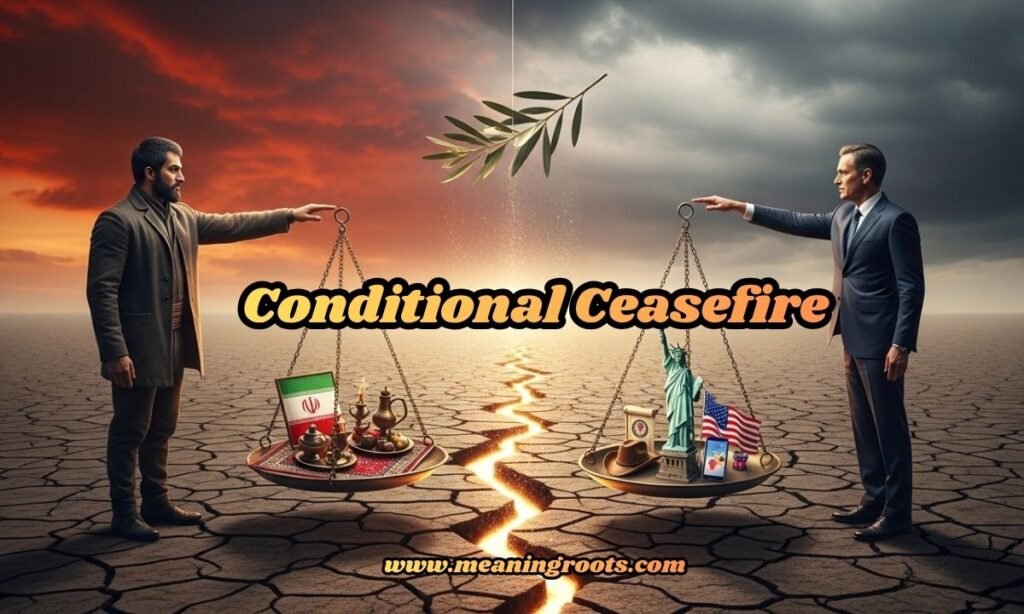
A conditional ceasefire comes with strings attached. Each side agrees to stop fighting only if specific demands are met. For example:
- “We will stop bombing if you reopen the shipping lanes.”
- “We will halt attacks if humanitarian corridors are established.”
- “We agree to a pause if prisoner exchanges begin within 72 hours.”
These are inherently unstable because if one condition is violated or even perceived to be violated the entire ceasefire can unravel.
4. Humanitarian Ceasefire / Humanitarian Pause
A humanitarian pause is a temporary cessation of hostilities purely for humanitarian purposes, usually for a defined period and specific geographical area where the humanitarian activities are to be carried out.
This type is often used to allow aid organizations to deliver food, medicine, and water to conflict zones or to evacuate wounded civilians.
Summary: Types of Ceasefire
| Type | Duration | Purpose | Stability |
| Temporary | Hours to weeks | Negotiations, humanitarian relief | Low–Medium |
| Permanent | Indefinite | Long-term halt to hostilities | Medium–High |
| Conditional | Variable | Specific demands must be met | Low |
| Humanitarian Pause | Hours to days | Deliver aid, evacuate civilians | Moderate |
| Definitive (UN-backed) | Indefinite | Part of broader peace framework | High |
Real Example of Ceasefire: Iran–US War 2026 Explained in Simple Terms
The Iran–US war of 2026 gave the world one of the most dramatic and complex ceasefire examples in recent memory. Here’s the full story in plain language.
How the War Started
On 28 February 2026, the United States and Israel launched airstrikes on Iran, targeting military and government sites, assassinating Supreme Leader Ali Khamenei and other Iranian officials, and inflicting civilian casualties. The surprise attacks were launched during negotiations between Iran and the US. Iran responded with missile and drone strikes against Israel, US bases, and Arab countries in the Middle East, and the closure of the Strait of Hormuz, disrupting global trade.
The Road to Ceasefire
The war quickly spiraled. Iran’s closure of the Strait of Hormuz the narrow passage through which roughly 20% of the world’s oil flows triggered a massive global economic shock. Oil prices surged past $120 per barrel. Stock markets dropped. Food prices in Gulf nations skyrocketed.
A two-week ceasefire between the United States and Iran halted 40 days of US-Israeli attacks on Iran that had pushed the region to the brink of a wider war. The truce, brokered by Pakistan, follows fierce exchanges of air strikes, missile attacks and threats that saw unprecedented strikes on Gulf nations, disrupted global shipping routes and heightened fears of a prolonged confrontation.
Pakistan’s Role as Mediator
Pakistan played a central and unexpected role. Iran, the US and Israel agreed to a two-week ceasefire brokered by Pakistan, beginning on 8 April. Pakistani Prime Minister Shehbaz Sharif and Field Marshal Asim Munir served as key mediators, delivering competing proposals between both sides.
The Announcement
After a month and a half of spiraling conflict in the Middle East, the United States and Iran agreed to a two-week ceasefire less than two hours before US President Donald Trump’s deadline, after which he had promised to wipe out a “whole civilization.”
President Trump announced the deal via a Truth Social post on April 7, with the ceasefire officially taking effect on April 8, 2026.
The “Fragile Truce” Label
As the ceasefire took effect, US Vice President JD Vance described it as a “fragile truce” that had taught him a lot about Iran.
Both sides claimed victory. Iran’s Supreme National Security Council called it an “enduring defeat” for Washington, while Trump described it as a “total and complete victory” illustrating perfectly how ceasefires can mean very different things to different parties.
Ceasefire Under Strain Immediately
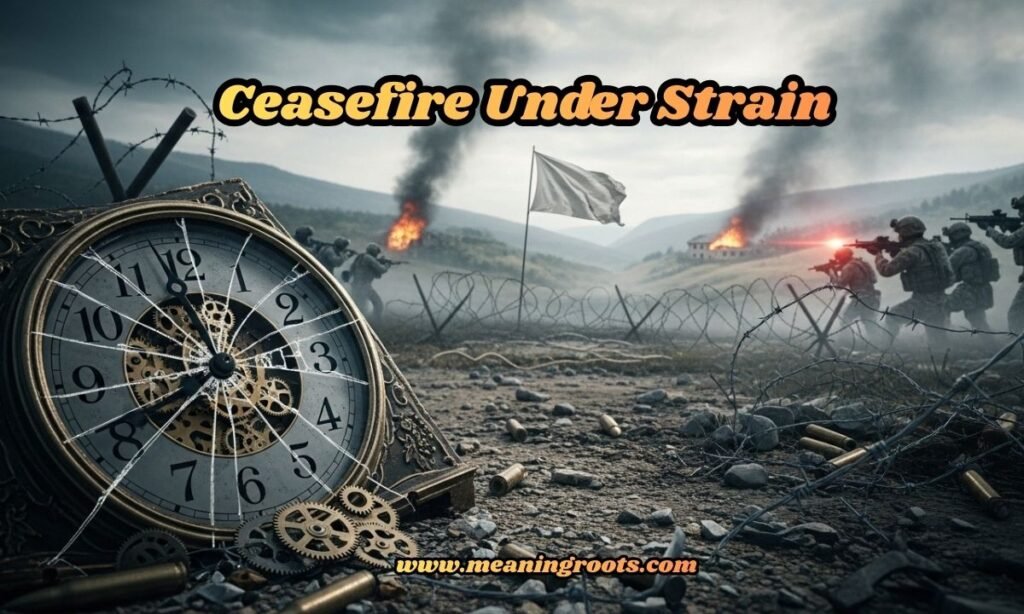
Almost as soon as the ceasefire was declared, it began to fracture. Since its declaration, the ceasefire has been violated by both sides. Israel continued strikes in Lebanon, Iran refused to fully reopen the Strait of Hormuz, and Hezbollah launched rocket attacks each violation threatening to unravel the fragile agreement.
Why Do Countries Agree to a Ceasefire During War?
Countries don’t enter ceasefires out of goodwill alone. There are hard, practical reasons why even bitter enemies agree to stop fighting at least for a while.
Military Exhaustion
Wars are physically and logistically costly. When supply lines are stretched, troops are fatigued, and equipment is damaged, a pause allows forces to regroup, resupply, and reassess.
Diplomatic Pressure
Third-party nations, the United Nations, or regional blocs often apply intense pressure on warring parties to agree to a halt. In the 2026 Iran war, Pakistan, China, and Qatar all played active diplomatic roles.
Humanitarian Crises
When civilian suffering becomes extreme hospitals overwhelmed, food supplies cut off, water systems destroyed the international community demands a pause. Civilians trapped in conflict zones need food, medicine, and a safe path out. A ceasefire creates the conditions for that to happen in practice.
Economic Damage
When a war disrupts global trade as the Strait of Hormuz closure did in 2026 economic pressure from allies and trading partners can force both sides toward a ceasefire.
Political Calculations
Leaders sometimes want a ceasefire not because they want peace, but because they want to appear responsible on the world stage, reduce domestic pressure, or buy time to strengthen their position.
Ceasefire vs Peace Agreement: What Is the Key Difference?
This distinction matters enormously and it’s one that news coverage often blurs.
| Feature | Ceasefire | Peace Agreement |
| Stops fighting? | Yes | Yes |
| Ends the war legally? | No | Yes |
| Resolves root causes? | No | Usually yes |
| Binding under int’l law? | Partially | Fully |
| Duration | Temporary or indefinite | Permanent |
| Example | Iran–US April 2026 truce | World War II surrender treaties |
| Followed by? | Negotiations | Normalization of relations |
An armistice or a cease-fire does not represent an end to hostilities, only a truce. Furthermore, they do not reflect a juridical end to the state of war. In this respect, they must not be confused with peace agreements, which do reflect an end to a conflict.
In everyday terms: a ceasefire stops the bleeding; a peace agreement stitches the wound shut.
What Happens After a Ceasefire Is Declared?
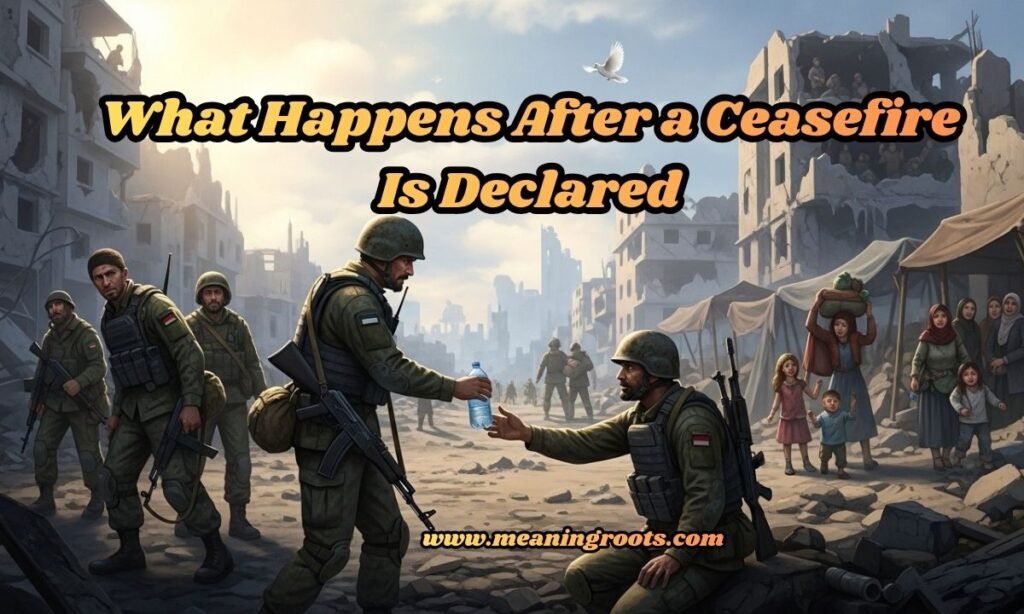
Declaring a ceasefire is just the beginning. What happens next determines whether it holds or collapses.
Step 1: Implementation
Both sides must communicate the ceasefire to their military forces on the ground. The Hague Regulations require that the start time be officially communicated to both the relevant authorities and the troops on the ground, with hostilities suspended immediately upon notification or on the fixed date. This sounds simple. In practice, it’s extremely difficult, especially with non-state armed groups, proxy forces, or decentralized command structures.
Step 2: Monitoring
Ceasefire agreements typically establish monitoring mechanisms UN observers, joint military commissions, or neutral third-party monitors to verify compliance.
Step 3: Negotiations
The most difficult issues will now have to be worked through in detail by negotiators: Can the United States offer credible assurances against renewed strikes and be trusted to uphold them? And is Iran willing to accept limits on its ability to threaten shipping in the Strait?
Step 4: Either a Peace Agreement or a Collapse
The ceasefire either becomes a foundation for a broader peace deal or it falls apart, and fighting resumes. Statistics are not encouraging: research shows that many ceasefires break down within the first three months.
Why Some Ceasefires Fail? Hidden Risks and Challenges
History is littered with failed ceasefires. Understanding why they fail is just as important as understanding what they are.
1. Lack of Genuine Intent
Sometimes the parties don’t really intend for the ceasefire to last; they agree to a pause often under intense international pressure but hope to use the time to regroup and fight again another day.
2. The Security Dilemma
Even when both sides do want a more permanent ceasefire, the fact that they mistrust each other so deeply can itself be the cause of war starting again. This creates what international relations scholars call a “security dilemma,” in which each side’s efforts to protect itself against aggression end up threatening the other side.
3. Vague Terms
When ceasefire agreements are poorly written with ambiguous geographic boundaries, unclear timelines, or undefined prohibited acts both sides interpret the terms differently. Disagreements over interpretation quickly become accusations of bad faith.
4. Spoilers and Proxy Forces
In many modern conflicts, the main parties are not the only actors on the battlefield. Non-state groups, proxy militias, or allied forces can continue fighting even after a ceasefire is declared deliberately or through lack of control.
In the 2026 Iran–US ceasefire, Hezbollah’s continued rocket attacks on Israeli border towns represented exactly this kind of spoiler problem, contributing to the immediate strain on the agreement.
5. Unresolved Core Issues
The 2026 Iran–US ceasefire left enormous unresolved issues: Iran’s nuclear program, control of the Strait of Hormuz, sanctions relief, and the future of regional proxy groups. It is doubtful that this was worth the costs to US military capability, and more importantly, to US relationships and credibility.
Meaning of Ceasefire in International Law and Politics
From a legal perspective, a ceasefire occupies a nuanced space in international law. It is more formal than a battlefield truce but less binding than a peace treaty.
In contemporary international law, a cessation of hostilities or ceasefire indicates a temporary or permanent cessation of hostilities with or without normalization of relations. In international armed conflict, ceasefire terms are now often underwritten by the UN in the form of UN Security Council resolutions. These resolutions enable publicly available and clearly documented ceasefire terms which, when accepted, are binding on all parties.
Ceasefire agreements typically address:
- The precise timing of when the ceasefire begins
- Geographic scope (which areas are covered)
- Prohibited acts (no airstrikes, no artillery, no naval action)
- Separation of forces and buffer zones
- Verification and monitoring procedures
- Humanitarian access and prisoner exchanges
- Consequences for violations
Unlike a truce, a humanitarian pause, or a cessation of hostilities, the declaration of a cease-fire often applies to the entire geographical area of a conflict, according to the UN.
The political dimension matters just as much as the legal one. Who mediates, how the agreement is framed, and what each side says publicly about the ceasefire all shape whether it survives its first week.
How Ceasefires Impact Global Economy and Oil Prices
The economic consequences of war and ceasefire — were never more visible than in 2026.
The Cost of War
The 2026 Iran war, including the closure of the Strait of Hormuz, has led to what the International Energy Agency characterized as the “largest supply disruption in the history of the global oil market.” The conflict echoed the 1970s energy crisis through acute supply shortages, currency volatility, inflation, and heightened risks of stagflation and recession.
Following the closure of the Strait of Hormuz on 4 March 2026, Brent Crude surged past $120 per barrel and forced QatarEnergy to declare force majeure on all exports.
The Relief of Ceasefire
When the ceasefire was announced on April 8, markets reacted immediately. When Iran’s foreign minister later announced the Strait was open to all shipping, oil prices dropped sharply, losing 11% in the immediate aftermath of the announcement.
This underscores a critical reality: ceasefires are not just humanitarian or political events. They are major economic events with immediate consequences for:
- Global oil and gas prices
- Food and commodity costs
- Shipping insurance and freight rates
- Stock markets and bond yields
- Aviation and supply chain costs
The 2026 crisis demonstrated that a single conflict involving one critical waterway could send shockwaves through the entire global economy and that a ceasefire, even a fragile one, could begin to reverse those shockwaves almost overnight.
What Does a ‘Fragile Ceasefire’ Really Mean?
When JD Vance called the April 2026 Iran–US truce a “fragile ceasefire,” it wasn’t just diplomatic language. It was a precise and meaningful warning.
A fragile ceasefire is one that has been agreed to but is at high risk of collapse due to:
- Unresolved grievances: The core issues that started the war remain completely unaddressed
- Competing claims of victory: Both sides publicly declaring they “won” makes compromise harder
- Ongoing violations: When either party continues limited hostilities while technically observing a ceasefire
- Absence of trust: When neither side believes the other will honor the agreement
- External actors: When allied or proxy groups continue fighting outside the ceasefire’s direct control
In the 2026 context, every one of these factors was present. Iran refused to fully reopen the Strait of Hormuz. Israel continued operations in Lebanon. Hezbollah launched rocket attacks. The US maintained its naval blockade. “Fragile” was, if anything, an understatement.
A fragile ceasefire is better than no ceasefire it saves lives and reduces immediate suffering. But it is not peace. It is, at best, the beginning of a very uncertain road.
Ceasefire Synonyms and Related Terms You Should Know
Journalists and diplomats use a cluster of related terms that are often treated as interchangeable but carry distinct meanings.
| Term | Meaning | Key Difference from Ceasefire |
| Truce | Informal agreement to halt fighting | Less binding; often short-term |
| Armistice | Formal military agreement to stop hostilities | More formal; can signal end of war |
| Cessation of hostilities | Broad halt to all hostile acts | Often used in UN language; may be broader in scope |
| Humanitarian pause | Brief halt specifically for aid delivery | Narrow scope; purely humanitarian purpose |
| Peace agreement | Formal, comprehensive end to conflict | Legally ends war; addresses root causes |
| Détente | Easing of tensions between states | Not a halt to active fighting; broader diplomatic thaw |
| De-escalation | Gradual reduction of military activity | Process, not a single agreement |
Understanding these distinctions helps readers interpret news coverage more accurately. When a headline says “ceasefire agreed,” it does not mean the war is over. When it says “peace agreement signed,” that is a far more significant development.
Is a Ceasefire a Sign of Peace or Just a Strategy in War?
The honest answer is: it depends entirely on context and intent.
Sometimes a ceasefire genuinely is the first step toward peace. Temporary ceasefires can open space for more permanent ones. And ceasefires to halt the fighting can also open space for negotiations over the underlying political issues.
Other times, a ceasefire is a purely strategic move:
- A chance to rearm, resupply, and reposition forces
- A way to relieve international pressure without making real concessions
- A tool to shift blame agreeing publicly while planning to resume hostilities privately
The most telling sign of a ceasefire’s true nature is what happens during and after it. Are serious negotiations taking place? Are both sides making genuine compromises? Is the agreement being monitored? Are violations being addressed, or ignored?
In the case of the 2026 Iran–US truce, the immediate post-ceasefire period was marked by continued violations, competing public narratives, a failed round of talks in Islamabad, and a US naval blockade that complicated the entire agreement. By mid-April, Iran had reasserted control over the Strait of Hormuz suggesting that, for at least one party, the ceasefire was as much a strategic tool as a path to peace.
Frequently Asked Questions
What is the simple meaning of ceasefire?
A ceasefire is a mutual agreement between warring sides to stop fighting, either temporarily or permanently. It suspends hostilities but does not legally end a war or resolve its underlying causes.
Is ceasefire the same as peace?
No. A ceasefire stops the active fighting, while a peace agreement formally ends the conflict and addresses its root causes. A ceasefire can lead to peace, but it doesn’t guarantee it.
What was the Iran–US ceasefire in 2026?
The United States and Iran agreed to a two-week ceasefire on April 8, 2026, mediated by Pakistan, after over 40 days of intense military conflict that disrupted global oil markets and pushed the Middle East to the brink of a wider war.
Why do ceasefires fail?
Ceasefires typically fail due to deep mutual distrust, vague agreement terms, continued actions by proxy forces, unresolved core political disputes, or when one or both parties use the pause strategically rather than pursuing genuine peace.
What is a fragile ceasefire?
A fragile ceasefire is one that has been agreed to but is at serious risk of collapsing due to ongoing violations, unresolved grievances, competing narratives of victory, or the absence of trust between the parties. The term was applied specifically to the April 2026 Iran–US truce by US Vice President JD Vance.
Conclusion
The word ceasefire carries enormous weight. It represents, at its best, the triumph of diplomacy over destruction a moment when human lives are spared and a door to peace is opened. At its worst, it can be a strategic pause: both sides pausing the war while preparing for the next round.
The Iran–US war of 2026 gave the world an exceptionally clear and immediate example of what a ceasefire looks like in practice its announcement, its violations, its economic implications, and its fragility. It showed that a ceasefire is not a destination but a crossroads. The road it leads to depends entirely on the political will, the depth of negotiations, and the commitments both sides are genuinely prepared to keep.
Understanding ceasefire meaning in its full context legal, political, economic, and human equips you to read international news more critically and to grasp why the stakes of these agreements are so extraordinarily high.
Whether it becomes the first step toward lasting peace or just another pause before renewed conflict, a ceasefire always tells you one thing with certainty: somewhere on a battlefield, guns have gone quiet and for the people living under them, that silence, however temporary, is everything.

My name is Daniel.I am a passionate writer in the meaning niche with over 4 years of experience exploring life purpose and personal growth. I create thoughtful content that helps readers understand deeper meaning in everyday experiences.