
You’re mid-conversation on WhatsApp, someone types “IDTS” and you freeze. What does that even mean? Is it rude? Is it sarcastic? Should you be offended?
Don’t worry. You’re not alone. Thousands of people search “IDTS meaning in text” every single day because internet slang moves fast and nobody has time to fall behind. This guide breaks down everything you need to know about IDTS its full form, how it’s used, real-life examples, and when you absolutely should NOT use it.
Whether you’re in Karachi, London, or Los Angeles, this one’s for you.
What Does IDTS Mean in Text?
IDTS stands for “I Don’t Think So.”
It’s one of the most common informal acronyms used in digital conversations today. When someone types IDTS, they’re expressing doubt, mild disagreement, or gentle skepticism all without typing a full sentence.
Think of it as a softer, faster version of saying “No” or “I’m not convinced.” It keeps the tone light while still getting the point across.
Quick Answer: IDTS = I Don’t Think So
The Full Form: IDTS Full Form in Chat
| Acronym | Full Form | Category |
| IDTS | I Don’t Think So | Internet Slang / Chat |
| IDTS | Integrated Drug Treatment System | Medical (rare, formal) |
IDTS is classified as internet slang and text messaging shorthand specifically an initialism of “I don’t think so.” As an initialism, each letter technically represents one word, though most people never actually say “Eye-Dee-Tee-Ess” out loud. It’s purely a written shortcut.
“I Don’t Think So”: Meaning and Nuance
The phrase “I don’t think so” is one of the most versatile expressions in English. It can mean:
- Polite disagreement: “That might not work out.”
- Gentle skepticism: “Are you sure about that?”
- Light sarcasm: “Yeah, right.”
- Casual doubt: “Hmm, I’m not convinced.”
When compressed into IDTS, it carries all of these possible tones depending on the context, the relationship between the people texting, and even the emojis around it.
The tone of IDTS depends heavily on context. It can sound neutral, polite, skeptical, or even dismissive if used abruptly. Adding explanations or softening language helps prevent misunderstandings.
Scenario Examples of IDTS in Use
Scenario 1: Casual Text with a Friend
Ali: Bro, do you think we’ll finish the assignment tonight? Hamza: IDTS 😅 We barely started.
Here, IDTS is friendly and relatable. The emoji softens the tone completely.
Scenario 2: WhatsApp Group in Pakistan
Sana: Guys, should we order biryani again? Usman: IDTS lol, we had it three times this week already 😂 Nida: Same 😭 let’s try something else
This is classic group chat energy IDTS fits perfectly in a bilingual Pakistani WhatsApp group where people mix Urdu-English communication naturally.
Scenario 3: Informal Email (Not Fully Professional)
Subject: Quick Check-in Hey! Do you think the client will approve this version? IDTS they mentioned they wanted changes to the intro. Let me revise before we send.
In a casual internal email between close colleagues, IDTS can slip in. But this would not be appropriate for formal client-facing emails.
Scenario 4: Bilingual Chat (Hindi/English)
Priya: Yaar, kya yeh plan kaam karega? Riya: IDTS honestly… schedule bahut tight hai.
This kind of code-switched conversation is extremely common across South Asia and IDTS fits naturally without sounding out of place.
Other Similar Acronyms You Might See
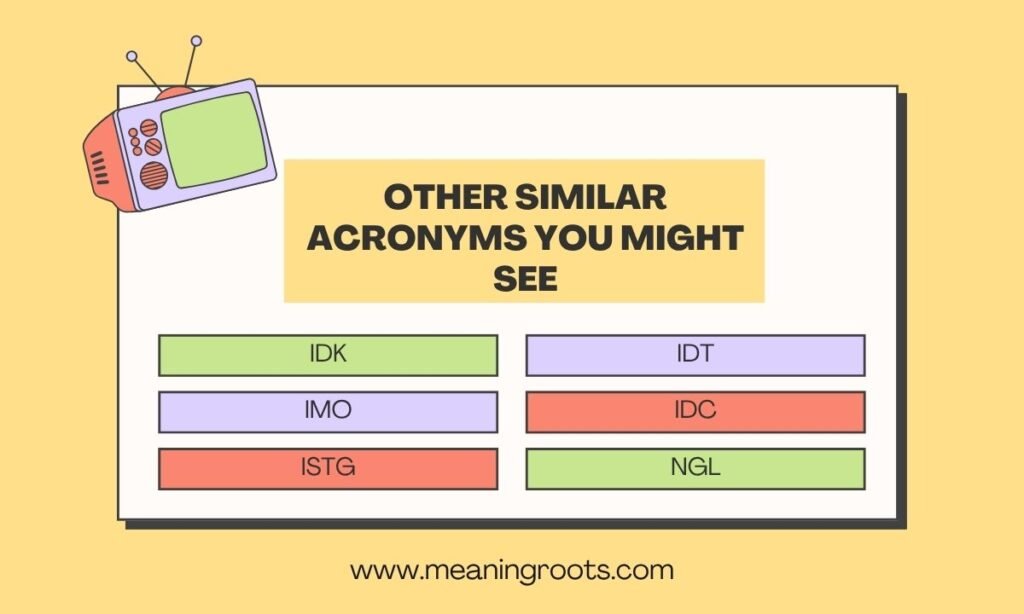
Understanding IDTS is easier when you know its neighbors in texting slang:
| Acronym | Meaning | Tone |
| IDK | I Don’t Know | Neutral / unsure |
| IDT | I Don’t Think | Casual doubt |
| IMO | In My Opinion | Opinion-sharing |
| IDC | I Don’t Care | Dismissive |
| ISTG | I Swear To God | Emphasis / frustration |
| NGL | Not Gonna Lie | Honest / casual |
| IDTS | I Don’t Think So | Doubt / disagreement |
Related expressions include IDT (I Don’t Think), IYTT (If You Think That), IDI (I Doubt It), and ORLY (Oh, Really!).
When Do People Use IDTS in Messages?
People reach for IDTS when they want to:
- Disagree without confrontation: It’s softer than a flat “No.”
- Express doubt about a plan: “IDTS that’ll work in time.”
- React to something unrealistic: “Win the lottery? IDTS 😂”
- Reply quickly in a fast-moving chat: Short and immediate.
- Add light sarcasm Especially when paired with “lol” or 😏
IDTS is useful when you want to respond quickly without sounding overly serious or confrontational. Use it when expressing doubt, mild disagreement, or uncertainty in a casual and friendly way.
Polite and Professional Alternatives to “IDTS”
If you’re in a setting where IDTS feels too casual, here are better options:
| Context | Instead of IDTS, Say… |
| Professional email | “I’m not sure that would work.” |
| Client communication | “I have some concerns about this approach.” |
| Formal meeting | “I’d suggest reconsidering this.” |
| Semi-formal chat | “Hmm, I don’t think that’s the best idea.” |
| Polite text | “Maybe not what do you think?” |
These alternatives keep your tone respectful and your credibility intact.
When to Avoid “IDTS”
Knowing when NOT to use IDTS is just as important as knowing when to use it:
- Emails to clients or management: Always write in full sentences.
- Job interviews or professional introductions: Avoid all slang.
- Conflict-sensitive conversations: IDTS can sound dismissive if the other person is upset.
- Talking to older family members: They may not recognize the abbreviation at all.
- Academic writing Never appropriate in essays, reports, or formal submissions.
IDTS is generally avoided in professional or business communication due to its informal nature. In emails, meetings, or technical discussions, using full phrases sounds clearer and more professional.
Special Contexts: “IDTS Full Form in Physiotherapy” and Medical Use
Many people search specifically for the meaning of IDTS in medical or physiotherapy contexts. Here’s the honest answer:
There is no recognized acronym “IDTS” specific to physiotherapy in scholarly literature. If a physiotherapist or patient uses “IDTS” in a chat, unless they’re using a specialized clinical acronym (which is unlikely), you should interpret it the same way as “I don’t think so.”
In broader medical terminology, IDTs in medical contexts commonly refers to Integrated Drug Treatment System, a comprehensive approach to managing and coordinating drug treatment services for patients. However, this is written as “IDTs” in most literature, not “IDTS.”
Bottom line: In any medical chat or health-related message thread, if you see IDTS, it almost certainly means “I Don’t Think So” not a clinical acronym.
Common Misunderstandings & Mistakes
1. Confusing IDTS with IDK IDK = “I Don’t Know” (uncertainty). IDTS = “I Don’t Think So” (disagreement). They’re different emotions.
2. Assuming it’s always sarcastic: IDTS can be completely sincere. Context and emojis tell the real story.
3. Using it in formal settings: One IDTS in a client email can undermine weeks of professional trust-building. Don’t do it.
4. Misreading IDTS as IDST or IDT: These are different acronyms. Double-check before you assume the meaning.
5. Thinking it’s rude by default: IDTS is usually polite and neutral, depending on context and tone. It can sound sarcastic in some situations, especially with “lol” or certain emojis.
IDTS Meaning in Social Media (WhatsApp, Instagram, TikTok)
IDTS shows up across every major platform, though its flavor shifts slightly depending on where:
WhatsApp: Used in group chats and one-on-one messages. Often followed by 😂 or 😅 to keep things friendly.
Instagram: Appears in comments and DMs when reacting to posts, polls, or opinions. “Is this outfit nice? IDTS tbh 😬”
TikTok: Frequently used in comment sections to quickly push back on a claim in a video. Short, punchy, and fits perfectly under viral content.
IDTS is used in social media and texting to convey sarcasm, and it appears commonly in comment threads and public posts.
Examples of IDTS in Text Messages
Here are clean, realistic examples you might actually see:
- “Can we make it to the 7pm show?” → “IDTS, traffic is crazy.”
- “Think he likes me?” → “IDTS bro, he barely texts back 😬”
- “Will it rain today?” → “IDTS, sky looks clear.”
- “Should I apologize first?” → “IDTS — you didn’t do anything wrong.”
- “Is she coming to the party?” → “IDTS, she said she was busy.”
Why Learn This in 2026?
Internet slang isn’t slowing down it’s accelerating. Texting slang exploded in the early 2000s, but IDTS became mainstream around the rise of smartphones and social media apps. Now, even people in their 30s and 40s use this abbreviation daily.
In 2026, not understanding common abbreviations can lead to:
- Miscommunication in personal relationships
- Confusion in international work chats
- Feeling left out of online conversations
- Accidentally using slang in the wrong context (and embarrassing yourself)
Knowing your IDTS from your IDK from your NGL makes you a sharper, more confident communicator.
Additional Scenario Examples
Internal Work Chat
Team Slack (casual): Raheel: Anyone think we’ll finish before the deadline? Zara: IDTS honestly 😅 We still have three modules left
Between colleagues with a relaxed team culture, this is totally fine.
WhatsApp Group with Clients
❌ Avoid this: Client: Will the report be ready tomorrow? You: IDTS, still working on the data 😅
✅ Better version: Client: Will the report be ready tomorrow? You: It may take until end of day tomorrow I’m still finalizing the data section. I’ll keep you updated!
Mixed Language Chat (Hindi/English)
Arjun: Yaar, kya aaj chutti milegi? Dev: IDTS bhai, boss bahut strict hai aajkal.
Bilingual Professional WhatsApp (Pakistan)
Colleague: Yaar, kya deadline extend hogi? You: I don’t think so honestly better we finish tonight.
Here, the person chose to write the full phrase in a semi-professional setting rather than IDTS the right call.
Is IDTS Rude or Polite?
This depends entirely on delivery. By itself, IDTS is neutral to mildly polite it’s a gentle form of disagreement. But pair it with sharp tone, no emojis, or use it after a heated argument, and it can feel dismissive.
Polite: “IDTS 😅 let’s think of another plan?” Potentially rude: “IDTS.” (Full stop, no context, cold reply)
Always read the room. Add a softening word or emoji if there’s any chance of misinterpretation.
IDTS Meaning in Business
In professional business environments, IDTS has no place in formal communication. However, in startup culture, creative agencies, or casual internal Slack channels, you might see it appear among colleagues who are comfortable with each other.
Rule of thumb: If you wouldn’t say it in a meeting, don’t write it in a client-facing message. Stick to full phrases like “I don’t believe that approach will work” or “I’d recommend reconsidering this.”
IDTS Meaning in Medical
As covered earlier, IDTS does not carry a standard clinical meaning. In a medical or physiotherapy-session context, clearer wording is always better. Just because “IDTS” shows up in a medical chat doesn’t mean it has a clinical meaning.
If you’re communicating with a doctor, therapist, or healthcare professional and they write “IDTS,” they almost certainly mean I Don’t Think So in a conversational sense.
IDTS vs Similar Slang
| Slang | Meaning | Key Difference |
| IDTS | I Don’t Think So | Expresses doubt/disagreement |
| IDK | I Don’t Know | Expresses uncertainty, not disagreement |
| IDC | I Don’t Care | More dismissive, stronger tone |
| NGL | Not Gonna Lie | Precedes an honest opinion |
| IMO | In My Opinion | Shares a view, not necessarily a rebuttal |
| TBH | To Be Honest | Similar to NGL, slightly formal |
Frequently Asked Questions
What does IDTS mean in text?
IDTS stands for “I Don’t Think So” a casual way to express doubt or disagreement in chats and messages.
Is IDTS rude?
No, not usually. It’s generally neutral or mildly polite, though tone and context can change how it lands.
Can I use IDTS in professional emails?
No. Avoid IDTS in any formal or professional communication. Use complete sentences instead.
What’s the difference between IDTS and IDK?
IDK means “I Don’t Know” (uncertainty). IDTS means “I Don’t Think So” (disagreement or doubt). They’re different responses.
Does IDTS have a medical meaning?
In texting, no. The only medical-adjacent usage is “Integrated Drug Treatment System” (IDTs), which is rarely relevant to everyday chat.
Conclusion
IDTS is one of those small abbreviations that carries a surprising amount of weight. At its core, it simply means “I Don’t Think So” but how you use it, when you use it, and who you’re texting can change the entire tone of a conversation.
Use it freely with friends, in group chats, or on social media. But keep it far away from professional emails, client messages, and any formal writing. Master that balance and you’ll communicate like a native digital speaker fast, clear, and always context-aware.
Now that you know exactly what IDTS means, you’ll never be caught off guard in a chat again.

My name is Daniel.I am a passionate writer in the meaning niche with over 4 years of experience exploring life purpose and personal growth. I create thoughtful content that helps readers understand deeper meaning in everyday experiences.